Signal messaging app moves to block AI agents from accessing private messages without explicit consent, warns sensitive data is being captured and stored
 Daniel Levi
Posted On November 24, 2026
AI agents don’t need to break end-to-end encryption to read your private messages. They may simply need access to your screen.
Privacy-focused messaging app Signal is introducing new restrictions to prevent AI agents from capturing and storing sensitive user information. The company is sounding the alarm over AI capabilities built directly into operating systems, warning they undermine its ability to guarantee conversation privacy.
Signal will block screenshots in its iOS 27 app and activate screen security on supported Android versions when it detects an AI assistant attempting to read the screen.
The move targets AI capabilities such as Google’s Gemini Intelligence and Apple’s Siri AI with Onscreen Awareness, which can scan information displayed on users’ devices and make that data available to AI systems.
Signal describes the development as “an existential threat to Signal,” raising questions about whether application developers can continue to protect sensitive user information when AI assistants operate at the operating system level.
“We want to be very clear: it is a serious problem that Signal — and application developers beyond — lack robust tools to prevent AI agents from undermining application-level privacy,” Meredith Whittaker, president of the nonprofit Signal Foundation, said in a blog post Friday.
AI agents are undermining the privacy guarantees of encrypted messaging
Apple, Google and Microsoft control the three major consumer operating system ecosystems on which applications like Signal depend. Their decisions about how AI agents interact with applications can directly affect the privacy and security protections available to third-party developers.
For more than a decade, Signal has relied on its open-source software and formally verified encryption protocol to protect private conversations. Operating system-level AI agents introduce a security problem that encryption alone cannot solve.
When an AI agent scans a user’s screen, it can capture decrypted messages and make them available to external systems. According to Signal, sensitive information is being captured, stored, and made accessible through local databases or remote servers used by these AI agents.
Once captured, the information falls outside Signal’s control.
The implications extend beyond the device owner. A person granting an AI assistant screen access could inadvertently expose confidential messages from other conversation participants who never consented to sharing their information with an AI system.
Signal faced a similar problem last year when it introduced screenshot blocking to prevent Microsoft’s Recall AI from capturing and storing private messages on Windows 11.
The company is now extending comparable protections to mobile devices.
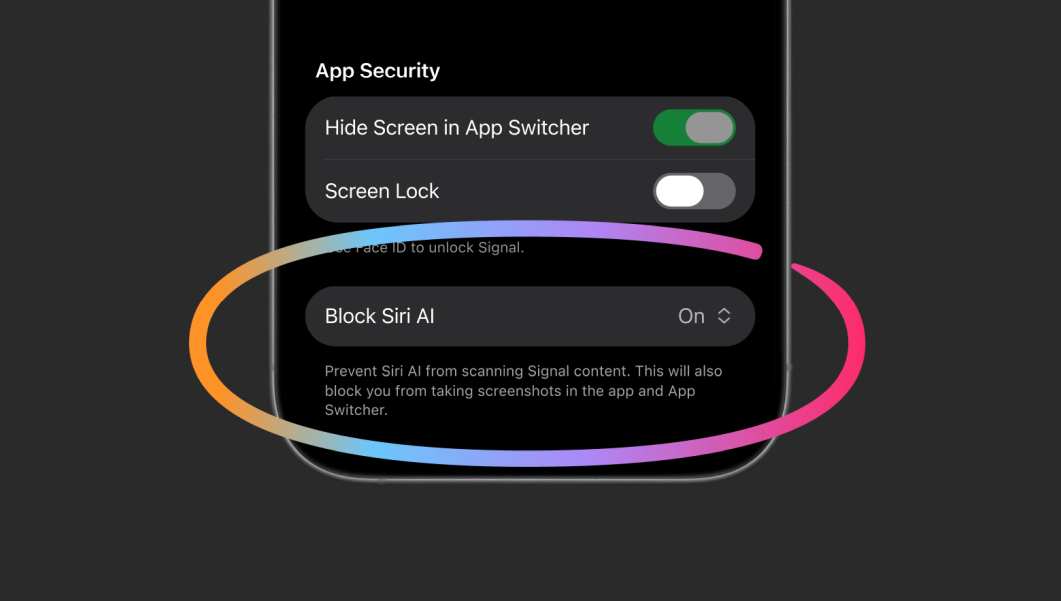
Signal’s Block Siri AI setting prevents Siri from scanning Signal content and blocks screenshots within the app. Image credit: Signal.
On supported Android devices, Signal’s screen security feature will prevent certain AI assistants, including Google Gemini, from scanning content displayed within the app.
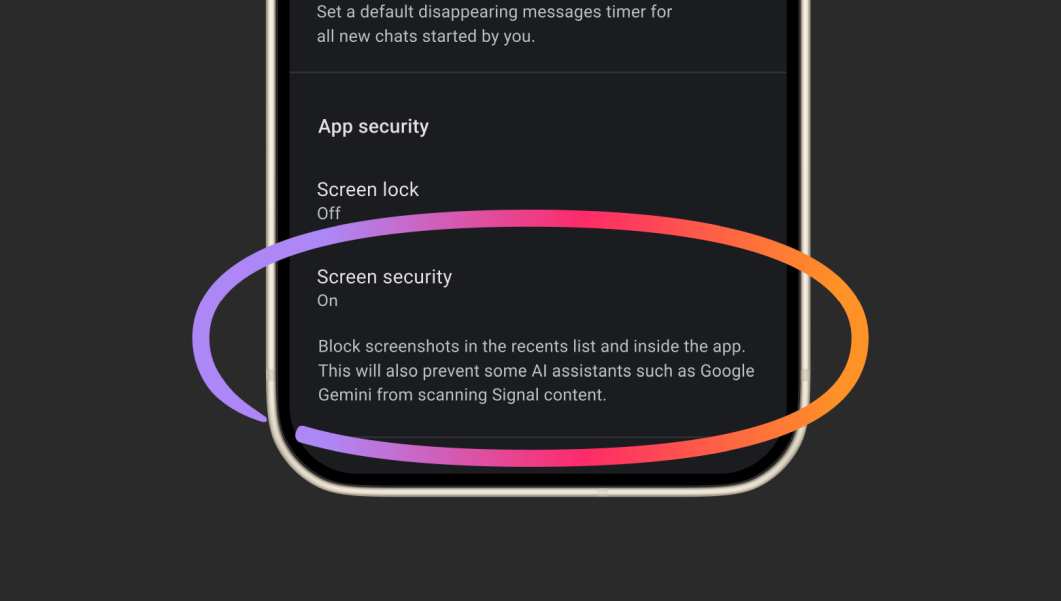
Signal’s Android screen security feature restricts screenshots and screen scanning by certain AI assistants. Image credit: Signal.
Signal acknowledged that these protections cannot address every way AI agents might obtain sensitive information, including accessing data already stored on a device.
“We continue to call on the major consumer operating system companies – Apple, Google and Microsoft – to provide simple technical tools and accurate documentation that give developers like Signal ways to prevent AI agents from accessing sensitive application data,” said Whittaker.
Banks and airlines are drawing their own boundaries around AI agents
Signal’s pushback comes amid growing concern over the security risks associated with autonomous AI assistants.
AvePoint’s State of AI 2026 report, based on a global survey of 750 IT leaders, found that 88.4% of surveyed organizations had experienced at least one AI-agent-related security breach during the previous year.
According to a CNBC report, in October, JPMorgan Chase CEO Jamie Dimon said outside AI agents posed too much risk to the bank and its customers. Morgan Stanley has blocked third-party agents from its platforms, and Charles Schwab has taken similar steps against unauthorized agents.
United Airlines announced restrictions on Nov. 11 targeting unauthorized AI agents that book or manage flight reservations, citing risks involving customer information, unintended purchases, and aviation regulations.
Some businesses are taking a different approach. Singapore Airlines has partnered with Meta’s Muse to let users explore travel and reservation options through the AI assistant.
“There’s a much higher risk around an agent able to move meaningful sums of money or access sensitive personal data than one making your restaurant reservations,” said Yat Siu, executive chairman and co-founder of Animoca Brands. “The reality is that, just like internet applications to date, agents require tiered safeguards.”
For Signal, the dispute raises a fundamental question about the future of digital privacy: Does granting an AI agent permission to access a device amount to consent to access everything displayed on it?
As AI assistants gain deeper access to personal devices, the next battle over digital privacy may be fought at the operating system level. An application can protect a conversation with encryption, but those protections lose their value if another system can capture the messages once they appear on a screen.