Code Effects Releases Version 7 with Secure AI Agents, Rule Governance, and Auditing for .NET
 Technologywire
Posted On November 18, 2026
Atlanta, Georgia, USA, November 18th, 2026, TechnologyWire
New release combines AI-assisted rule management, MCP integration, deterministic execution, and mandatory human control over critical operations.
Code Effects Software, LLC, a provider of embeddable .NET business rules engine technology, announced the release of Code Effects Version 7. The new platform introduces AI-assisted rule authoring, secure AI agent integration, centralized rule repositories, version management, testing, production evaluation auditing, and AI-powered reporting.
Version 7 enables organizations to incorporate artificial intelligence into business rule management while preserving deterministic execution, granular permissions, and human oversight of production operations.
Secure AI Agent Integration
One of Version 7’s most significant additions is an embeddable Model Context Protocol (MCP) server that allows external AI clients and autonomous agents to interact with business rules, source objects, versions, tests, and evaluation history.
The platform supports two AI agent operating models:
- User-delegated agents: AI agents operate on behalf of authenticated users, inheriting their permissions and access restrictions.
- Independent agents and services: Autonomous agents operate under separate identities with individually configured permissions.
Both models are subject to additional, non-bypassable security restrictions.
AI agents and independent services cannot approve rules, delete rules or source objects, publish rules to production (Go Live), or take production rules offline. These restrictions are enforced internally by Code Effects, even if the host application mistakenly grants permissions authorizing these operations.
AI-generated changes also require human approval before production deployment. These protections ensure that AI agents can assist with business rule management without independently controlling critical production operations.
AI-Assisted Rule Authoring and Analysis
Version 7 allows users to create, modify, and investigate business rules through natural-language interactions. An AI assistant can translate business requirements into structured rules using the fields, methods, and operators exposed by the host application.
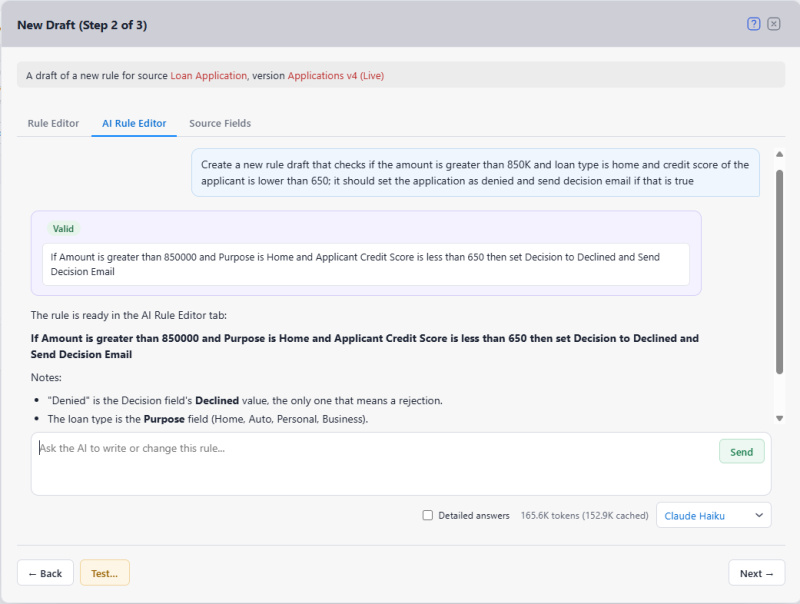
Generated rules remain readable and editable in the Code Effects visual Rule Editor and are validated against the application’s source definitions.
The platform follows a Bring Your Own AI (BYOAI) approach, allowing organizations to integrate any commercial or privately hosted language models without depending on a proprietary AI provider.
Through the MCP server, authorized users and agents can also request rule explanations, compare versions, investigate failed tests, analyze evaluation history, and generate reports using natural language.
Rule Repository, Versioning, and Testing
The new Code Effects Rule Repository provides embeddable web-based interfaces for managing rules, source objects, versions, tests, approvals, and user activity.
Version 7 introduces centralized rule storage, rule and source versioning, draft management, approval workflows, and permission-controlled access.
Built-in testing allows users to define input values, specify expected outcomes, execute tests against individual rule versions, and inspect detailed results. Saved tests support regression testing when business logic changes.
These capabilities establish a governed rule lifecycle, from initial creation and testing through human approval and production deployment.
Production Auditing and Explainability
The new Code Effects Audit component records production rule evaluations, including executed rule versions, relevant inputs, results, and execution details.
Authorized users can investigate why a particular decision occurred, review historical evaluations, analyze rule behavior, and replay recorded evaluations for testing and troubleshooting.
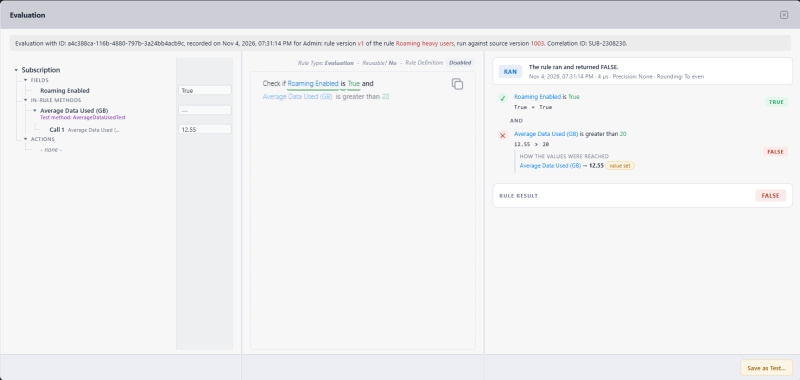 AI assistants can use this information to answer questions about rule performance, execution history, and decision outcomes, subject to the requesting identity’s permissions.
Audit is designed to operate asynchronously without unnecessarily delaying normal rule execution.
Expanded Business Rules Engine Capabilities
Version 7 also enhances the core rules engine and editor with additional operators, collection functions, string and date operations, improved nullable-value handling, inline rule execution, rule composition, and enhanced validation.
The engine continues to execute approved business logic deterministically within the host application’s .NET environment, without requiring an LLM for ordinary rule execution.
This separation allows AI agents to interpret requests and assist with workflows while Code Effects remains responsible for executing explicitly defined business policies.
Self-Hosted Deployment and Java Roadmap
Code Effects Version 7 remains an embeddable, self-hosted platform. Customers maintain control over their infrastructure, authentication, permissions, business rules, and evaluation data.
The repository initially supports Microsoft SQL Server and PostgreSQL, with Oracle and MySQL support planned for subsequent releases. Core assemblies target .NET Standard 2.0, while the MCP server requires .NET 8 or later.
Code Effects also plans to release the entire Version 7 platform for Java in Q1 2027, including the rules engine, visual editor, repository, audit, MCP server, and AI integration capabilities.
Availability
Code Effects Version 7 is available through the company’s distribution and licensing channels.
About Code Effects
Founded in 2009, Code Effects Software, LLC develops embeddable business rules engine and rule management technology. Its platform enables organizations to integrate human-readable business logic, deterministic execution, and secure AI-assisted rule management into their applications.
For additional information, visit Code Effects – Version 7.
Contact
Product Development
Sergey Minin
Code Effects Software
[email protected]