U.S. intelligence casts doubt on Chinese spy allegations after Nvidia CEO Jensen Huang’s resignation
 Daniel Levi
Posted On November 13, 2026

U.S. intelligence officials are questioning whether the woman at the center of the scandal that forced Nvidia CEO Jensen Huang to resign was actually spying for China, raising new questions about the allegations that helped bring down one of Silicon Valley’s most influential executives.
According to a new CNN report, multiple sources familiar with the intelligence gathered on Alice Huang say investigators have yet to establish that the Chinese businesswoman was knowingly working for Beijing. The findings reveal disagreements within the U.S. intelligence community over a case that has rocked Nvidia, rattled investors, and triggered a leadership crisis at the world’s leading artificial intelligence chipmaker.
The uncertainty comes just a day after Jensen Huang’s departure, ending his 33-year run at the company he co-founded in 1993.
Some officials at the Office of the Director of National Intelligence have described earlier claims that Alice Huang was a Chinese spy as “not entirely accurate and over-torqued,” CNN reported.
CIA officials are similarly unconvinced that intelligence collected so far, including intercepted communications, establishes that she knowingly passed sensitive information to Chinese authorities.
The FBI has reportedly been investigating the relationship for at least a year, yet the central allegation remains unresolved.
Justice Department Says Spy Allegations Remain Unproven
The uncertainty extends beyond intelligence agencies.
U.S. Attorney General Todd Blanche confirmed Thursday that the Justice Department has reached no conclusion on whether Alice Huang was operating as a Chinese intelligence asset.
Speaking to reporters, Blanche said the FBI was investigating reports that Huang had worked for the Chinese government, but cautioned against treating the allegations as established facts.
“So you assumed that DOJ learns that she is, in fact, a spy?” Blanche responded when questioned about the investigation. “Nobody’s said that.”
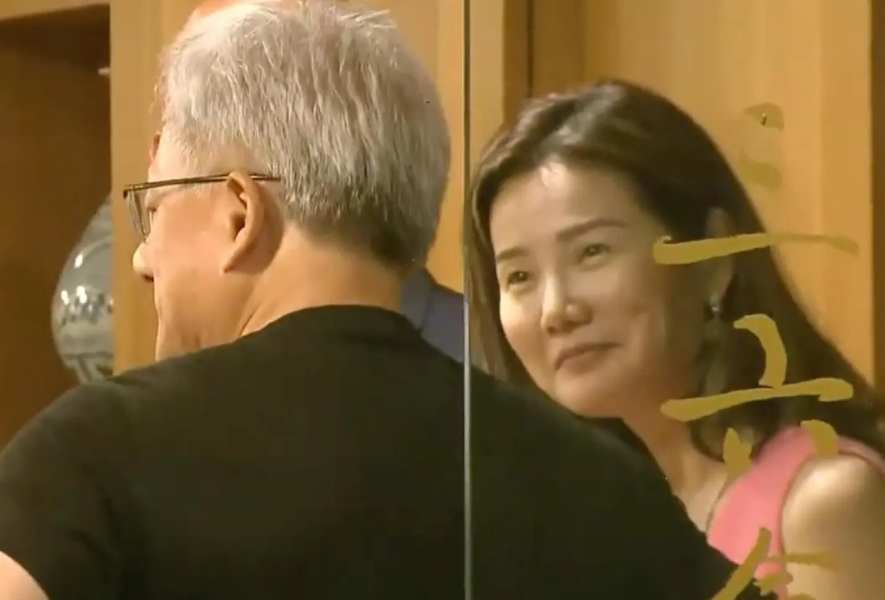
Alice Huang attends a dinner hosted by Jensen Huang in Taipei, Taiwan, on May 22, 2025. (Video still: TVBS via AP)
President Donald Trump struck a similarly cautious tone during an interview with the “Straight Shooter” podcast, questioning whether Jensen Huang’s resignation was justified before investigators established the facts.
“The big thing is, was the woman a spy? And I don’t know if that’s been determined yet. But if the woman was a spy, yes. If the woman was not a spy, perhaps it would be different,” Trump said.
Trump confirmed that he spoke with Jensen Huang on Wednesday.
The developments mark a significant shift in the public understanding of the scandal. Earlier reports had presented Alice Huang as a suspected Chinese intelligence operative with access to one of America’s most strategically important technology executives.
U.S. officials remain divided. Some still believe her relationship with Jensen Huang posed a serious counterintelligence threat, particularly through his close ties to senior government officials.
The lack of conclusive evidence does not rule out espionage. It does raise questions about the strength of the allegations that contributed to Nvidia’s leadership crisis.
Nvidia Faces Bigger Questions Beyond the Spy Investigation
The controversy began attracting public attention following an October 2025 New York Times report connecting Jensen Huang to Alice Huang, a former executive at Singapore-based Megaspeed.
Megaspeed was an official Nvidia cloud partner, giving it preferential access to the company’s highly sought-after AI chips.
That business relationship has since drawn scrutiny from U.S. authorities investigating whether restricted American semiconductor technology was diverted to China.
CNN reported that the Justice Department and Commerce Department began investigating Megaspeed in 2024 as part of a broader examination of companies suspected of routing advanced Nvidia chips into China.
Singapore’s Home Affairs Ministry confirmed Thursday that Alice Huang left the country in February and was subsequently barred from returning following an investigation into possible offenses. The ministry clarified that its investigation was unrelated to espionage.
Beijing has denied that Alice Huang was a Chinese spy. Reuters said she could not be reached for comment.
On November 8, Jensen Huang publicly acknowledged being unfaithful to his wife, apologizing to his family and Nvidia employees without identifying the individuals involved.
Nvidia subsequently launched an independent investigation into the allegations surrounding its longtime chief executive.
The company announced Huang’s resignation on November 12 and appointed Chief Financial Officer Colette Kress as interim CEO. Harvey Jones became chairman of the board as Nvidia began searching for a permanent successor.
The leadership upheaval arrives at a difficult moment for Nvidia, whose chips sit at the center of the global AI boom. The company’s technology is critical to cloud providers, AI startups, and governments competing to build advanced computing infrastructure.
For Nvidia, the immediate challenge is maintaining confidence among customers, investors, and regulators as investigations continue.
The broader question is now impossible to ignore: How did unproven espionage allegations become part of a crisis that ended Jensen Huang’s three-decade leadership of Nvidia?
His acknowledged personal misconduct remains a separate issue from the unresolved national security allegations. The distinction matters, particularly for a company whose technology has become central to U.S.-China competition.
For now, investigators have not established that Alice Huang was spying for Beijing. Jensen Huang is no longer Nvidia’s CEO, and the investigation that helped fuel his departure remains open.