OpenAI Launches Business Profiles and AI Agents, Turning ChatGPT Into a Customer Discovery Platform
 Daniel Levi
Posted On November 11, 2026
OpenAI is turning ChatGPT into a customer discovery platform, letting businesses claim verified profiles, track how often their brands appear in AI conversations, and deploy AI agents that speak directly with potential customers. The move could reshape how companies compete for visibility online, bringing business discovery, customer engagement, and advertising into the same AI interface.
The company announced Businesses in ChatGPT on November 10, introducing a beta service that allows eligible companies to manage their presence through a new Business Hub. The launch marks another step in OpenAI’s push beyond answering questions and into helping people discover businesses, compare products, and make purchasing decisions.
OpenAI says ChatGPT now reaches 1.2 billion weekly users, giving participating businesses access to a potentially enormous discovery channel.
The implications extend beyond ecommerce. For years, businesses have spent billions competing for visibility in Google Search. ChatGPT introduces a different challenge: getting mentioned when an AI assistant recommends products, services, or companies.
OpenAI is now giving brands a direct look at that activity.
OpenAI’s Business Hub gives brands a window into ChatGPT mentions
One of the biggest features is the ability to measure how frequently a business appears in ChatGPT conversations.
Through Business Hub, eligible companies can claim their business profiles, verify ownership, update information, and submit product feeds containing pricing and availability.
The dashboard provides aggregated data showing brand mentions, website clicks, and discovery topics. These topics highlight common themes in conversations where a company’s website is cited, potentially revealing opportunities to improve product information or address unanswered customer questions.
For businesses trying to measure their visibility in AI-generated answers, this offers something previously difficult to obtain directly from ChatGPT.
A retailer, for example, could use the insights to identify which product categories generate attention and where its website might need better information.
The data comes with privacy restrictions. OpenAI says businesses cannot access individual user conversations or Business Agent chats. Insights become available only after activity reaches certain thresholds.
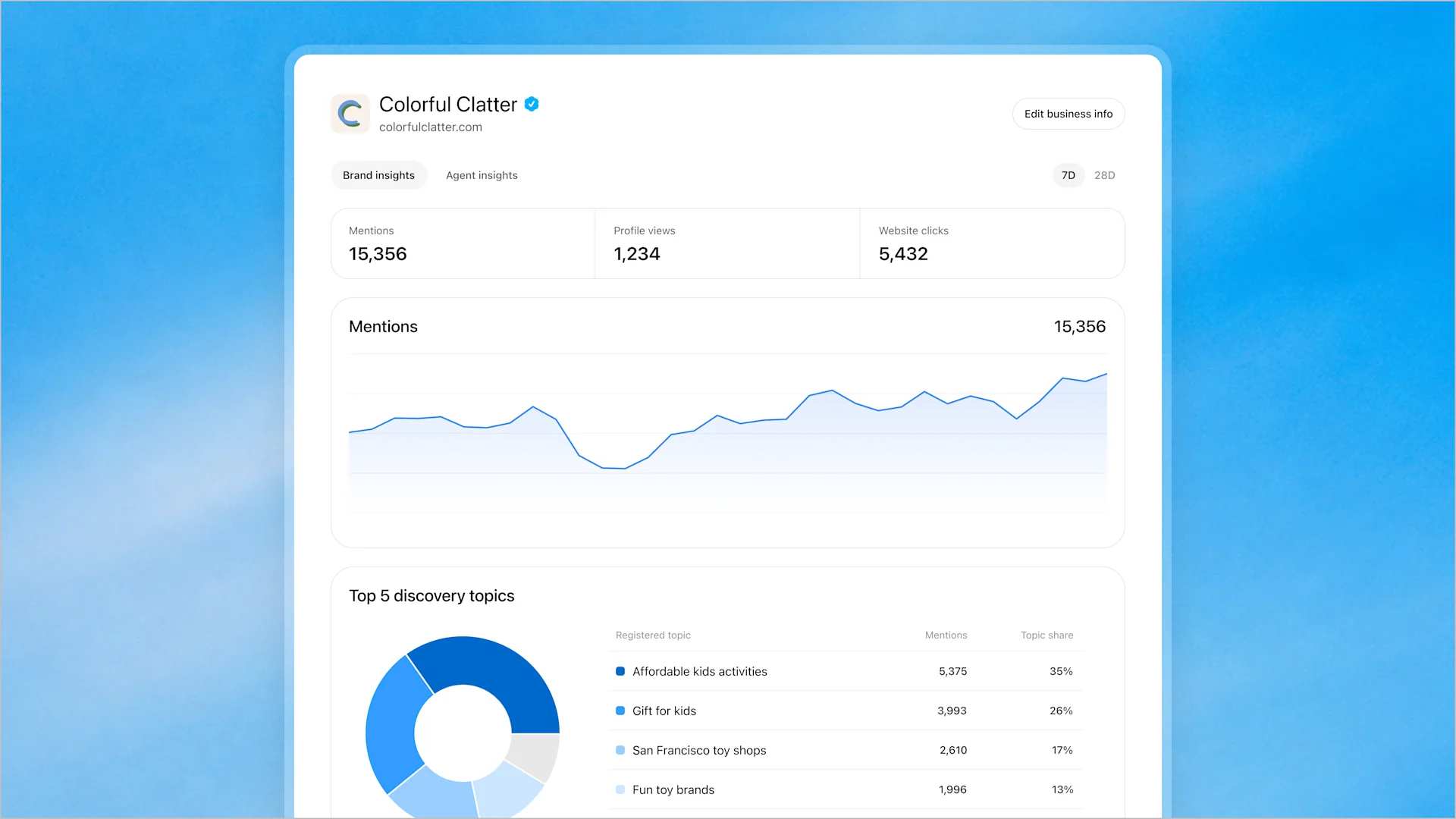
Aggregated insights into how people engage with a business in ChatGPT
Eligible businesses in markets where ChatGPT operates can claim their profiles. Shopify merchants can connect their stores through Business Hub or Shopify’s administration interface, simplifying verification and product integration.
Business Agents bring customer conversations directly into ChatGPT
The second major feature is Business Agents, which allow eligible companies to create AI assistants that answer questions about their products and services.
Instead of sending a potential customer to an external website, a business can engage that person through a dedicated conversation inside ChatGPT.
Consider someone shopping for a laptop. After ChatGPT mentions a retailer, the shopper could open its verified business profile and start a conversation with the retailer’s agent to compare models, ask about specifications, or explore available options.
Businesses can configure their agents with instructions and product information, giving them greater control over how their offerings are explained.
OpenAI draws a clear boundary between these interactions and ChatGPT’s regular responses. Business Agent conversations are labeled and operate separately from the user’s original conversation.
The feature is initially available to eligible e-commerce and online service businesses in the United States. OpenAI plans to extend access to additional markets and business categories.
ChatGPT ads gain a new destination
The launch creates another opportunity for advertisers.
Businesses can sponsor their Business Agents and direct ChatGPT advertisements to those agents, giving users a conversational destination instead of a conventional landing page.
That could change how companies approach customer acquisition.
A traditional search advertisement typically sends users to a website, where they must find the information they need. An AI agent offers a different experience, letting shoppers ask questions before deciding.
OpenAI says sponsored placements are clearly labeled and remain separate from ChatGPT’s independent responses.
The company has not disclosed conversion rates or other performance figures demonstrating whether agent-based advertising produces better results than traditional landing pages.
A New Battleground for Businesses Competing in AI Search
Search engine optimization has traditionally focused on helping websites rank for relevant keywords. AI-driven search introduces another challenge: getting mentioned when someone asks an AI assistant to recommend a product, service, or company.
OpenAI’s Business Hub gives companies a new way to measure that visibility. Instead of relying entirely on third-party monitoring platforms or manually testing prompts, businesses can now access aggregated data showing how often ChatGPT mentions them and directs users to their websites.
But visibility doesn’t necessarily translate into recommendations or sales.
Claiming a verified business profile does not guarantee favorable placement in ChatGPT’s responses. Managing business information is different from controlling what an independent AI assistant recommends.
Questions remain about how businesses will measure the commercial impact of AI mentions, whether these tools will generate meaningful customer traffic, and how smaller companies will compete with established brands.
Why It Matters: The Battle for Customer Discovery Is Moving Beyond Google
For years, businesses competed for a place at the top of Google’s search results. Now, another opportunity is emerging: connecting with customers directly through AI-powered conversations.
OpenAI’s Business Agents could change how those interactions happen. Instead of directing every interested shopper to a traditional website, eligible businesses can answer questions, explain their offerings, and help customers compare products through dedicated conversations inside ChatGPT.
The implications extend beyond another marketing channel. Google built a massive advertising business around helping consumers discover companies through search. OpenAI is exploring a different approach, bringing business discovery, product research, advertising, and customer conversations into a single AI platform.
For businesses, this adds a new consideration alongside traditional SEO: how effectively their products and services appear in AI-generated answers.
The question is no longer just whether customers can find a business on Google. It’s whether AI assistants will mention that business when customers ask for recommendations.