Elon Musk spends $474 million elections but loses big as Democrats sweep midterms and voters reject AI data centers
 Daniel Levi
Posted On November 4, 2026

Elon Musk spent at least $474 million trying to influence the 2026 midterm elections. By Wednesday morning, November 4, much of that money had gone into losing races, as Democrats swept into control of Congress and voters delivered another warning to an industry pouring trillions into artificial intelligence and data centers.
The election dealt a major political setback to President Donald Trump and his technology allies. It raised questions about how much influence Silicon Valley billionaires can buy in Washington and whether the AI infrastructure boom can survive growing public opposition to the enormous facilities supporting it.
According to CNBC, Musk directed $224 million into Texas, where Republican Senate nominee Ken Paxton lost to Democrat James Talarico and three-term Republican Gov. Greg Abbott lost to Democrat Gina Hinojosa.
“Musk, who spent a record of at least $474 million on the midterms, funneled $224 million, or nearly half, into Texas alone,” CNBC reported, citing analysis of campaign finance records.
The losses were especially significant for Musk, whose business empire is deeply rooted in Texas. Tesla operates a major vehicle factory near Austin, SpaceX launches rockets from its Starbase facility in South Texas, and Musk has announced ambitious plans involving AI infrastructure and semiconductor manufacturing.
The election results now put those investments under a different political administration.
Musk’s $474 million political gamble delivers little return
Musk’s political spending was extraordinary in both scale and outcome.
His America PAC spent approximately $86.8 million across 44 federal races, according to CNBC’s analysis of Federal Election Commission filings. As of Wednesday morning, Republican candidates backed by the PAC had lost 29 contests, won just three, and were awaiting results in another 12.
More than $80 million, representing roughly 93% of the PAC’s spending, went into races Republicans lost.
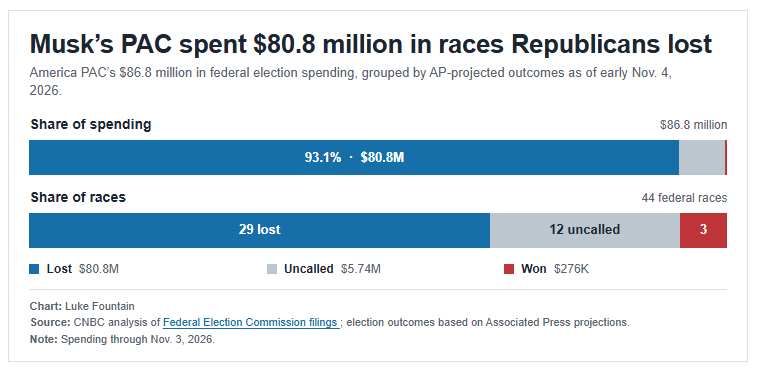
Musk’s PAC spent $80.8 million in races Republicans lost (Credit: CNBC)
Texas delivered the biggest surprise. Talarico became the first Democrat elected to the U.S. Senate from the state in nearly four decades. Hinojosa’s victory ended decades of Republican control of the governor’s office.
“We must get big money out of our politics, so no billionaire or trillionaire can buy our elections,” Talarico said in his victory speech. “We must unrig this economic system that only benefits the top 1%.”
The results represent a setback for Musk’s preferred candidates, though they do not establish that his spending caused their defeats.
The consequences could reach his companies. Democrats controlling Congress may investigate Musk’s federal contracts, his former role in Trump’s Department of Government Efficiency, and his businesses’ relationships with federal agencies.
Trump still controls the executive branch and retains veto authority, limiting how far congressional Democrats can reshape federal policy.
In Texas, Hinojosa has proposed a moratorium on new data centers, an end to industry tax incentives, and requirements forcing developers to cover their electricity costs. Republicans retain control of the state Legislature, making sweeping changes harder to enact.
Still, her administration could influence permitting, infrastructure decisions, and subsidies affecting future projects.
Markets reacted to the political shakeup. Tesla and SpaceX shares fell around 4% in early Wednesday trading, according to CNBC, and companies tied directly to AI infrastructure faced selling pressure.
Voters send a warning to the $5 trillion AI data center boom
The election delivered another message to Silicon Valley: Americans are becoming increasingly concerned about the costs of AI infrastructure.
Across the country, communities have questioned whether massive data centers deliver enough economic benefits to justify their electricity demand, water consumption, and pressure on local infrastructure.
The backlash became a major campaign issue.
According to advertising analytics firm AdImpact, campaigns and outside groups spent approximately $173 million on advertisements about AI data centers during the general election. Nearly all were negative, with Democratic advertisers accounting for $140 million.
In Ohio, Democrat Sherrod Brown defeated Republican Sen. Jon Husted after making data center development a campaign issue. In South Carolina, Democrat Annie Andrews defeated Republican Sen. Darline Graham after campaigning for a two-year moratorium on new facilities.
The opposition also reached local ballots.
Ballotpedia tracked 41 data center-related measures scheduled for November 3 across 10 states. At least 10 communities approved bans or restrictions, according to election reporting available Wednesday morning.
The results do not amount to a nationwide rejection of AI. They show growing resistance to how the industry is building the infrastructure needed to support it.
The financial implications are substantial.
JPMorgan Asset Management estimates that AI infrastructure spending could reach roughly $5 trillion through 2030, with approximately $2 trillion financed through investment-grade debt markets.
That financing depends on expensive projects becoming operational and eventually generating sufficient revenue to justify their costs.
Permitting delays, rising electricity prices, higher borrowing costs, and new restrictions could complicate those calculations. Projects that looked financially attractive under favorable regulations may become harder to justify under tighter oversight.
For AI companies and their investors, the election introduced another risk that raising more capital can’t solve.
Musk’s enormous political spending could not prevent defeats in some of the races that mattered most to his business interests. And for an AI industry accustomed to moving ahead with massive investments, voters in several communities have made clear that local approval can no longer be taken for granted.
The message from the 2026 midterms is bigger than one billionaire’s election losses: Money can finance the AI boom, but it cannot guarantee the political and public support needed to build it.