Daytona raises $60M at $1B valuation to provide AI agent infrastructure to OpenAI, Anthropic, and others
 Daniel Levi
Posted On October 20, 2026

AI infrastructure startup Daytona has raised $60 million in Series B funding at a $1 billion valuation, joining the growing ranks of AI unicorns as demand surges for the computing infrastructure needed to run autonomous AI agents. The San Francisco-based company, whose technology is used by OpenAI, Anthropic, NVIDIA, Meta, and other major AI players, has now raised $91 million in total funding.
FirstMark led the round, with backing from some of Silicon Valley’s most recognizable founders, including Stripe’s Patrick Collison, Shopify’s Tobi Lütke, Perplexity’s Aravind Srinivas, Zoom’s Eric Yuan, Quora’s Adam D’Angelo, Mercor’s Brendan Foody, and Datadog’s Olivier Pomel. Qualcomm Ventures, Samsung Next, and Okta Ventures participated, alongside existing investors.
The funding comes as AI companies face a growing problem: giving autonomous agents the computing resources to perform real work without exposing sensitive systems or overwhelming existing infrastructure.
AI agents can write code, browse websites, operate software, and carry out tasks with limited human supervision. Yet each agent needs a secure environment to execute those tasks. Running thousands simultaneously creates a different computing challenge than serving users who simply ask chatbots questions.
Daytona is betting that this shift will create a new category of cloud infrastructure.
The company said its revenue run rate grew 25-fold between January and September, reflecting rising demand from AI labs and businesses moving beyond conversational AI.
In an interview with Fortune, co-founder and CEO Ivan Burazin said Daytona had been growing an average of 50.9% each month. The company did not disclose its revenue, leaving its size unclear.
Why Daytona thinks AI agents need their own cloud, not just GitHub Codespaces
Founded in 2023 by Ivan Burazin, Goran Draganić, and Vedran Jukić, Daytona originally focused on automating software development environments. The founders later shifted their focus to AI agents after recognizing that autonomous software would need its own dedicated computing environments.
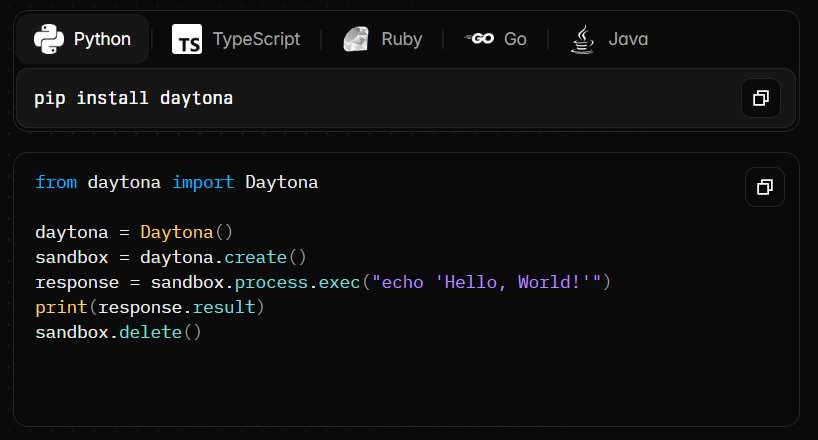
Daytona’s platform creates isolated virtual computers, known as sandboxes, where AI agents can execute code, interact with applications, and complete tasks without unrestricted access to a company’s underlying systems.
Credit: Daytona
The company says it can provision these environments in milliseconds, giving agents access to computing resources across Linux, Windows, and macOS. Customers can scale resources according to demand, pause tasks, resume previous work, or duplicate environments to test different approaches.
The approach has attracted customers beyond OpenAI and Anthropic. Daytona identifies Cursor, Cognition, Cohere, Mercor, Handshake, Postman, n8n, Clay, and others among companies using its infrastructure.
The company reports that AI data startup Snorkel has provisioned more than one million sandboxes on its platform, reducing evaluation cycles by 96%. Another customer, Trajectory, has provisioned 700,000 sandboxes and reduced environment startup times from 30 minutes to seconds.
Those figures, supplied by Daytona, illustrate the scale of computing resources required as AI systems move from generating answers to executing tasks.
Security remains another concern.
“Recent agent security incidents are not edge cases. They are previews,” Burazin said. “The agents aren’t going rogue; they are doing their job without any morals or fear of consequences. Companies are going to manage thousands of digital employees, and each one needs a safe place to fail. Daytona ensures one rule breaking agent doesn’t spill into company wide chaos.”
Daytona’s strategy puts it in competition with established cloud providers such as Amazon Web Services, Microsoft Azure, and Google Cloud, which already offer virtual computing environments.
Burazin argues that traditional cloud infrastructure was built around more predictable workloads. AI agents can create sudden bursts of demand, potentially launching thousands of computing environments for a single workflow.
The shift could put growing pressure on CPUs, the processors that run conventional software, at a time when much of the AI industry’s investment has focused on GPUs used to train and run AI models.
Daytona plans to use its new funding to grow its computing infrastructure and expand its workforce across San Francisco, Croatia, and Singapore.
The larger question is whether AI agents will require a dedicated cloud architecture or whether established providers can adapt quickly enough to serve the same demand.
For Daytona, the $1 billion valuation represents a major bet that the next wave of AI spending will go beyond building smarter models to giving those models somewhere secure to work.