Trump declares anyone still using the term ‘artificial intelligence’ instead of ‘super intelligence’ ‘THE ENEMY’
 Daniel Levi
Posted On October 8, 2026
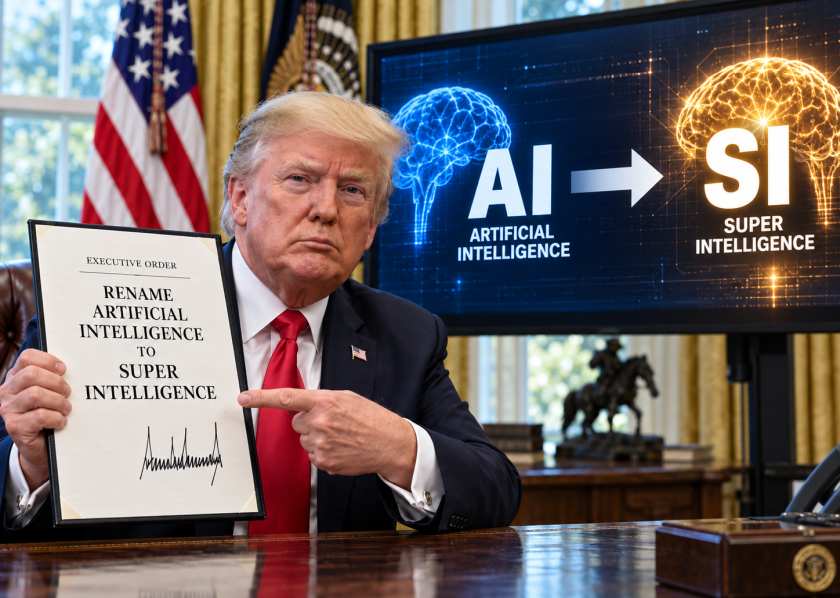
President Donald Trump declared Thursday that the White House considers anyone who continues using the term “Artificial Intelligence” instead of his preferred “Super Intelligence” an enemy, escalating his campaign to rename one of technology’s most widely used terms.
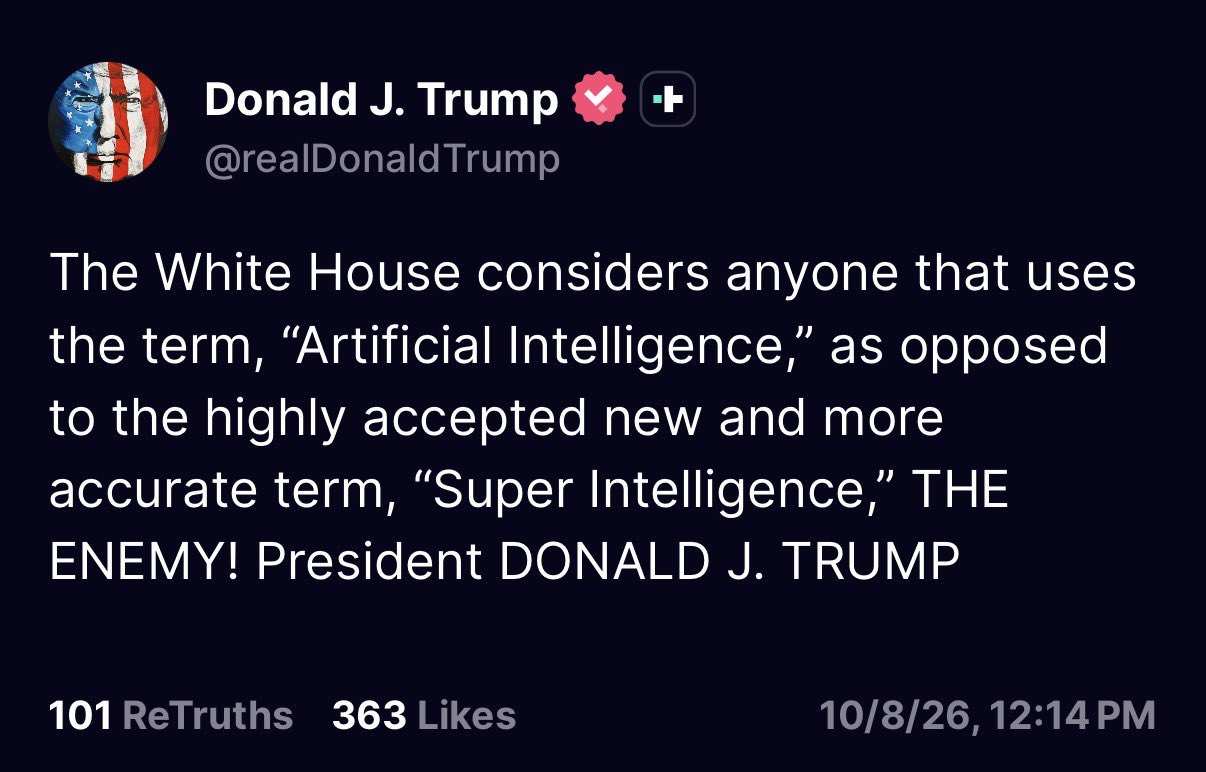
In an October 8 post on Truth Social, Trump wrote:
“The White House considers anyone that uses the term, “Artificial Intelligence,” as opposed to the highly accepted new and more accurate term, “Super Intelligence,” THE ENEMY!
The statement comes just nine days after Trump signed a September 29 executive order directing federal agencies to replace “Artificial Intelligence” and “AI” with “Super Intelligence” and “SI” in official communications, websites, reports, and other non-statutory documents.
The order, titled “Inaugurating the Era of Super Intelligence,” applies to the executive branch. It does not require private companies, researchers, journalists, or ordinary Americans to abandon the term AI. It establishes no penalties for continuing to use it.
Trump’s latest declaration takes that terminology campaign into more confrontational territory, turning what began as a government naming directive into a public dispute over the language the technology industry uses.
From artificial intelligence to super intelligence
The administration has already begun implementing the order.
On October 6, Reuters reported that the Justice Department instructed employees to use “super intelligence” in place of artificial intelligence in most contexts, including legal proceedings. The directive followed the September executive order.
Elon Musk is among the first major technology executives to embrace the new terminology. On October 4, Musk posted on X: “No more AI. SI. It’s better.” When another user asked whether SpaceXAI would be renamed SpaceXSI, Musk replied, “Yes, we will make that change.”
Trump argues that the term artificial intelligence no longer reflects what modern systems can accomplish. His executive order describes today’s advanced models as technologies that go far beyond simply imitating human intelligence, arguing that “Super Intelligence” better represents their capabilities and future potential.
That argument runs into a significant distinction in computer science.
Artificial intelligence is a broad category covering technologies that perform tasks associated with human intelligence. Artificial superintelligence, commonly abbreviated ASI, generally refers to hypothetical systems that can surpass human intelligence across virtually every cognitive domain.
The two terms are not scientifically interchangeable. Renaming today’s AI systems does not establish that they have achieved superintelligence.
The executive order itself reflects that distinction. For implementation purposes, it initially defines “Super Intelligence” using the existing federal statutory definition of artificial intelligence. It directs the White House science adviser to propose legislative language for a new federal definition within 60 days.
The push has already attracted attention from prominent technology executives.
On October 4, Elon Musk said he would rename SpaceX’s artificial intelligence division from SpaceXAI to SpaceXSI, aligning its branding with Trump’s preferred terminology, Reuters reported.
That inconsistency illustrates the scale of the proposed shift. Artificial intelligence is embedded in university programs, scientific research, product names, government regulations, international standards, and countless technology businesses.
For companies developing AI products, the executive order creates no general obligation to change their names or marketing materials. It remains unclear how widely Trump’s preferred terminology will spread beyond federal agencies and businesses that voluntarily embrace it.
For now, the United States is pursuing an unusual experiment: attempting to change the official name of a major technological field through presidential action, even as the scientific community continues to distinguish artificial intelligence from the far more advanced concept of superintelligence.