Hadrian raises $40M to expand its agentic AI cybersecurity platform as AI-driven attacks accelerate
 Daniel Levi
Posted On October 6, 2026

Hadrian, an Amsterdam-based cybersecurity startup using AI agents to find and validate exploitable security weaknesses, has raised $40 million in new funding as companies face a growing wave of AI-assisted cyberattacks.
The round was co-led by Forgepoint Capital International and SmartFin, with participation from existing investors HV Capital, Motive Partners, Picus Capital, and Oetker Ventures. The new financing brings Hadrian’s total funding to $65 million.
Hadrian plans to use the capital to grow across the U.S. and EMEA and increase investment in engineering and research.
The timing is significant. AI models are increasingly being used to automate parts of the hacking process, from reconnaissance and vulnerability discovery to exploit development. Anthropic recently reported cases involving criminals and state-linked groups using AI models across portions of attack chains, including work related to zero-day vulnerabilities.
That shift creates a difficult problem for security teams. Attackers can automate more of their work, yet many companies still rely heavily on periodic manual penetration tests.
Hadrian says 87% of organizations still use manual penetration testing, citing data from its 2026 Offensive Security Benchmark Report. The company’s research found that just 0.47% of vulnerability scanner findings were genuinely exploitable, leaving security teams sorting through large volumes of alerts that may never translate into real attacks.
Hadrian is trying to narrow that gap by using AI agents to behave more like attackers.
AI agents that test companies like hackers
The company combines continuous exposure management with agentic penetration testing. Its Atlas product maps an organization’s external attack surface and uses AI agents to determine which exposures can actually be exploited. Nova performs on-demand agentic penetration testing to replicate work traditionally done by human pentesters.
The idea is to move beyond simply identifying vulnerabilities and focus security teams on weaknesses that present a credible path into their systems.
Hadrian says customers have seen 10 times greater visibility into critical exposures, an 80% reduction in time to resolution, and five times the return on investment compared with manual penetration testing. Those figures come from the company and have not been independently verified.
“Everyone can see that AI is changing the threat landscape. It might also hold the answer, but most people are focused on automating the wrong bits. We have been working with LLMs since before they went mainstream, and we know that AI can work much faster than any human offensive security team. So we built a platform that emulates hackers’ attack paths, helping our customers to understand their key risks and prioritize their security resources appropriately,” Hadrian CEO Rogier Fischer said.
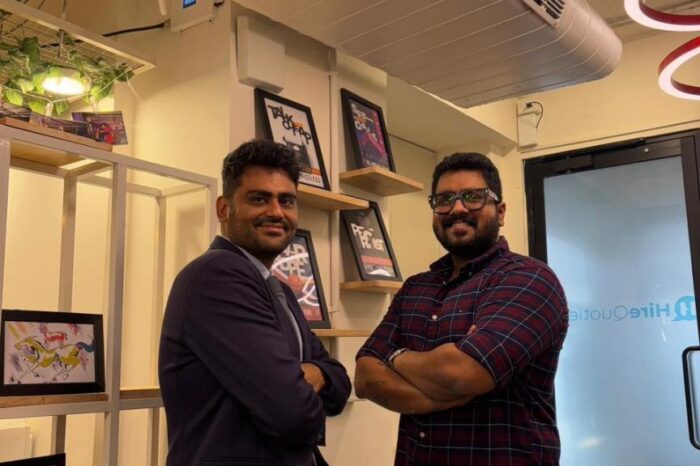
Fischer founded Hadrian with Olivier Beg and Maurice Clin. Fischer and Beg were teenage ethical hackers before becoming entrepreneurs.
The company now works with customers in the U.S. and Europe, including McKesson, NBC Universal, Francisco Partners, TotalEnergies, Amadeus, Leroy Merlin, and Damen Shipyards.
Hadrian’s pitch reflects a broader change in cybersecurity. The old model assumed attackers were constrained by human time. AI weakens that constraint.
That leaves security teams with a new race: using automation to find the weaknesses that matter before AI-assisted attackers do.

Hadrian Founders