Claude beats experienced human accountants 100% to 37% in Mercor test, and finishes in under 10 minutes
 Daniel Levi
Posted On October 5, 2026

AI recruiting and evaluation startup Mercor just published a study that should get the attention of accountants, finance executives, and anyone watching how quickly AI is moving into professional work.
Mercor had 12 licensed CPAs compete against frontier AI models on real-world accounting tasks. The accountants weren’t novices. They averaged about 5.4 years of experience; 10 of the 12 were senior accountants or managers, and half had worked at Big Four accounting firms.
That experience didn’t save the humans in the head-to-head test.
The accountants scored an average of roughly 37% and took anywhere from 30 minutes to three hours to complete the tasks. By comparison, Claude Opus 5 scored 100% across all 20 solo attempts and finished every run in under 10 minutes.
“We compared 12 licensed accountants against frontier AI models on realistic accounting tasks. The models were faster and more accurate than every accountant in our study,” Mercor wrote in a post on X.
The result is striking on its own. What makes it far more consequential is how quickly AI got here. Less than two years ago, leading models struggled to match the accountants on similar tasks. Now a frontier model is completing them faster, more accurately, and at a fraction of the cost.
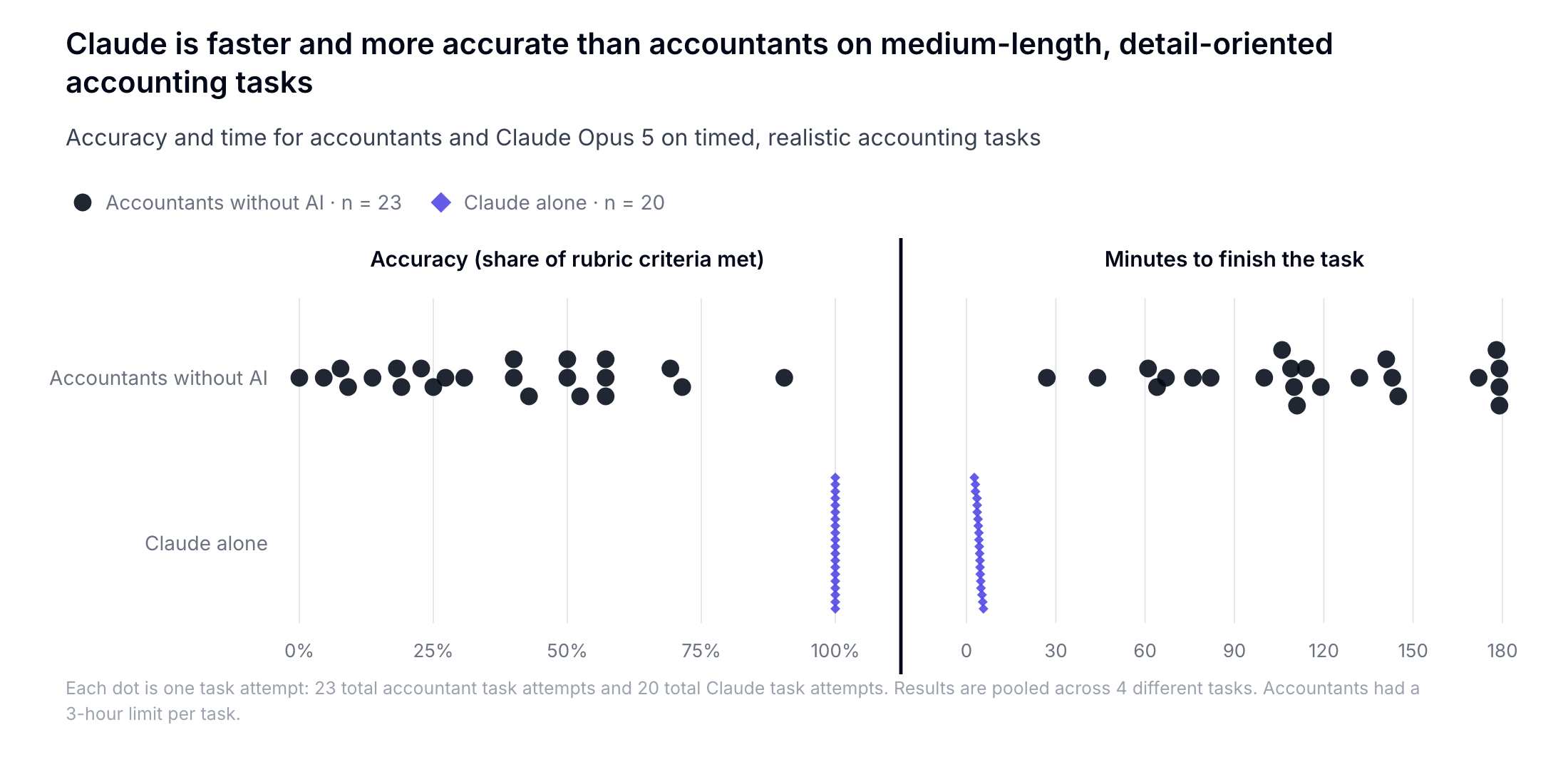
Claude is faster and more accurate the human accountants (Credit: Mercor)
This isn’t really a story about Claude. It’s a story about what frontier AI can now do to professional work that, less than two years ago, still favored humans.
Mercor based the test on simplified versions of tasks from its APEX-Accounting benchmark. The accountants worked through four realistic month-end close scenarios that required searching company files, locating the correct figures, performing calculations, and delivering the results in a specified format.
No accountant in the study matched Claude’s performance.
The economics were just as striking. Mercor calculated that Claude cost about $0.21 for each successfully completed rubric criterion, compared with $10.35 for the human accountants. By that measure, the AI was roughly 49 times cheaper.
The bigger story is how quickly AI caught up
Perhaps the most consequential finding has little to do with Claude’s perfect score.
Just 18 months ago, the best AI models tested by Mercor could not match the accountants’ average of roughly 37%.
GPT-4o scored close to zero on the study tasks. OpenAI’s o3 moved past the human average around spring 2025. GPT-5 later reached roughly 69%. Recent frontier models have moved close to, or reached, perfect scores on the same set of exercises.
That progression changes the study’s significance.

AI Models passed human accountants (Credit: Mercor)
This is less a story about machines beating accountants on four tasks and more a snapshot of how quickly frontier AI can cross a professional capability threshold. A set of tasks that challenged leading models less than two years ago can now be completed perfectly in minutes.
Mercor found the results provocative enough that researchers said they considered not publishing them over concerns they could be misinterpreted.
The company is clear about what its study does not prove.
“These results do not mean accountants are replaceable,” Mercor wrote, noting that the test focused heavily on areas where AI performs particularly well, including searching files, following detailed instructions and handling structured work.
Real accounting jobs contain much more.
Accountants talk with clients, question unusual transactions, work with colleagues, apply institutional knowledge and make judgments in situations where instructions may be incomplete. Mercor’s test stripped away much of that context.
Its broader accounting research tells a similar story. AI performs strongly on many isolated accounting tasks, but performance drops on longer workflows that require judgment and sustained execution.
AI may change accounting before it replaces accountants
The near-term threat may be less about eliminating the accountant and more about eliminating chunks of the accountant’s workload.
Month-end close work can involve hours spent searching spreadsheets, reconciling figures, locating discrepancies, and repeating calculations. Those are exactly the kinds of structured tasks AI systems are getting better at doing.
That shifts the value of human accountants toward work machines still struggle to own: judgment, communication, context, exception handling, and responsibility for the final result.
There is a historical precedent. Spreadsheet software dramatically reduced manual calculation across finance departments. It did not eliminate finance teams. It changed what those teams spent their time doing.
AI could push that transition much further.
The question for accounting firms and finance departments may soon stop being whether AI can perform professional work. Mercor’s experiment shows that, within defined tasks, it already can.
The harder question is what happens when work that once took a trained professional an hour or two can be completed by a model in less than 10 minutes for pennies.
And if the improvement seen over the past 18 months continues, today’s benchmark may look far less surprising a year from now.