Only 2% of U.S. households pay for AI, even as AI adoption reaches 41% of U.S. workers
 Daniel Levi
Posted On October 2, 2026

Quick Highlights
- Only about 2% of U.S. households currently pay for an AI service.
- About 25% of U.S. households pay for SiriusXM.
- Roughly 55% pay for cloud storage.
- About 91% pay for at least one streaming service.
- Yet generative AI adoption has already reached about 41% of U.S. workers for work-related tasks.
AI has already worked its way into millions of American jobs, yet almost no households are paying for it directly.
Just 2.2% of U.S. households had a paid AI subscription as of April 2026, according to PNC Research data highlighted by Andreessen Horowitz in its September 2026 State of Markets report. The figure has climbed sharply from near zero in early 2023, but it still means roughly 98% of American households don’t pay for a dedicated AI service.
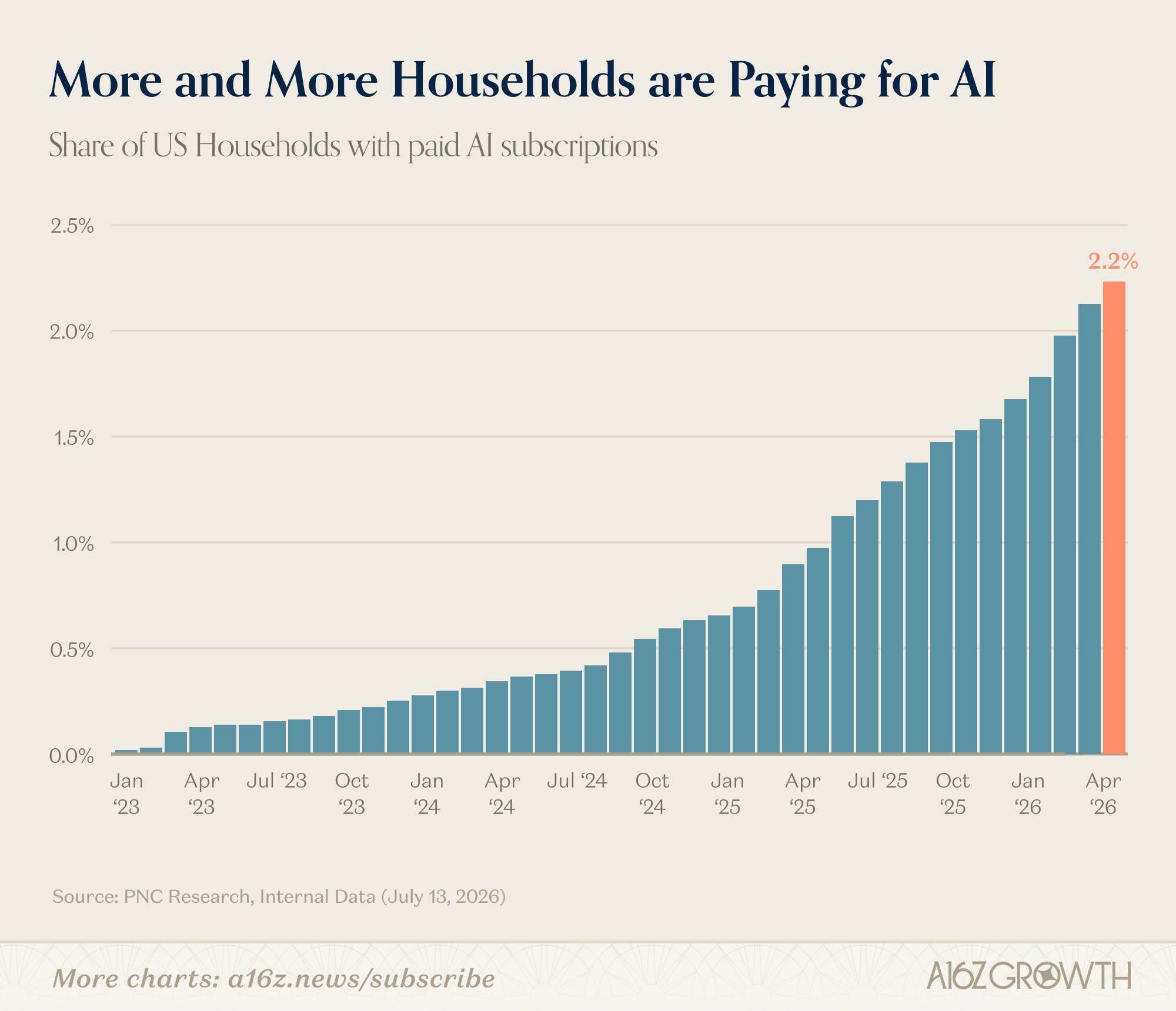
Only about 2% of U.S. households currently pay for an AI service (Image credit: a16z)
The gap becomes even more striking when you factor in usage.
Federal Reserve research published in April found that about 41% of U.S. workers reported using generative AI for work-related tasks as of November 2025, up from roughly 33% in August 2024. Non-work usage reached about 50% of the population during the same period.
Those figures measure different populations and should not be treated as a direct apples-to-apples comparison. The PNC data tracks households paying for AI subscriptions. The Fed data measures reported GenAI use among workers and the broader population.
Still, the disconnect is hard to miss: AI usage is spreading much faster than direct consumer spending.
That may tell us more about where the AI market stands than another billion-dollar funding round.
AI has a monetization gap
People can use ChatGPT, Gemini, Claude, and other AI products without paying. Employers can cover subscriptions. AI features can arrive inside software people already buy, from office tools and search engines to phones and creative apps.
That lets adoption outpace standalone subscriptions.
The business numbers point in the same direction. U.S. Census Bureau data show overall business AI use hovering between 17% and 20% from December 2025 through May 2026. Adoption was much higher among large companies, with 37% of firms employing at least 250 people reporting AI use.
Transaction data tells an even broader story. Ramp’s AI Index, which tracks spending across more than 70,000 American businesses, reported that 56.1% of businesses on its platform were spending on AI models, subscriptions, tokens, or APIs by August 2026. Ramp’s sample and methodology differ from Census surveys, so the two figures measure different things.
Consumer spending is moving too.
Among households that already pay for AI, average monthly spending rose from roughly $22 in May 2024 to $31 by May 2026, according to the PNC data. Paid household penetration reached 2.2% in April.
That creates an unusual picture of the AI economy.
Hundreds of billions of dollars are being committed to chips, data centers, and electricity infrastructure even as direct household monetization remains tiny. Enterprises are buying AI services, workers are incorporating the technology into their jobs, and consumers are using free products at scale. Yet paid AI subscriptions have barely entered American household budgets.
The 2% figure can be read as evidence that consumer willingness to pay still has a long way to go. It can just as easily show how much of the addressable market remains untouched.
The real test comes next.
AI companies have already shown they can get people to use their products. Turning a much larger share of those users into paying customers is a different challenge.
For an industry pouring unprecedented sums into computing capacity, the remarkable part may be that the infrastructure race is already this intense, even as 98% of U.S. households remain outside the paid AI subscription market.

98% of American households don’t pay for a dedicated AI service (Credit: a16z)