Satellite startup Astro Digital to go public in $587 million SPAC deal as space sector heats up
 Nickie Louise
Posted On September 28, 2026

Satellite startup Astro Digital is heading to Wall Street in a $587 million SPAC deal, joining a fresh wave of space companies seeking public-market capital as demand for satellites, defense systems, and orbital infrastructure grows.
The California-based satellite maker said Monday it agreed to merge with Proem Acquisition Corp I, a special purpose acquisition company listed on Nasdaq. The transaction values Astro Digital at approximately $587 million on a pro forma post-money enterprise basis.
The deal could bring Astro Digital up to $180 million in gross proceeds. That includes up to $130 million held in Proem’s trust account, assuming no shareholder redemptions, plus roughly $50 million from PIPE investments led by Proem Asset Management and Leon Capital Group. Proem Asset Management and its affiliates have committed $25 million to the PIPE.
“Breakthrough technologies and expanding commercial applications are driving rapid innovation across the constellation and space sectors and Astro Digital is uniquely positioned to benefit from these tailwinds,” said Chris Biddy, Co-Founder and Chief Executive Officer of Astro Digital. “Over the past 11 years, we have developed strong customer relationships, meeting growing demand with rapid execution capabilities, our scalable manufacturing platform and cost discipline. Unlike competitors in this industry, we have been able to deliver nearly 40 satellites, profitably, with revenue compounding at 42% annualized over two years, positive adjusted EBITDA, and a backlog that doubled last year.”
The companies expect to close the merger in the first quarter of 2027, pending shareholder approval, regulatory filings, a $30 million minimum cash requirement, and other closing conditions. Astro Digital’s management team, led by co-founder and CEO Chris Biddy, is expected to remain in place after the transaction.
Astro Digital has spent more than a decade building spacecraft for customers that need satellites without building their own manufacturing operations from scratch. Since 2018, the company has delivered nearly 40 satellites across 16 mission types for more than 30 customers. Its customer roster includes NASA, the U.S. Department of Defense, Boeing, and Sony.
Its satellites support Earth observation, communications, defense, and space infrastructure, putting the company in several markets seeing heavier government and commercial spending.
SPACs are making a comeback
Astro Digital’s public-market plan comes at a striking moment for SPACs.
The blank-check boom that peaked in 2021 eventually collapsed under poor post-merger performance, tighter scrutiny, and fading investor enthusiasm. In 2026, the structure has returned in force.
Data from SPACAnalytics.com shows 152 SPAC IPOs have been completed in the United States this year out of 227 total IPOs, meaning SPACs account for roughly 67% of new U.S. listings. That compares with 144 SPAC IPOs for all of 2025 and just 57 in 2024.
Space companies have an obvious reason to pay attention.
Building satellites and the infrastructure around them can consume large amounts of capital long before revenue reaches scale. A SPAC merger can give a private company access to public markets and fresh funding without following the conventional IPO route.
The timing is especially interesting as governments increase spending on space-based defense, communications, Earth observation, and satellite networks. Commercial companies are pursuing larger constellations too, creating demand for the spacecraft platforms behind them.
Astro Digital sits in that supply chain.
The company is selling the machines that go into orbit rather than betting its future on a single satellite network or application. If the transaction closes as planned, investors will get another publicly traded way to bet on the infrastructure behind the growing space economy.
For Astro Digital, the $587 million deal could turn more than a decade of satellite manufacturing into something it has never had before: a public-market currency for funding its next stage of growth.
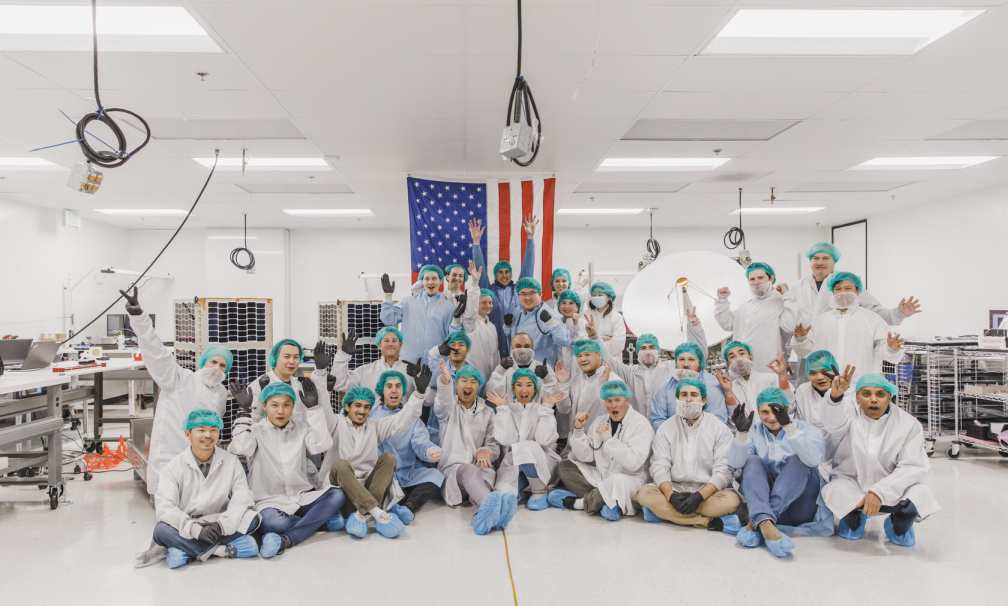
Astro Digital Team (Image credit: Astro Digital)