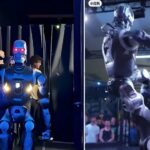
Chinese humanoid robot T800 takes on human in first-of-its-kind cage fight, sends him flying and leaves him with a broken arm
 Daniel Levi
Posted On September 22, 2026

For the first time in history, a six-foot Chinese humanoid robot stepped into an octagonal cage in San Francisco, traded blows with American entertainer Frankie LaPenna, and ended a 44-second fight with a kick that appeared to send him crashing across the mat. Organizers at robotics company REK billed the September 18 bout as the first human-versus-humanoid robot cage fight in the US.
The footage looks like a scene pulled from The Terminator or Real Steel. It isn’t a movie set.
LaPenna, an internet personality known for physical comedy and stunts, entered the cage wearing protective gear and faced an EngineAI T800, a 1.83-meter humanoid built by Shenzhen-based robotics startup EngineAI.
The robot begins by throwing punches before shifting to kicks. One strike appears to connect hard enough to knock LaPenna off balance. A later kick sends him across the cage.
https://www.youtube.com/shorts/I-UGq3XG6-M?feature=share
Reports surrounding the event say LaPenna suffered a broken arm during the encounter. He is not a professional boxer, and the short video does not show enough of the bout to independently establish exactly how the injury occurred or how much force the machine generated.
That uncertainty matters, especially with footage this dramatic.
Human vs. Robot: Human Fighter Loses to Humanoid Robot and Suffers Broken Arm in Real Fight
REK has presented the event as a genuine human-versus-robot fight rather than a conventional robotics demonstration. The company called it its first “Human VS Terminator robot fight” and said it would release more footage from the event.

One detail changes what viewers are actually seeing.
A human operator remotely controlled the T800.
The machine was not autonomously studying LaPenna, deciding which strike to throw, or developing a fighting strategy in real time. A person was controlling the humanoid’s movements.
That makes the fight less a demonstration of artificial intelligence learning combat and more a test of what a modern humanoid body can physically do under human control.
That distinction takes some of the science-fiction edge off the footage, but the mechanical achievement remains striking. Humanoid robots are becoming stable and agile enough to walk, recover their balance, throw punches, execute kicks, and interact physically with people in human-built spaces.
A fighting cage puts those advances on display in a way a warehouse demonstration rarely can.
The T800’s appearance adds to the effect. For the event, the robot wore a menacing head and glowing features that made it resemble a machine built for a dystopian action film rather than an engineering lab.
Humanoid Robot Combat is Becoming a Spectator Sport
The San Francisco matchup did not appear out of nowhere.
Robot combat is moving beyond small wheeled machines smashing into each other. Humanoid platforms are entering competitions built around striking, balance, defensive movement, recovery, and durability.
China held a major humanoid robot fighting tournament in July, putting machines against other machines inside a cage. REK has staged robot-versus-robot matches too.
Putting a human inside the cage changes the spectacle.
It turns advances in humanoid robotics into something instantly understandable. Viewers do not need benchmark charts or engineering specifications to grasp what they are seeing. A machine shaped like a person is standing across from an actual person, moving around the same cage and exchanging physical strikes.
The video should not be mistaken for proof that autonomous robots can now fight humans on their own. It shows something narrower, but still remarkable.
A remotely operated humanoid robot can move through a confined fighting space, maintain its balance, throw coordinated strikes and deliver enough apparent force to knock a human opponent to the floor.
For years, humanoid robotics demonstrations focused on walking without falling.
Now the robots are stepping into cages.