Feldera raises $21.5M to cut database compute costs by 95% for AI workloads
 Daniel Levi
Posted On September 21, 2026

Feldera has raised $21.5 million in Seed and Series A funding to commercialize database technology that the startup says can cut compute costs by 95% or more, giving enterprises a cheaper way to keep large datasets fresh for AI agents and real-time applications.
The San Francisco startup raised a $15.4 million Series A led by Inovia Capital, with participation from Costanoa Ventures and Battery Ventures. Costanoa Ventures led an earlier $6.1 million Seed round that included Ion Stoica, co-founder of Databricks and Anyscale.
The fresh capital infusion gives the company more resources to turn years of database research into infrastructure for a growing class of AI applications that need current enterprise data without repeatedly paying to recompute it, the startup said in a blog post.
Feldera was founded by five PhDs and former VMware researchers: Lalith Suresh, Leonid Ryzhyk, Mihai Budiu, Ben Pfaff, and Gerd Zellweger. The team has collectively published more than 200 research papers spanning database internals, distributed systems, and operating systems.
The startup is tackling a costly problem hidden beneath the AI boom. Companies may have enormous stores of data, yet keeping answers continuously updated can require repeated scans across huge datasets. That gets expensive when AI agents need fresh information repeatedly.
Feldera takes a different approach. Its engine uses incremental view maintenance, a method that updates query results by processing only the changed data rather than recomputing everything from scratch.
The startup says this can turn analytical jobs that take hours into sub-second updates and reduce infrastructure costs by 95% or more for some workloads.
That pitch becomes more significant as companies deploy AI agents inside businesses. An agent making decisions from outdated information can produce bad results, but constantly refreshing that information can drive up database, cloud, and token costs.
“Making timely decisions against massive amounts of fast-changing data using traditional methods requires an immense amount of compute,” said Lalith Suresh, CEO and co-founder of Feldera. “AI agents are only as good as the data they can access. So if that data is too stale because it is too expensive to compute, companies will burn tokens on agents that are just going to be wrong all the time.”
From database research to an enterprise product
Feldera grew out of work by five former VMware researchers: Suresh, Leonid Ryzhyk, Mihai Budiu, Ben Pfaff, and Gerd Zellweger. The founders have collectively published more than 200 research papers spanning database internals, distributed systems, and operating systems.
Their work led to DBSP, or Database Stream Processing, a mathematical framework for incremental SQL computation. Feldera uses DBSP to convert SQL programs into incremental programs that calculate changes as new information arrives.
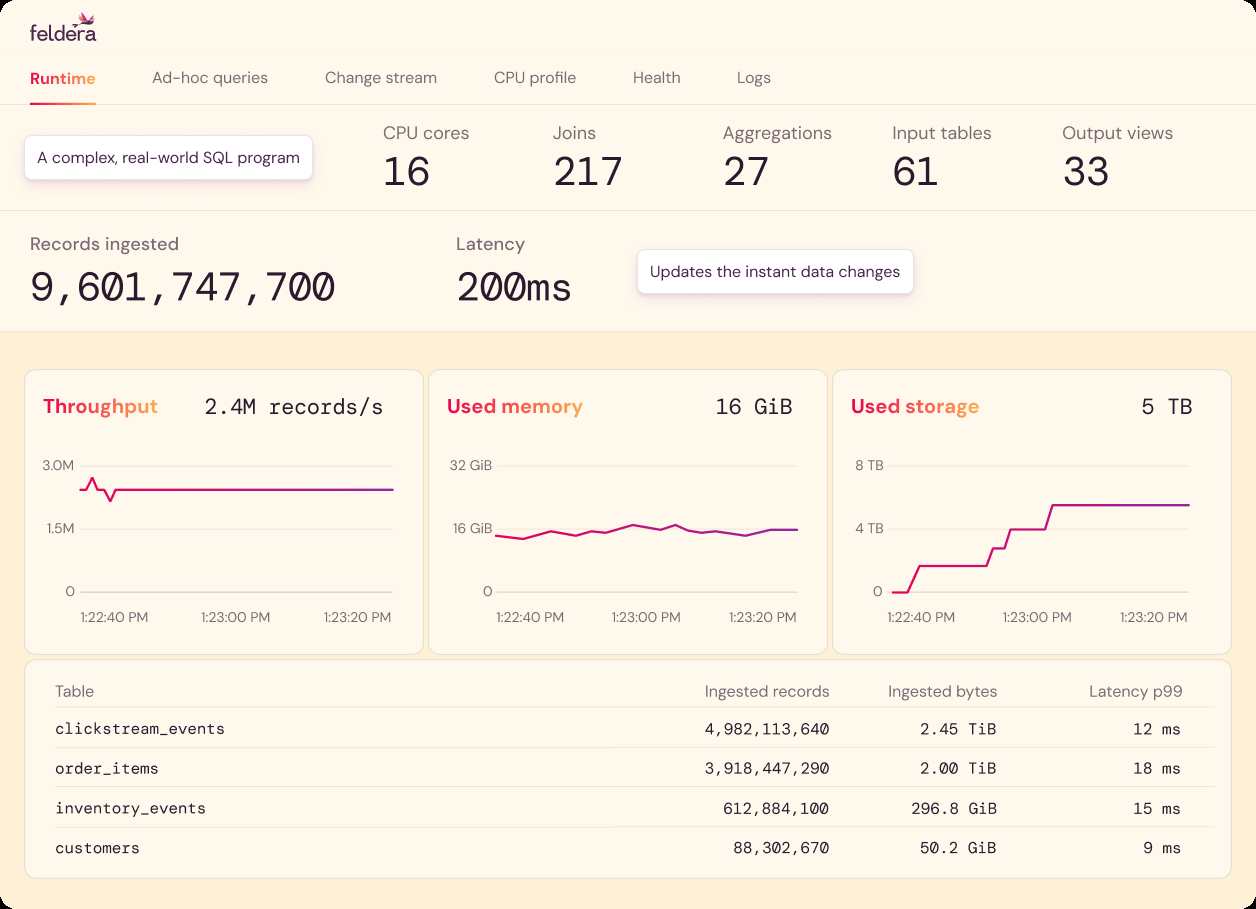
Image credit: Feldera
The company says customers can use their existing SQL without rewriting applications or rebuilding their data architecture. Feldera connects with existing data warehouses, lakes, and pipelines, which could make adoption less disruptive for enterprises sitting on years of existing infrastructure.
Feldera says customers are already using its software to detect fraud in real time, manage large logistics operations, and provide fine-grained authorization for AI agents. Some customers have reduced infrastructure costs by 10 times on average, according to the company, with certain workloads seeing reductions greater than 100 times.
The larger bet is that AI infrastructure will increasingly depend on how efficiently companies can retrieve fresh information, not simply how capable their models become.
“The team at Feldera solved a 50-year-old fundamental database problem with rigorous mathematical proof,” said Taha Mubashir, Partner at Inovia Capital. “As enterprises scale their real-time AI initiatives, the cost and latency of traditional data compute become unsustainable. Feldera provides the foundational compute layer that enables companies to run continuous, complex analytics at a fraction of the cost.”