OpenAI launches ChatGPT for Financial Services with GPT-6 Astra and built-in financial data
 Daniel Levi
Posted On September 10, 2026

OpenAI is taking ChatGPT deeper into Wall Street with a new product built for investment bankers and equity researchers, putting GPT-6 Astra alongside premium financial data from LSEG News, PitchBook, Daloopa, Crunchbase, Quartr, and other providers inside a single workspace.
The company launched ChatGPT for Financial Services on Thursday, positioning the product as a place where finance teams can research companies, build financial models, trace figures back to source material, and create client-facing documents such as pitchbooks.
Morgan Stanley and Evercore served as design partners, giving OpenAI direct input from institutions whose analysts and bankers spend much of their working day moving between financial databases, spreadsheets, research documents, filings, and presentation software.
“We’re introducing ChatGPT for Financial Services, a tailored ChatGPT Work experience that combines built-in financial data with GPT-6 Astra’s reasoning to help teams develop research, financial models, and customized client materials,” OpenAI said in a blog post.
The bigger story is what OpenAI has put around the model.
Instead of asking bankers to connect ChatGPT to a collection of outside data sources on their own, OpenAI is indexing premium financial information on its infrastructure. The approach gives the AI direct access to financial statements, company fundamentals, earnings transcripts, news, and other material used in professional research.
That moves ChatGPT closer to the daily workflow of financial data and research platforms, where access to trusted information can matter as much as the intelligence of the model processing it.
OpenAI brings premium financial data inside ChatGPT
ChatGPT for Financial Services includes built-in data from Daloopa, PitchBook, LSEG News, Crunchbase, Quartr, and other providers. Firms with existing subscriptions can connect services including FactSet, S&P Global, Preqin, and Datasite, Reuters reported.
OpenAI said hosting and indexing the data improves retrieval and lets ChatGPT provide granular citations, letting users trace figures and claims back to their original sources.
“Built-in premium data from providers like Daloopa, PitchBook, LSEG News, and Crunchbase removes the challenges with MCP connectors and access to data. This data is indexed and hosted by OpenAI to enable higher accuracy and new features like granular citations so that bankers can trace figures and claims back to their sources, and check the evidence as their analysis develops.”
That citation layer could prove particularly important in finance. A generated answer that sounds convincing is of limited use to an analyst preparing an investment recommendation or a banker working on a multibillion-dollar transaction if the underlying numbers cannot be verified.
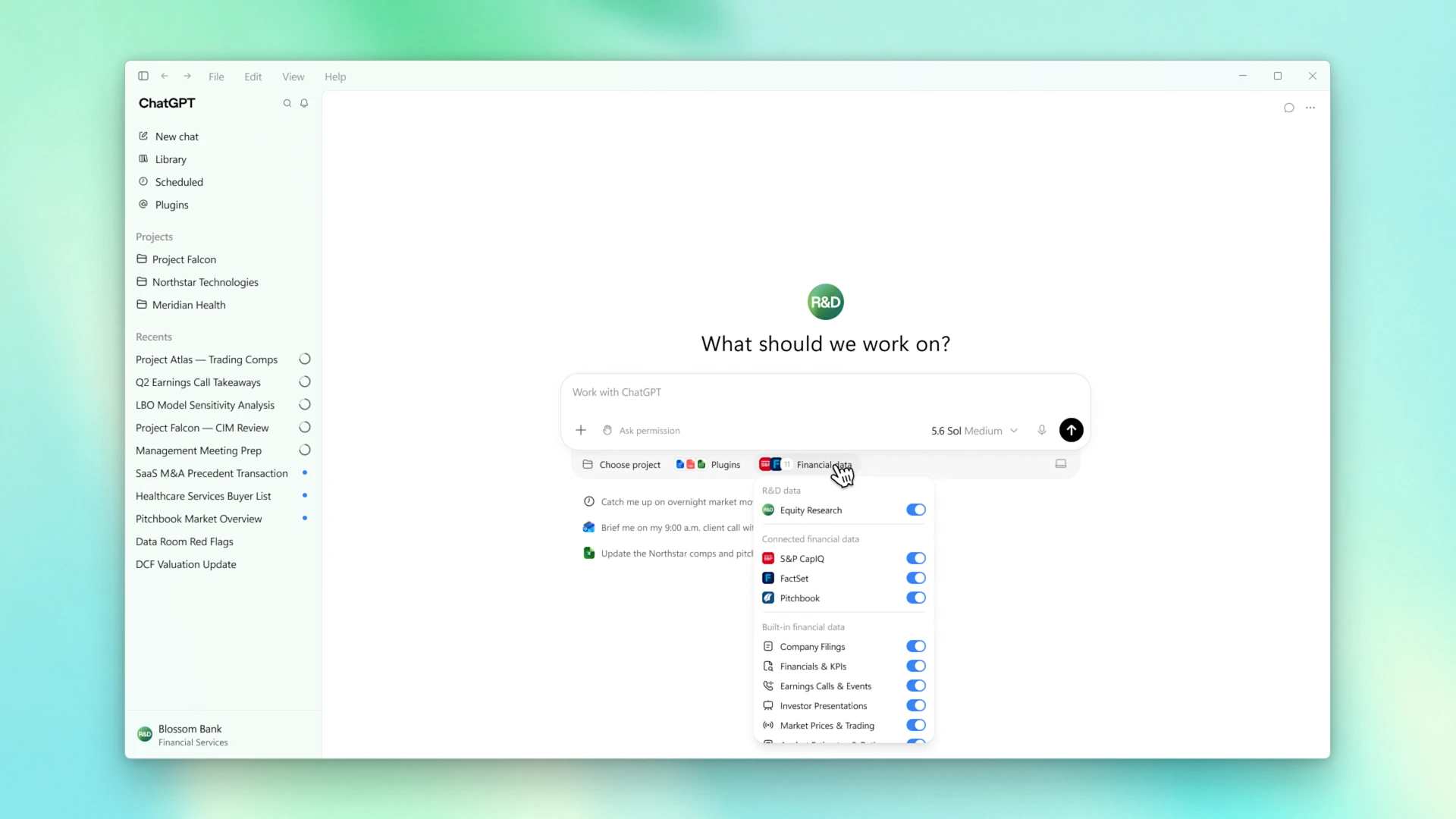
ChatGPT for Financial Services brings together built-in data, connected sources, and financial analysis workflows.
OpenAI says GPT-6 Astra was built to improve retrieval across financial data tools, financial reasoning, and generated-content accuracy. Users can research across multiple sources, create financial models, and generate client materials using their firm’s own templates.
The company plans to add more financial datasets and train its models to identify, interpret, and apply financial information across tasks traditionally performed by experienced analysts.
ChatGPT is moving from assistant to financial workspace
The launch points to a larger shift in enterprise AI. The contest is moving beyond who has the strongest general-purpose model and into who can put that intelligence next to proprietary data, trusted sources, company workflows, and compliance systems.
That challenge becomes harder in banking, where institutions have strict rules around sensitive information, access controls, record-keeping, and auditability.
ChatGPT for Financial Services builds on ChatGPT Enterprise security controls, including encryption and role-based access. Compliance teams can export workspace logs into existing audit workflows, giving financial institutions a record of how the system is being used.
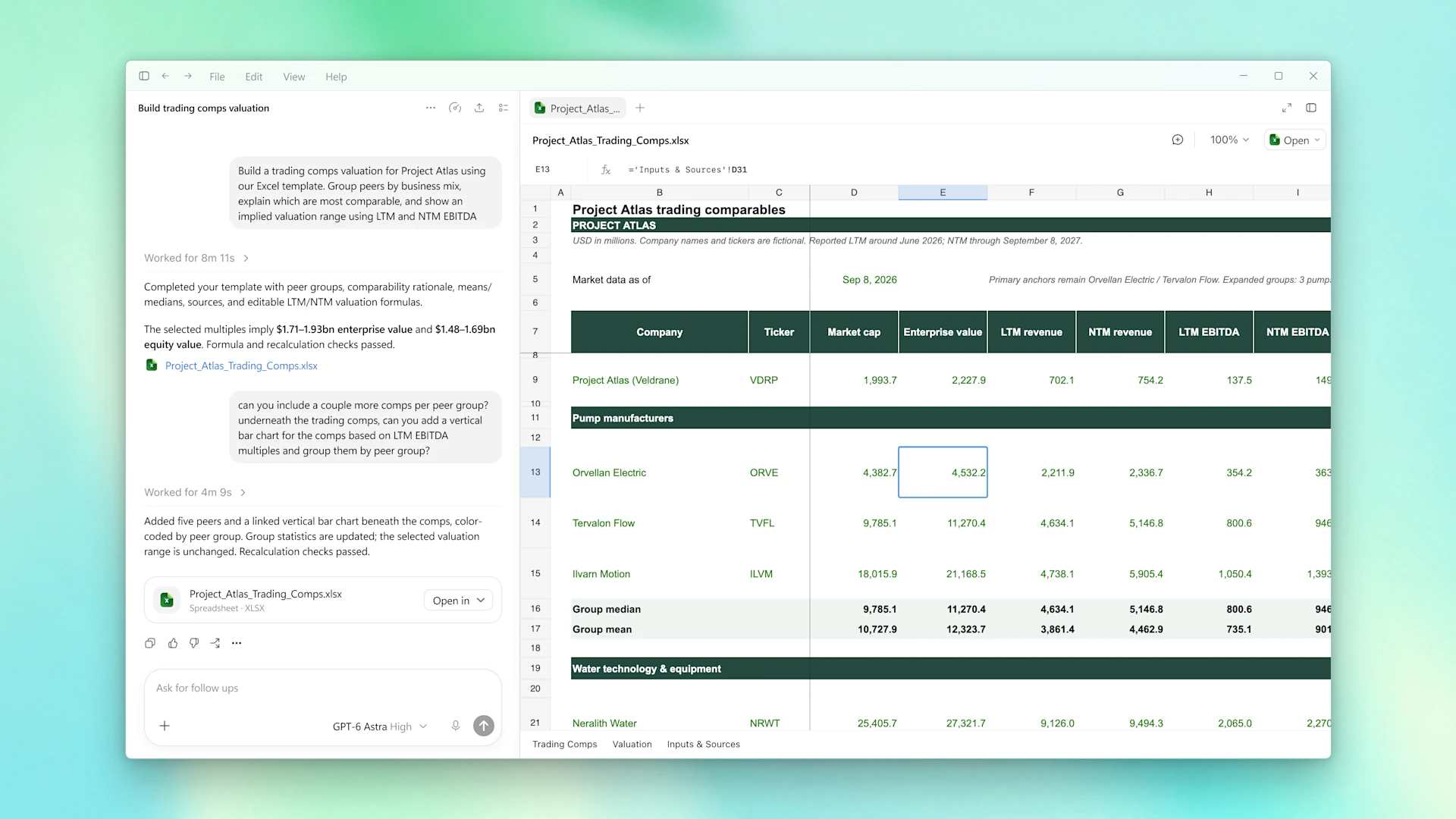
Value Analysis (Image credit: OpenAI)
OpenAI’s decision to work with Morgan Stanley and Evercore during development suggests it wants the product embedded much deeper into financial work than the familiar ChatGPT question-and-answer interface.
The initial focus is investment banking and equity research, but OpenAI said it plans to bring the product to more areas of financial services.
That raises an interesting question for Wall Street’s established data providers. OpenAI still relies on many of them for the information feeding ChatGPT. Yet by placing those datasets behind one conversational and agentic interface, OpenAI is increasingly becoming the layer through which bankers interact with that information.
For Wall Street, that may be the more consequential part of Thursday’s launch. ChatGPT is no longer sitting beside the financial data terminal. OpenAI wants it sitting between the banker and the data.
A warning for startups building on foundation models
For AI startup founders, OpenAI’s move into financial services comes with an uncomfortable lesson: the foundation model beneath your startup can eventually absorb what you built on top of it.
ChatGPT for Financial Services shows the risk of building a company whose main product is a specialized interface sitting on top of someone else’s foundation model. A startup can spend years packaging a general-purpose model for bankers, analysts, lawyers, developers, or another profession, only to see the model provider eventually build that workflow directly into its own platform.
What looked like a standalone product can become a feature.
That doesn’t mean every startup built on OpenAI, Anthropic, Google, or another model provider is destined to disappear. The harder question is what remains valuable if the underlying model gains the same capability tomorrow.
Proprietary data can remain valuable. So can distribution, customer relationships, deep integrations, specialized workflows, regulatory expertise, network effects, and software that becomes difficult for customers to replace. A thin interface around an API offers far less protection.
OpenAI’s financial services launch makes that distinction unusually clear. The company isn’t stopping at providing the intelligence layer. It is moving further up the stack by combining GPT-6 Astra with premium datasets, citations, financial modeling, company templates, compliance controls, and workflows shaped with Morgan Stanley and Evercore.
For founders, that creates a useful test: **If the foundation model adds your startup’s core feature next year, what does your company still own?**
The answer may increasingly determine which AI startups become lasting companies and which ones become features inside somebody else’s platform.