The Boring Company raises $3 billion in funding, valuing Elon Musk’s tunnel startup at $23 billion
 Nickie Louise
Posted On September 10, 2026

The Boring Company, Elon Musk’s tunnel startup, has raised $3 billion in a Series D funding round that values the company at $23 billion, giving Musk fresh capital to pursue one of his oldest and most ambitious ideas: moving urban transportation underground.
The round was led by the United Arab Emirates and affiliated investment entities, The Boring Company announced Thursday. Human Capital, Vy Capital, Valor Equity Partners, Sequoia Capital, Andreessen Horowitz, Temasek, Shamal Holding, and Baron Capital joined the financing alongside other new and existing investors.
“The Boring Company is pleased to announce our Series D funding round of $3 billion, led by the United Arab Emirates. The financing now values The Boring Company at $23 billion,” Elon Musk’s tunnel startup said on its website.
The round size puts The Boring Company in rare territory for a private infrastructure startup. It also deepens Musk’s ties to the UAE, where the company already has plans for its first major international Loop system.
The new investment comes with a much larger commitment. The Boring Company said its partnership with the UAE will include more than 150 kilometers, or roughly 93 miles, of underground infrastructure across the country. That agreement is separate from the Dubai Loop project announced earlier.
For The Boring Company, the UAE could become something Las Vegas has yet to fully provide: a chance to prove that its tunnel network can work across a much larger urban footprint.
TechStartups last covered The Boring Company in April 2022, when Elon Musk’s tunneling startup raised $675 million at a $5.7 billion valuation. Four years later, the company is raising more than four times as much capital in a single round, at roughly four times the valuation.
Musk’s tunnel bet is getting much bigger
Musk founded The Boring Company in 2016 after repeatedly complaining about Los Angeles traffic. The idea sounded characteristically Musk-like: instead of adding more roads above ground, build networks of inexpensive tunnels below cities and move passengers directly between destinations.
Nearly a decade later, the company has moved beyond its original test tunnel.
Its Vegas Loop currently transports passengers in Tesla vehicles through tunnels beneath Las Vegas, and the company is developing projects including Music City Loop in Nashville and Dubai Loop.
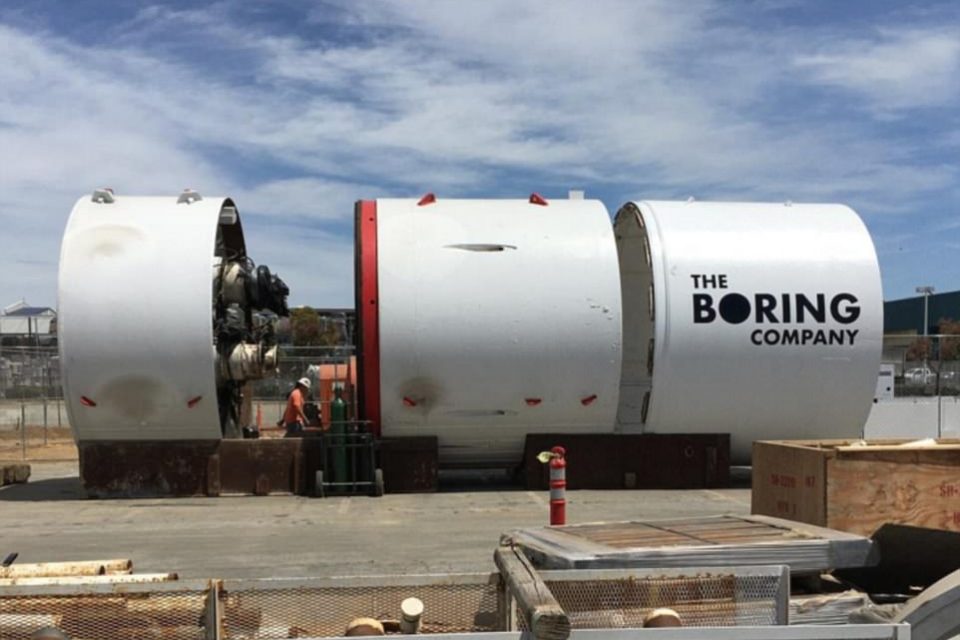
A major piece of that expansion rests on Prufrock, The Boring Company’s tunnel-boring machine.
The company says newer versions of Prufrock can launch directly from a transporter called The Monster, removing the need for conventional launch pits and some heavy construction work. In May 2025, the company demonstrated what it calls Zero-People-in-Tunnel continuous mining, allowing Prufrock to advance and install tunnel rings without workers inside the tunnel.
By August 2026, the company says its system could autonomously assemble a tunnel ring using six concrete segments weighing roughly 3,750 pounds each. The company says the segments can be positioned with millimeter-level precision in less than a minute, with operations monitored remotely from Texas.
Those engineering claims matter more now. Building demonstration tunnels is one thing. Constructing more than 150 kilometers of infrastructure across the UAE would put the company’s tunneling economics, machine reliability, construction speed, and Loop transportation model under a far larger test.
The fresh funding will go toward hiring across engineering, production, and operations, along with construction of Loop projects in Las Vegas, Nashville, Dubai, and other locations. Part of the money will fund further development of Prufrock and future tunneling systems.
The $23 billion valuation suggests investors are betting that The Boring Company can become more than another Musk experiment. The UAE agreement may offer the clearest test yet.
If The Boring Company can build underground infrastructure at the speed and cost it has been promising, the company could turn tunneling into another major Musk business. If it cannot, 150 kilometers of planned tunnels will make the gap between the pitch and reality much harder to hide.