Qualcomm acquires AI startup Modular in $4 billion deal to challenge Nvidia’s CUDA dominance
 Daniel Levi
Posted On June 24, 2026
Daniel Levi
Posted On June 24, 2026
Qualcomm is making a nearly $4 billion bet that the next big AI fight will not be won by chips alone.
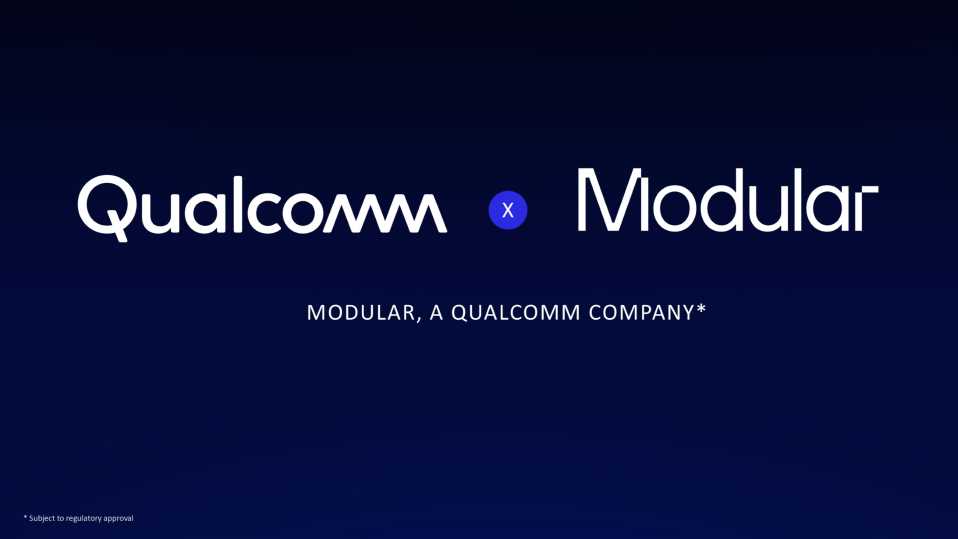
The company said Wednesday it plans to acquire AI startup Modular in an all-stock deal valued at about $3.92 billion, a move that gives Qualcomm a software layer built to run AI models across different chips without forcing developers to rewrite code for each processor. The deal puts Qualcomm more directly in the fight over AI infrastructure and gives it a clearer shot at one of Nvidia’s strongest advantages: CUDA, the software platform that has helped lock developers into Nvidia’s ecosystem.
Qualcomm did not disclose the financial terms of the acquisition, but Reuters’ calculations, based on Qualcomm’s last closing price, value the transaction at roughly $3.92 billion. Bloomberg had reported earlier this week that Qualcomm and Modular were in advanced talks on a deal worth nearly $4 billion. Qualcomm said the acquisition is expected to close in the second half of 2026.
“This acquisition marks a pivotal moment not just for Qualcomm, but for the AI industry,” said Cristiano Amon, President and CEO, Qualcomm Incorporated. “As agentic AI scales across data centers and edge environments, the industry is moving toward disaggregated, multi-vendor architectures that demand a more open and modern software foundation. We believe the future belongs to developer-friendly, horizontal platforms that can run across diverse compute environments and give customers real choice in how and where they deploy AI. With Modular, we’re accelerating that shift, combining our scale and energy-efficient data center technologies with an open ecosystem approach to help drive the next chapter of AI.”
Qualcomm Acquires Modular to Build AI Software Layer That Runs Across Any Chip
The timing says a lot about where the AI market is heading. For the past two years, the spotlight has been on the hardware race, with Nvidia, AMD, and a growing list of startups chasing demand for the chips that train and run large AI models. But another battle is taking shape underneath that hardware stack: who controls the software layer that developers use to build, deploy, and scale AI across it all.
That is where Modular comes in.
Founded to make AI development less dependent on any single chip vendor, Modular built software that lets developers write once and run AI workloads across a mix of hardware, from Nvidia GPUs to AMD chips and other processors used in data centers and at the edge. In practical terms, that means companies can move AI workloads more easily, reduce integration work, and avoid getting boxed into one vendor’s stack.
For Qualcomm, that matters on two fronts.
The first is the data center market, where the company has been trying to carve out a larger role as demand for AI infrastructure continues to climb. Qualcomm has already been pushing into data center processors and has said it plans to ship its AI-focused chips by the end of the year. Buying Modular gives it software that can sit atop that hardware push, making its offerings more attractive to developers and enterprise customers.
The second is inference, the part of AI that runs models after they have already been trained. Inference has become one of the most important battlegrounds in AI infrastructure, as businesses seek cheaper, more efficient ways to deploy models at scale. Training grabs headlines, but inference is where many companies will spend heavily over time as they put AI tools into products, internal systems, and customer workflows.
That shift is one reason Modular has drawn attention. Businesses are looking for ways to control rising AI costs as token usage and infrastructure bills pile up. Modular’s pitch has been simple: give developers a unified compute platform that makes AI deployment more efficient and less tied to one hardware ecosystem. Its software is built to support AI workloads across data center and edge environments, a mix that closely aligns with Qualcomm’s own ambitions.
Qualcomm framed the deal in those terms. “We believe the future belongs to developer-friendly, horizontal platforms that can run across diverse compute environments and give customers real choice in how and where they deploy AI,” CEO Cristiano Amon said in a release.
That line gets at the bigger strategic point behind the acquisition. NVIDIA’s grip on AI has never been just about having the best chips. CUDA helped create a software moat around those chips by making Nvidia the default environment for millions of developers building AI systems. Breaking that hold does not mean beating Nvidia on hardware specs alone. It means offering developers a credible software alternative that works across multiple environments and does not force them into a single stack.
Modular gives Qualcomm a piece of that story.
The deal lands at a time when Qualcomm is trying to reduce its dependence on smartphone chips, which still generate most of its revenue. AI has given the company an opening to push deeper into adjacent markets, from PCs and edge devices to automotive systems and now data center infrastructure. The company has been more vocal about that shift over the past year, and the Modular acquisition is one of its clearest signs yet that it wants to be taken seriously as an AI infrastructure player, not just a mobile chip supplier.
It may not stop there. Qualcomm is reportedly in talks to acquire AI chip startup Tenstorrent for between $8 billion and $10 billion, according to The Information. If that deal goes through, it would add another layer to Qualcomm’s AI push and signal that the company is willing to spend aggressively to build a broader market position.
For now, Modular gives Qualcomm something it has needed: a stronger software story at a moment when AI customers are looking for flexibility, lower costs, and fewer dependencies on any one vendor. The AI race is no longer just about who has the biggest chip. It is about who can give developers and enterprises the easiest way to build once, run anywhere, and keep their options open.
Trending Now