Bitcoin crashes to $59,000 as worst week since 2022 sparks fears of deeper crypto selloff
 Daniel Levi
Posted On June 5, 2026
Daniel Levi
Posted On June 5, 2026

Yesterday, Bitcoin fell below $61,500 as roughly $3 billion in liquidations ripped through the crypto market and traders braced for more pain. Today, those fears became reality.
The world’s largest cryptocurrency extended its slide on Friday, plunging to an intraday low of $59,099, its weakest level since October 2024. Bitcoin was recently trading near $61,500, down more than 3% on the day and 16% for the week, capping its worst weekly performance since 2022.
“The flagship cryptocurrency was last lower by 3.4% at $61,514.90. Earlier, it fell to $59,099.25, its lowest level since October 2024. It was off 16% on the week,” CNBC reported. Bitcoin has since climbed back up, and it’s trading at $61,608.63 at the time of writing.
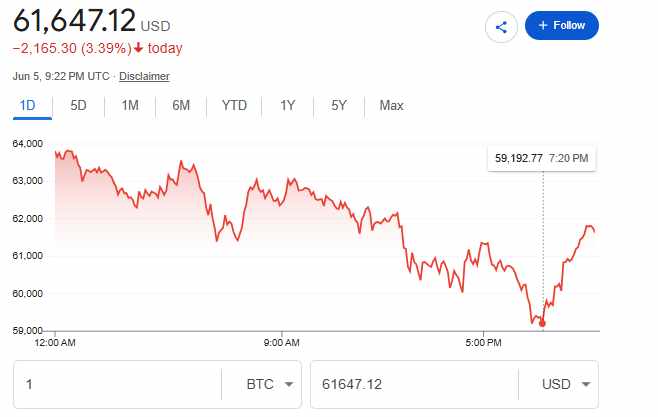
The selloff has pushed Bitcoin back into territory many investors hoped was behind it. At current levels, the cryptocurrency has lost more than half its value from the record high of roughly $126,000 reached in October 2025.
The decline marks a sharp reversal for an asset that spent much of last year riding a wave of optimism fueled by spot Bitcoin ETFs, expectations of crypto-friendly regulation, and growing institutional adoption.
Now, traders are asking a different question: Has Bitcoin entered a deeper correction?
Bitcoin Breaks Key Support Levels
Technical indicators suggest sellers remain firmly in control.
On the daily chart, Bitcoin has broken below both its ascending recovery channel and the 100-day moving average near $74,000. The breakdown came after repeated failures to reclaim the descending 200-day moving average around the $82,000 level.
That rejection triggered a wave of selling that sent Bitcoin crashing through several major support zones, including the closely watched $65,000 level, which had previously acted as a floor for the market.
The next battleground sits near $60,000.
Analysts have identified that area as one of the most important support zones on the chart. It served as a major rebound point following February’s capitulation event and now represents what many traders view as the last major line of defense before a deeper decline could unfold.
Strategy Sale and Strong Jobs Data Add Pressure
Market sentiment deteriorated after Strategy, the company founded by Michael Saylor and one of the largest corporate holders of Bitcoin, disclosed the sale of a small portion of its Bitcoin holdings.
The move sparked concerns that one of Bitcoin’s most prominent supporters could be becoming more cautious.
The selling pressure intensified Friday after a stronger-than-expected U.S. jobs report pushed Treasury yields higher and weighed on risk assets across financial markets.
Shares of Strategy recovered from their session lows but still closed down nearly 7% on the day and 24% for the week, marking the stock’s worst weekly performance since November 2022.
Investors Shift Attention to AI Stocks and IPOs
Some market observers believe Bitcoin is losing capital to other parts of the market.
Charles-Henry Monchau, chief investment officer at Syz Group, said Bitcoin’s recent weakness reflects a mix of Strategy’s selling activity and investors chasing opportunities elsewhere.
“Speculators are going all-in on AI stocks and memory chips, especially in Korea, and the market also anticipates that upcoming monster IPOs will divert some retail money into the new stocks,” Monchau told CNBC.
The comments highlight a growing challenge for crypto markets. AI-related companies have attracted enormous investor attention over the past year, drawing capital that might otherwise have flowed into digital assets.
Regulatory Momentum Slows
Bitcoin has lost another catalyst that many investors expected would support prices.
The Clarity Act, a proposed crypto market structure bill that supporters hoped would create clearer rules for the industry, appears to be slipping further down Washington’s legislative agenda.
Lawmakers remain divided on several provisions, leaving the future of the legislation uncertain.
That delay comes at a difficult moment for crypto markets, which have struggled to find a strong narrative capable of attracting fresh inflows.
Bitcoin’s Identity Crisis Deepens
The latest downturn has revived a debate that has followed Bitcoin for years.
Supporters have long argued that Bitcoin serves as “digital gold” and should benefit during periods of geopolitical uncertainty. Others have viewed it as a high-growth technology asset that tends to rise alongside risk markets.
Recent price action has challenged both arguments.
Tensions surrounding the Iran conflict have persisted for months, yet Bitcoin has failed to attract meaningful safe-haven demand. At the same time, major stock indexes have continued to set new records, driven largely by enthusiasm for artificial intelligence.
Rajiv Sawhney, head of international portfolio management at Wave Digital Assets, said Bitcoin’s relationship with traditional markets has changed dramatically in recent weeks.
“We saw the 30-day Pearson correlation between bitcoin and the Nasdaq and S&P 500 reach a near-perfect positive correlation as recently as a month ago, but that has collapsed over the last several weeks,” Sawhney said.
“So while global equities, particularly tech stocks, continued to reach new all-time highs, bitcoin has failed to track the same upward price trend.”
ETF Demand Remains Weak
Spot Bitcoin ETFs, one of the strongest drivers of institutional demand over the past two years, have offered little support.
The funds recorded a modest net inflow of just $3 million on Thursday, ending a 13-day streak of outflows that marked the longest withdrawal period since the products launched.
Total net assets across Bitcoin ETFs have fallen to $80.4 billion from $107.8 billion on May 14, reflecting the scale of investor withdrawals during the recent downturn.
Some Investors Still See a Buying Opportunity
Not everyone believes the decline signals a long-term problem.
In an appearance on CNBC’s Squawk Box Europe, Matt Cole, chief executive of Strive, argued that Bitcoin’s underlying fundamentals remain strong despite the recent selloff.
“This is the fifth time that bitcoin has been at its 200-week moving average — the previous four have all been the perfect time to buy the dip, and I think this time will age in the same manner,” Cole said.
For now, traders remain focused on whether Bitcoin can hold the critical $60,000 level.
A successful defense could provide a foundation for stabilization. A decisive break below it would likely fuel fresh concerns that the correction has further to run.
Trending Now