Bitcoin falls below $61,500 as $3 billion in liquidations rock crypto market and traders brace for more pain
 Daniel Levi
Posted On June 4, 2026
Daniel Levi
Posted On June 4, 2026

Just months ago, Bitcoin was trading above $126,000 and fueling fresh predictions of a six-figure future. Today, traders are asking a different question: How much lower can it go?
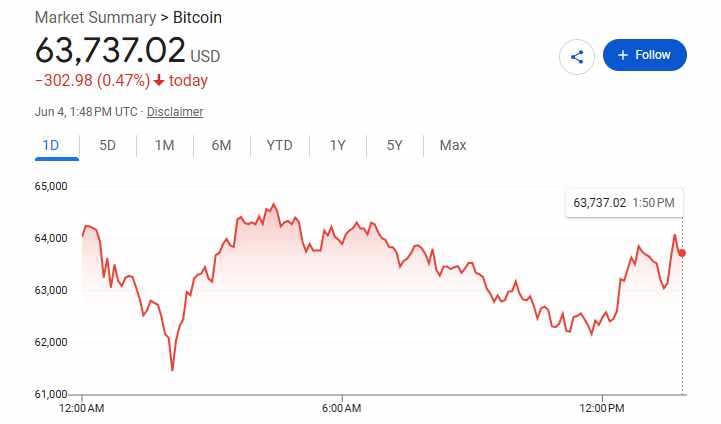
The world’s largest cryptocurrency briefly plunged to $61,300 during a sharp sell-off that erased billions of dollars from the crypto market and triggered one of the year’s largest liquidation events. Bitcoin later recovered to around $62,500, but the damage had already been done.
“BTC crashed to $61,300 before recovering to $62,500 with $3 billion in liquidations over two days. Traders loaded up on $60,000 puts in anticipation of further declines,” CoinDesk reported.
Bitcoin is currently trading at $63,737.02 at the time of writing.
More than $3 billion in leveraged positions were wiped out over the past two days as traders rushed to exit losing bets. At the same time, several indicators suggest that investor confidence remains under pressure.
One signal stands out.
Investors who have historically shown the strongest conviction in Bitcoin are now selling.
Long-Term Holders Join the Sell-Off
According to a note from Compass Point analyst Ed Engel, long-term Bitcoin holders have shifted from sitting on the sidelines to actively reducing their positions.
These investors, defined as those who have held Bitcoin for at least 155 days, were largely inactive between February and April. In recent weeks, that changed.
Over the past two days alone, long-term holders sold roughly $2.4 billion in Bitcoin, a move Engel said carries significant implications for supply-and-demand dynamics.
The selling pressure extends beyond long-term holders. Compass Point estimates that 26% of Bitcoin sold during the past 30 days came from investors who purchased their coins above $90,000.
“This cohort of top-buyers had been resilient throughout the bear market; however, they’re finally capitulating as BTC approaches new cycle lows,” Engel wrote, according to CNBC. “Top-buyer capitulation is a very common theme in late-cycle bear markets. This makes us more confident that BTC’s bear market is in late stages.”
Capitulation often marks a period when investors who held through previous declines finally decide to exit. Market historians frequently view this phase as one of the final chapters of a prolonged downturn, though it does not guarantee an immediate recovery.
Bitcoin’s Narratives Face a New Test
Bitcoin’s struggle comes at a time when U.S. stock markets continue to push higher.
That divergence is raising questions about two of Bitcoin’s most popular investment narratives.
For years, Bitcoin supporters have argued that the asset could function as digital gold during periods of geopolitical uncertainty. Others viewed it as a high-growth asset that would benefit alongside technology stocks.
Recent market action has challenged both assumptions.
Escalating tensions surrounding the Iran conflict have weighed on crypto prices, yet Bitcoin has failed to attract the safe-haven demand many expected. At the same time, major stock indexes continue setting new records.
The result is a growing disconnect between crypto and traditional markets, leaving investors searching for a clear catalyst.
ETF Investors Continue Heading for the Exit
Institutional demand appears to be weakening.
Data from SoSoValue shows that spot Bitcoin ETFs recorded their 12th consecutive day of net outflows on Tuesday, marking the longest withdrawal streak since the products launched.
Total net assets across Bitcoin ETFs have fallen to roughly $85 billion, down from $107.8 billion on May 14.
For many market observers, ETF flows remain one of the most important gauges of investor appetite.
“ETF flows are the primary driver of BTC price appreciation, explaining approximately 45% of weekly return variation, and the best vehicle for tracking investor adoption/appetite,” Citi analyst Alex Saunders said in a note, according to CNBC. “Recent flows have been negative, and the chances for the passage of a U.S. market structure bill (a potential catalyst for renewed investor interest in our view) are diminishing.
“We expect sentiment to remain lackluster, especially as the divergence with equity performance remains stark, absent positive news on the regulatory front or ‘de-basement trade’ fears around fiscal position,” he added.
Derivatives Markets Flash a Bearish Warning
Price action tells only part of the story.
The derivatives market is sending an even stronger signal.
Total crypto futures volume climbed to $305 billion during the past 24 hours, reflecting elevated trading activity. Open interest moved in the opposite direction, falling 8.5% to $111.4 billion.
That decline suggests traders are closing positions rather than opening new ones.
Liquidations have been severe. Roughly $1.7 billion in futures positions were wiped out during the past 24 hours alone. Bitcoin accounted for about $750 million of those liquidations, with ether contributing another $390 million.
Bitcoin open interest has fallen from record highs above 800,000 BTC to around 766,000 BTC. The drop points to a large number of leveraged bullish positions being forced out of the market.
Solana presents a different picture.
According to CoinDesk, open interest in SOL surged to a record 72.16 million tokens even as the token’s price declined. Traders often interpret that combination as evidence of aggressive short positioning. Similar patterns have emerged in TRX and ADA.
Market sentiment has become increasingly defensive.
Volatility expectations are rising, according to Volmex’s bitcoin and ether implied volatility indexes. Options traders are paying more for downside protection, a sign that many expect larger price swings ahead.
The clearest example can be found in Bitcoin’s options market.
The $60,000 put option on Deribit now carries more than $1 billion in notional open interest. The $55,000 put was the most actively traded options contract during the past day.
As Bitcoin moves closer to those levels, traders may need to adjust positions aggressively, which can increase volatility and intensify price moves.
For now, derivatives traders appear to be preparing for further weakness.
The message coming from options and futures markets is difficult to ignore: sentiment remains firmly bearish.