Speech datasets for AI: what they contain, how they’re built, and where they break
 Nickie Louise
Posted On June 1, 2026
Nickie Louise
Posted On June 1, 2026
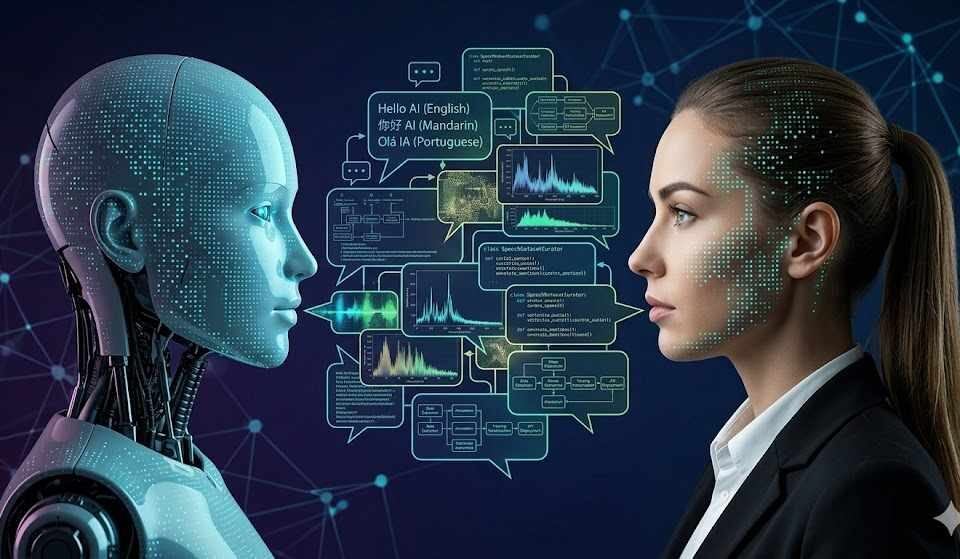
Every time a voice assistant parses what you said, or a transcription tool turns a meeting recording into text, something upstream makes that possible: a speech dataset. Not one dataset, usually — a stack of them, built from different sources, for different purposes, with different quality tradeoffs baked in from the start.
What a speech dataset is, technically
A speech dataset for AI is a collection of audio recordings paired with labels. The labels depend on what the dataset is for.
For automatic speech recognition (ASR), the label is a transcript — the words spoken in the recording, usually with punctuation and sometimes with timing information marking when each word was said. For speaker identification, the label is an identity — which voice belongs to which person. For emotion recognition, the label is an emotional category: neutral, angry, sad, happy. For language identification, the label is simply the language being spoken.
The audio itself matters too. Sample rate, encoding format, background noise level, microphone type, recording environment — all of these affect what a model trained on the data can and can’t handle. A model trained on clean studio recordings at 44kHz will fail in ways that aren’t obvious until you point it at a phone call recorded at 8kHz in a room with an HVAC system running.
The combination of audio quality, label accuracy, and coverage across different speakers and conditions determines whether a speech dataset is useful or just large.
How speech datasets get built
There are three main approaches, and most serious training pipelines use all three.
Scraping and transcribing existing audio. Podcasts, audiobooks, broadcast news, parliamentary records, YouTube videos with captions — these are the primary sources for large open speech datasets. Mozilla’s Common Voice and OpenAI’s Whisper training data both draw heavily from this kind of material. The advantage is scale: there’s a lot of audio online. The disadvantage is that the transcripts are often auto-generated, meaning they carry the errors of whatever ASR system produced them. Training a new model on transcripts made by an old model is a known quality problem, and it doesn’t disappear just because the dataset is large.
Controlled collection with human speakers. You recruit speakers, give them scripts or prompts, record them in known conditions, and have human annotators transcribe and verify the audio. This is how datasets like TIMIT (influential in the 1990s and still used) and LibriSpeech (based on LibriVox audiobook recordings with clean transcripts) were built. Quality is higher. The scale is lower. You also control who participates, which introduces its own biases — more on that below.
Synthetic generation. Text-to-speech systems can generate thousands of audio-transcript pairs in the time it takes to record a handful of real ones. Synthetic data is useful for filling distribution gaps: if your real dataset has almost no examples of a particular accent, a TTS system trained on speakers with that accent can generate more. The ceiling on synthetic data is the same as always — it reflects what you already know. A synthetic speaker can’t surprise you the way a real one can.
The coverage problem
The most-studied speech datasets in the research literature are heavily weighted toward a few languages, a few accents, and a few recording conditions. English dominates. Within English, American and British varieties dominate. Clean, quiet recordings dominate.
This creates models that work well for some speakers and poorly for others. Not slightly worse — measurably, significantly worse. A 2020 study from researchers at Stanford found that a leading commercial ASR system had error rates nearly twice as high for Black speakers as for white speakers, even controlling for recording quality. The cause was straightforward: the training data didn’t represent the full population of English speakers.
The fix is also straightforward in principle: collect more diverse speech data, recruit a broader range of speakers, annotate it carefully, and train on it. In practice, that requires finding speakers, compensating them fairly, building collection infrastructure in communities that haven’t historically been part of AI research, and doing this at enough scale to actually shift model behavior. It’s slow and expensive work. The benchmark numbers that attract attention and funding tend to reward aggregate performance rather than performance for underrepresented groups, which shapes what gets funded.
Progress is real but uneven. Projects like Masakhane have done important work on African languages. Mozilla’s Common Voice has expanded to over 100 languages. The gap between well-resourced languages and everything else remains large.
Annotation is where quality actually lives
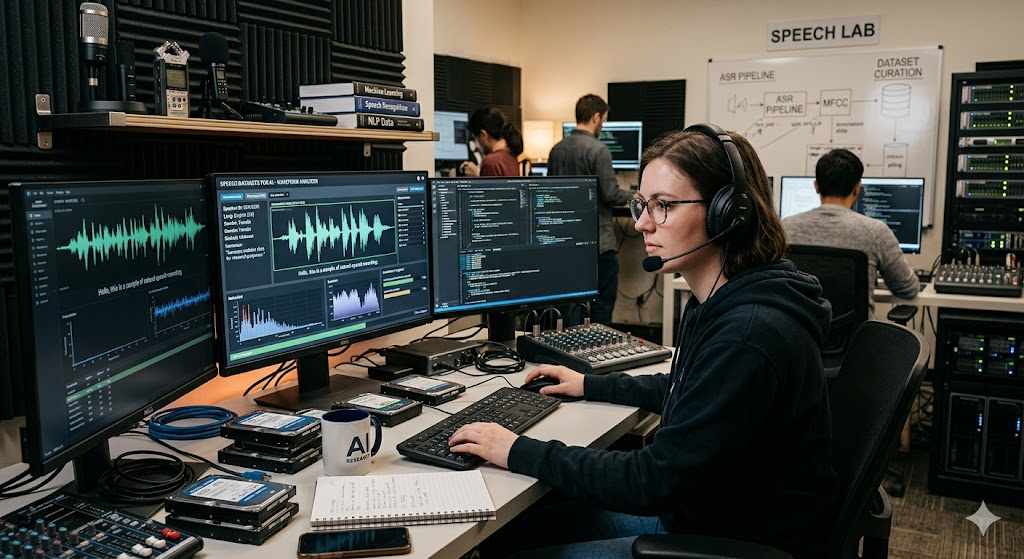
Collecting audio is the easier half of building a speech dataset. Getting reliable labels is harder.
For transcription tasks, annotation quality depends on the annotators — their native language, their familiarity with the domain, and whether they have enough time and context to do the job carefully. Medical speech is a useful example. A general annotator transcribing a cardiology consultation might get the words right but miss that a drug name was mispronounced in a clinically relevant way, or that two similar-sounding terms were confused. Domain-specific annotation requires domain-specific knowledge, and that knowledge is expensive to hire.
For subjective labels — emotion, intent, speaker affect — annotation gets harder. Emotion categories that feel natural in one culture don’t map cleanly onto another. Whether a speaker sounds “confident” or “nervous” is a judgment call that varies across annotators, and inter-annotator agreement on emotional speech labels is often lower than researchers report because disagreements tend to be resolved by majority vote rather than surfacing as genuine ambiguity in the published dataset.
The result is that many speech datasets carry latent disagreement baked into the labels. A model trained on those labels will learn whatever consensus the annotation process produced, including its errors and its cultural assumptions.
The consent and privacy question
Speech data has a specific sensitivity that image data mostly lacks: a voice is biometric. You can change your password. You can’t change your voice. A dataset containing your speech, even in aggregate, could be used to train speaker identification systems, voice cloning systems, or audio deepfake systems without your knowledge or consent.
Many early speech datasets were collected without meaningful consent from speakers. Recordings from phone calls, broadcast media, courtroom proceedings, and public events were used because they were technically available, not because the speakers agreed to their voices being used as training material. Some of those datasets are still in circulation.
This is starting to change. Common Voice collects voice clips from volunteers who explicitly consent to their recordings being used for AI training and to their release under open licenses. Several newer research datasets require opt-in consent, demographic information (for bias analysis), and the right to request removal.
The shift hasn’t caught up with the scale of existing data. Models trained on older datasets carry the provenance of those datasets — and that provenance often doesn’t include meaningful consent from the people whose voices are in them.
Noise, domain, and the deployment gap
One of the more predictable failures in speech AI is the gap between training conditions and deployment conditions.
Clean speech datasets are cheaper to annotate and easier to use in benchmarks. So training pipelines use a lot of clean speech, and models score well on clean speech benchmarks, and those benchmark numbers get cited in product claims. Then the product gets deployed on phone calls, in warehouses, in hospital rooms, in cars — and performance degrades in ways the benchmark didn’t predict.
The domain problem runs alongside the noise problem. A model trained on podcast interviews and audiobooks will struggle with technical jargon from a specific field, with the speech patterns of non-native speakers in a particular language pair, and with spontaneous conversational speech full of fillers and restarts that scripted recordings don’t have. Each deployment context is its own distribution, and training data that doesn’t cover that distribution produces a model that fails in that context.
The practical response is domain adaptation: fine-tuning a general model on data from the specific deployment context. That requires collecting labeled speech from that context, which loops back to the collection and annotation challenges above. There’s no shortcut that doesn’t involve getting the right data.
What distinguishes a good speech dataset from a large one
Size matters, but it’s not the thing that matters most.
A 10,000-hour dataset with consistent annotation, broad speaker diversity, documented provenance, and good metadata — recording conditions, speaker demographics, domain — is more valuable than a 100,000-hour dataset scraped from random internet audio with noisy auto-transcripts and no speaker information.
The metadata point is undersold. A dataset where you know something about each speaker — age range, regional background, native language — lets you diagnose model failures by population. A dataset where you know the recording conditions lets you understand why the model breaks on certain audio types. Without that information, you’re debugging blind.
The field has more large datasets than it has carefully documented ones. That balance is shifting as the costs of undocumented data become more visible — in biased models, in consent violations, in systems that fail predictably for specific user populations — but it’s shifting slowly.
Where the work is now
The speech AI community has largely solved the narrow problem of high-resource ASR for standard varieties of a handful of languages. The open problems are everywhere else.
Code-switching — speakers shifting between languages mid-sentence — is poorly represented in most datasets and genuinely hard to annotate. Spontaneous, disfluent speech from real conversations is underrepresented relative to read speech. Low-resource languages, pediatric and elderly speech, and speech with atypical patterns from conditions like dysarthria — all of these are areas where the training data is thin, and the models show it.
Those gaps aren’t academic. Accessibility tools for people with speech differences, translation systems for languages spoken by millions but ignored by AI research, transcription tools for healthcare settings — all of these depend on speech datasets that are either inadequate or do not yet exist.
The data is the constraint. It usually is.