Saris raises $28.8M Series A to bring agentic AI workflows to banks and credit unions
 Nickie Louise
Posted On May 28, 2026
Nickie Louise
Posted On May 28, 2026
Banks have spent years talking about digital transformation. Many still rely on employees to manually review documents, verify data, and move paperwork across disconnected systems. That bottleneck is now turning into a real business problem as financial institutions face rising pressure to process loans faster, reduce operational costs, and compete with fintech startups built around automation.
Saris wants to change that.
The AI startup, which builds agentic workflow software for banks and credit unions, announced Thursday it has raised $28.8 million in Series A funding led by 8VC. The round included participation from Audacious Ventures, Homebrew, Btech Consortium, and Service Ventures.
The fresh capital will help Saris scale its platform across more financial institutions, deepen integrations with banking software providers like Fiserv, Encompass, and MeridianLink, and expand the team responsible for training and deploying its AI agents.
The pitch from Saris is straightforward: banks are drowning in repetitive back-office work that slows lending, compliance reviews, and customer operations. Saris says its AI agents can take over large portions of that workload under human supervision, helping institutions process more work without adding staff.
“Financial institutions of every size are under pressure to modernize their operations, and most have been underserved by technology that wasn’t built for the complexity of today’s banking. Saris is changing that. Their platform delivers real, measurable results without disrupting the systems and teams institutions depend on,” said Alex Kolicich, founding partner of 8VC.
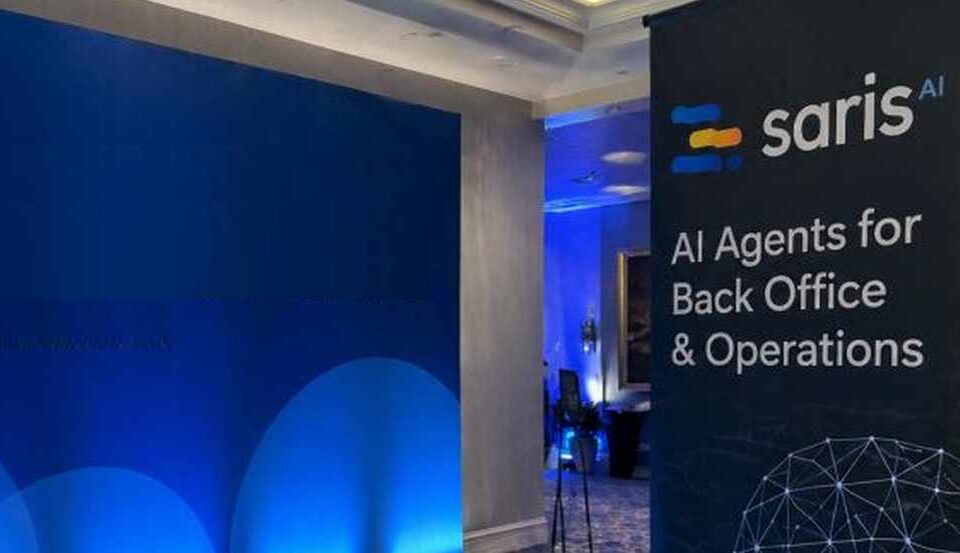
With $28.8M in funding, AI startup Saris wants to become the AI workflow layer for banks and credit unions
The timing reflects a broader shift taking place across the banking industry. Generative AI started as an experimental project inside many financial firms. Now banks are looking for systems that can automate actual workflows tied to lending, compliance, underwriting, and operations.
That shift has created a wave of startups selling “agentic AI” platforms, software built to complete multi-step tasks with minimal human input. Financial services firms have become one of the biggest targets for those products since banks still run on large amounts of manual processing and legacy software.
Saris says its platform can automate up to 70% of consumer, mortgage, and commercial lending tasks. The company claims institutions using its software have reduced operational costs by as much as 35% and more than doubled output without increasing headcount.
Community Bank CRO Matt Mayo said the appeal came down to measurable business results instead of AI hype.
“We needed an AI strategy with a clear ROI, something that can help us compete and grow using existing resources. Saris provided a single, end-to-end solution that streamlines workflows and integrates with our existing technology for easy adoption. The results have been incredible and appreciated by our teams. It’s clear that Saris built this solution with bankers in mind,” Mayo said.
Catalyst Corporate Credit Union CTO and SVP Diana Hennel pointed to another concern common inside banking: balancing automation with oversight.
“With Saris, we reduced manually intensive processes while improving accuracy and maintaining human oversight. Their strategy to focus on high-impact business cases and close collaboration with our team helped us deliver meaningful changes to our customers,” Hennel said.
Why banks are turning to agentic AI to handle back-office work
That human oversight piece matters. Banks remain heavily regulated, and many financial institutions are still cautious about fully autonomous AI systems making decisions without review. Saris appears to be positioning its software as an operational co-pilot rather than a replacement for banking staff.
“Our vision is a future where humans and AI work side by side in financial services,” said Danial Jameel, co-founder and CEO of Saris. “The best institutions won’t replace people; they’ll give people the leverage to do more with less strain and better serve customers and members as a result. Our platform already delivers measurable results, and this funding lets us bring that to more institutions, faster.”
The funding lands at a moment when Wall Street and Silicon Valley are both pouring money into AI systems built for enterprise operations. Much of the public conversation around AI has focused on chatbots and image generators. Behind the scenes, many investors believe the larger opportunity sits inside industries still dependent on repetitive manual work.
Banking may end up being one of the biggest proving grounds for that thesis.
Trending Now

Top Tech News Today, May 5, 2026