Amazon launches AI shopping tools for outside retailers as agentic commerce battle heats up
 Nickie Louise
Posted On May 27, 2026
Nickie Louise
Posted On May 27, 2026

Amazon is taking the AI shopping war beyond its own storefront. The retail giant announced on Wednesday a new AWS-powered service that lets retailers build their own AI shopping assistants using the same technology behind Alexa for Shopping, the company’s recently rebranded AI commerce agent.
The move signals Amazon’s latest attempt to turn internal infrastructure into a business line others depend on, much like it did with AWS nearly two decades ago.
Agentic Shopping Assistant
The company said retailers can use the new “AWS Agentic Shopping Assistant” to launch AI-powered shopping experiences tied to their own storefronts, product catalogs, customer data, and branding in “as little as 60 days.” Amazon described the offering as a package of “architecture, starter code and learnings” pulled directly from Alexa for Shopping.
“Today, AWS announces a new AI retail solution based on Alexa for Shopping that for the first time enables retailers outside Amazon to tap into the technology and learnings directly,” Amazon wrote in a blog post.
The launch comes just weeks after Amazon merged Rufus and Alexa+ into a single shopping-focused assistant called Alexa for Shopping. The assistant now sits directly inside Amazon’s search experience and can answer product questions, compare items, track prices, reorder essentials, and even shop across other websites.
Amazon says more than 300 million customers used Rufus in 2025 to research and buy products, giving the company a massive real-world testing ground before commercializing the technology for outside retailers.
The company’s first public customer is Kate Spade, owned by Tapestry, which used the technology to build a gifting assistant. Amazon said more retailers are already testing the service.
The broader fight unfolding behind the scenes is much bigger than shopping chatbots.
Major AI companies are racing to become the interface consumers use to discover and buy products online. OpenAI has been experimenting with shopping inside ChatGPT. Google is pushing deeper into “agentic commerce” through Gemini and AI-powered search. Perplexity has been building shopping and product discovery tools into its platform. Retailers including Walmart, Target, Etsy, Gap, and eBay are experimenting with their own AI shopping systems while partnering with external AI providers.
Amazon’s pitch to retailers is centered on control.
In its announcement, the company argued that retailers should own the AI shopping experience themselves rather than hand over customer relationships to external AI platforms or intermediaries. Amazon said retailers already possess “deep vertical knowledge” about their products and customers that general-purpose AI systems lack.
That message lands at a sensitive moment for the retail industry.
Amazon wants retailers to own the AI shopping experience
AI shopping assistants are becoming more capable of researching products, comparing prices, filling carts, and eventually completing purchases without human input. Tech companies see a huge opportunity if consumers begin relying on AI agents instead of traditional search engines or retailer websites. Accenture estimates more than $3 trillion in commerce could eventually flow through AI agents by 2030.
The bigger question is whether consumers are ready to let bots handle purchases on their behalf.
Early AI commerce tools have produced mixed results. Some systems still struggle with hallucinated product information, inconsistent recommendations, and trust issues around payments and automated checkout. Even OpenAI reportedly faced friction with retailer onboarding during earlier shopping experiments.
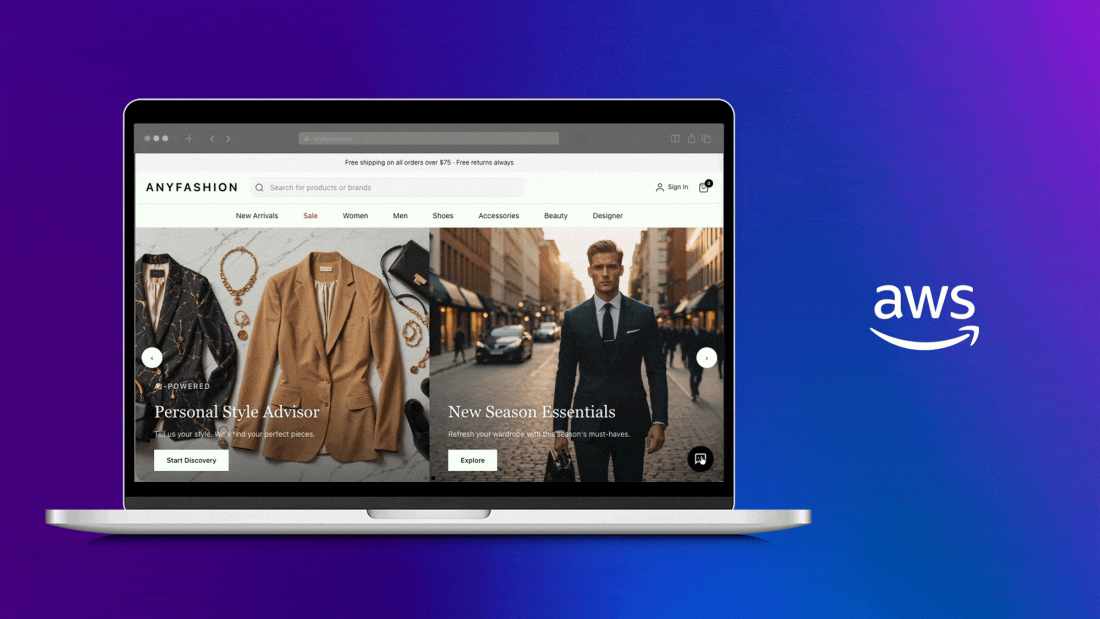
Image Credit: Amazon
Amazon appears to be betting that retailers will trust AWS more than they trust outside AI platforms controlling the entire customer experience.
That distinction may matter.
Retailers have spent years worrying that Amazon would use marketplace data to compete against them. By routing the new service through AWS rather than Amazon’s retail arm, the company is trying to position itself as an infrastructure provider rather than a middleman.
The strategy echoes Amazon’s broader history. What started as internal cloud infrastructure became AWS. Internal logistics systems evolved into fulfillment and supply chain services sold to businesses. Cashierless checkout technology turned into Amazon One and Just Walk Out.
Now Amazon wants to export its AI shopping stack to the rest of retail.