OpenRouter raises $113M as AI token usage surges to 100 trillion monthly
 Nickie Louise
Posted On May 26, 2026
Nickie Louise
Posted On May 26, 2026

The AI industry spent the past two years obsessing over bigger models. Now the attention is shifting to something else: what happens after companies start using all of them at once.
OpenRouter, the AI model exchange that sits between applications and major AI providers, announced Tuesday it has raised a $113 million Series B led by CapitalG, Alphabet’s independent growth fund. The round included participation from NVentures, NVIDIA’s venture arm, alongside ServiceNow Ventures, MongoDB Ventures, Snowflake Ventures, Databricks Ventures, Andreessen Horowitz, and Menlo Ventures.
The funding comes as demand for AI inference infrastructure is exploding across enterprises deploying agents and multi-model systems into production. OpenRouter said its traffic has climbed to 25 trillion tokens per week, or roughly 100 trillion tokens per month, marking a 5x increase from six months ago.
Just a year ago, OpenRouter raised $40 million in Seed and Series A funding as developers struggled to keep pace with the explosion of new AI models. Andreessen Horowitz and Menlo Ventures led that investment, with participation from Sequoia and several prominent angel investors.
That growth offers a glimpse into a larger shift unfolding across the AI market. Companies are no longer betting on a single foundation model. Instead, many are routing workloads across OpenAI, Anthropic, Google, xAI, DeepSeek, and other providers depending on pricing, speed, reliability, and task performance.
With $113M funding from CapitalG and Nvidia, OpenRouter wants to become the control layer for enterprise AI
OpenRouter wants to become the control layer sitting in the middle of that chaos.
The startup provides developers and enterprises with access to more than 400 AI models via a single API. Its system routes requests across providers, manages failover, tracks usage, and helps companies reduce vendor lock-in. The platform says it now serves more than 8 million users globally, ranging from AI-native startups to large enterprises.
The scale of token consumption inside enterprises has become staggering. A 2026 Deloitte study, cited by the company, found that 67% of enterprises already consume more than 1 billion tokens per month. As AI agents spread across software, customer support, coding, research, and operations, inference traffic is becoming one of the fastest-growing layers in enterprise computing.
“Running inference at scale is fundamentally a multi-model problem. The era of picking a single model is over,” said Alex Atallah, CEO and co-founder of OpenRouter. “Success now depends on continuously routing across a changing market. Because OpenRouter sits in the flow of production traffic, we can optimize every request for cost, performance, and reliability in real time.”
Investors backing the company see parallels with earlier infrastructure shifts that produced massive platform businesses.
“Every platform shift creates infrastructure gaps: from Cloudflare with the internet and Stripe with digital payments, to Databricks with data and AI. These infrastructure gaps create opportunities for generational businesses to solve real customer needs. OpenRouter is solving the infrastructure gap for inference in the AI era,” said Mo Jomaa, partner at CapitalG.
CapitalG partner Jane Alexander framed OpenRouter as a potential intelligence layer atop the fragmented AI ecosystem.
“As companies shift toward a multi-model paradigm, OpenRouter enables them to seamlessly leverage the right model for every task,” Alexander said. “OpenRouter is uniquely positioned to become the data clearinghouse and unified intelligence layer for AI models.”
OpenRouter’s public rankings and usage data have quietly become influential across the AI industry. Investors, researchers, developers, and media outlets increasingly use the platform’s traffic and adoption metrics to track which models are gaining momentum, how pricing is changing, and where enterprise demand is moving.
The company plans to use the new funding to expand its routing, governance, and optimization systems as enterprise AI deployments grow larger and more difficult to manage.
Founded in 2023, OpenRouter sits at the center of one of AI’s biggest transitions. The market is moving away from the idea of a single dominant model and toward a future where enterprises constantly switch between providers in search of lower costs, faster responses, and better performance.
That shift is creating a new category of infrastructure companies built to manage the growing mess underneath the AI boom.
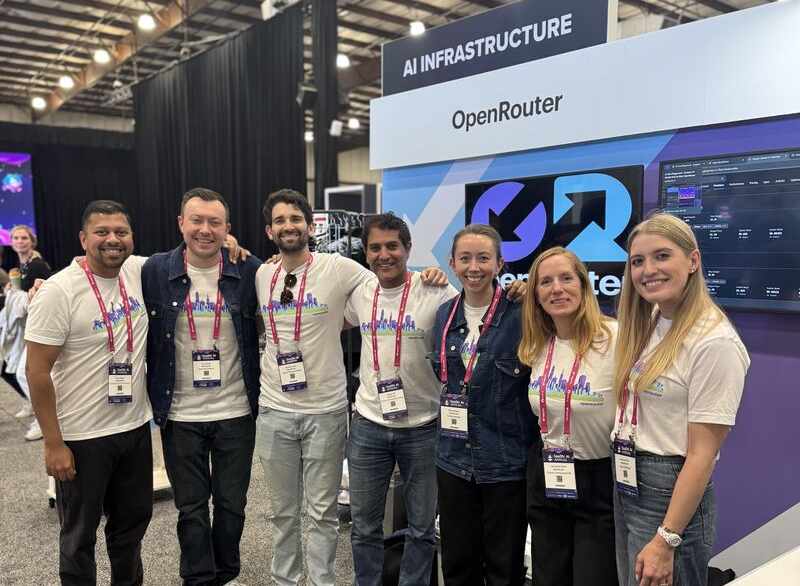
OpenRouter Team