Mistral AI acquires Emmi AI to expand industrial AI push across Europe
 Nickie Louise
Posted On May 19, 2026
Nickie Louise
Posted On May 19, 2026
Europe’s race to build its own AI champions is moving deeper into factories, robotics, and semiconductor production.
French startup Mistral AI said Tuesday it has acquired Austrian startup Emmi AI for an undisclosed amount, giving the company new technology focused on physics-based industrial AI models used in manufacturing, engineering, and automation.
The deal signals where the next AI battle may be heading.
For the past two years, much of the AI industry has centered on chatbots, image generation, and general-purpose assistants. Mistral is betting that Europe’s manufacturing sector could become one of the biggest long-term opportunities for artificial intelligence, especially in industries where downtime can cost millions of dollars.
“European AI leader Mistral AI is acquiring Emmi AI in one of Europe’s most important and strategic AI acquisitions to date,” Emmi AI said on its website.
Founded in Linz, Austria, Emmi AI develops AI systems capable of modeling physical processes such as airflow, heat transfer, and material stress. The startup raised €15 million in 2025, reported as Austria’s largest funding round that year.
The acquisition comes less than two months after Mistral AI raised $830 million to build and scale Nvidia-powered AI data centers across Europe.
Mistral is betting Europe can win the industrial AI race with acquisition of physics AI startup Emmi AI
Mistral said the acquisition strengthens its industrial AI strategy across Europe, where governments and manufacturers are pushing to reduce dependence on American and Chinese technology providers. Last year, the European Commission identified manufacturing as one of the bloc’s AI-critical sectors as part of its broader re-industrialization plans.
The company already works with major European industrial players including ASML, Stellantis, Veolia, and defense-focused drone startup Helsing.
Mistral says its approach differs from large general AI systems trained on massive public internet datasets. Instead, the company builds specialized models trained on a customer’s own operational data. In industrial settings, that could include machine telemetry, factory sensor data, inspection records, or robotics workflows.
The company described scenarios in which multiple AI systems work together in a production environment. One model could inspect products for defects using computer vision. Another could control robotic systems. A separate model could process logistics data or production schedules.
Adding Emmi AI’s technology enables those systems to simulate and interact with physical environments with greater precision, according to Mistral.
One example comes from ASML, the Dutch semiconductor equipment giant whose lithography machines are used to manufacture advanced chips. Mistral said AI vision systems deployed on ASML EUV machines can detect engraving defects and reduce diagnostic times from several hours to about 8 minutes, cutting waste associated with expensive silicon wafers.
“You just save 10 hours of downtime on very expensive equipment,” ASML CFO Roger Dassen told shareholders during the company’s April annual meeting, according to a Reuters report.
The acquisition adds another chapter to Mistral’s rise from startup newcomer to one of Europe’s most closely watched AI companies.
Founded in 2023 by CEO Arthur Mensch alongside Guillaume Lample and Timothée Lacroix, the Paris-based company quickly became a symbol of Europe’s attempt to build homegrown AI infrastructure capable of competing with American tech giants.
French President Emmanuel Macron publicly praised the startup earlier this year as an example of European innovation challenging U.S. dominance in artificial intelligence.
Mistral has gained attention for releasing several open-weight AI models alongside commercial API products, including its flagship Mistral Large model and its AI assistant Le Chat. The company employs fewer than 100 people, with much of the team focused on research and product development.
CEO Arthur Mensch said the Emmi acquisition should strengthen Mistral’s position across aerospace, automotive, semiconductor, and industrial manufacturing sectors.
The move arrives as industrial AI starts drawing more investor attention across Europe. Manufacturers are searching for ways to reduce waste, shorten production delays, improve inspection systems, and offset labor shortages without rebuilding entire production lines.
For Europe, the push carries larger stakes than software alone.
The region still holds deep expertise in automotive engineering, aerospace manufacturing, industrial machinery, and semiconductor equipment. Mistral appears to be betting that combining that industrial base with AI could give Europe an opening in a market where it has struggled to keep pace with Silicon Valley.
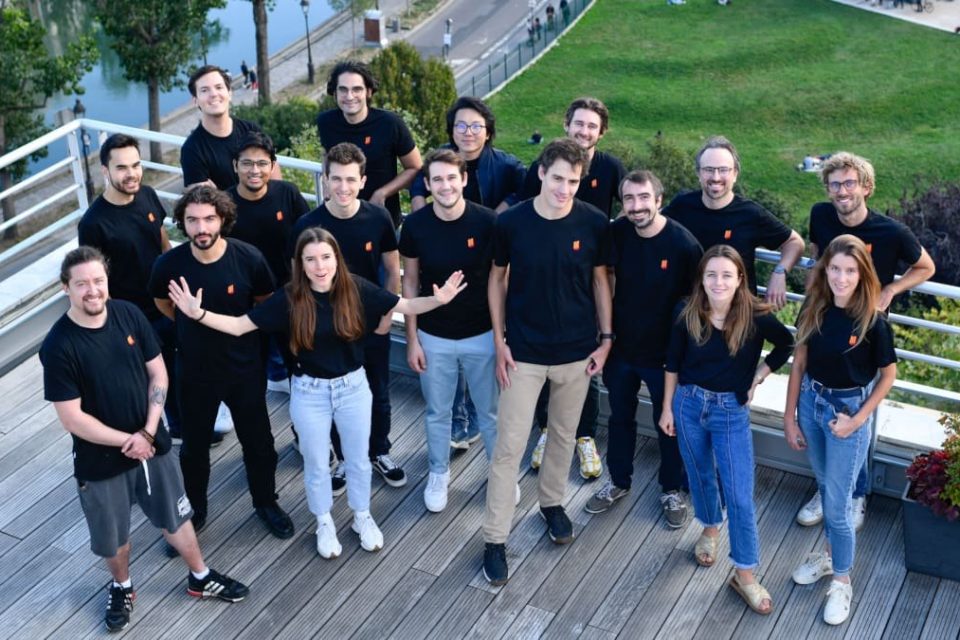
Mistral AI Team