Armada raises $230M at $2B valuation to build modular AI data centers for military and energy sectors
 Daniel Levi
Posted On May 19, 2026
Daniel Levi
Posted On May 19, 2026
Artificial intelligence has created a new race for computing infrastructure, and a startup called Armada wants to bring AI processing far beyond traditional data centers.
The San Francisco startup announced Tuesday that it has raised $230 million in Series B funding at a $2 billion valuation to scale its modular AI data centers, which are already being deployed across military operations, oil fields, mining sites, and remote industrial locations where traditional cloud infrastructure often falls short.
The funding round was co-led by Overmatch, 8090 Industries, and BlackRock, which joined as a new investor. New strategic backers included Johnson Controls, NightDragon, Mitsui, and Singtel Innov8. Existing investors, including Founders Fund, Lux Capital, Felicis, Marlinspike, Shield Capital, Veriten, and Gladebrook, participated in the oversubscribed round.
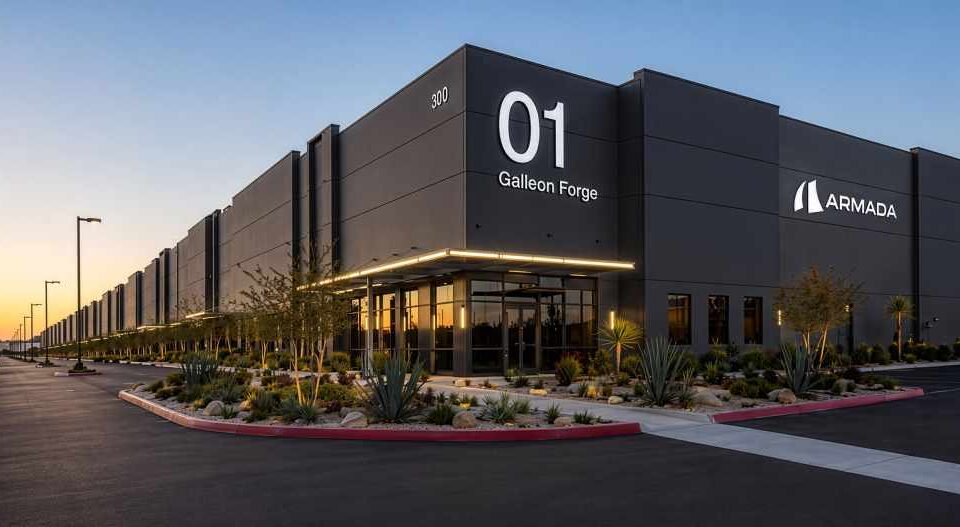
The investment comes alongside a manufacturing partnership with Johnson Controls to build Armada’s modular data centers at a new 400,000-square-foot factory in Arizona, Galleon Forge One. The facility is expected to create more than 500 jobs and begin producing Armada’s Leviathan megawatt-scale data centers this summer.
With $230M in funding, AI infrastructure startup Armada aims to build deploy-anywhere modular data centers
Armada’s rise comes as governments and enterprises search for faster ways to deploy AI systems outside large urban data hubs. Building a conventional hyperscale data center can take years and require massive amounts of land, water, and electricity. Armada is pitching something very different: portable AI infrastructure that can connect directly to existing energy sources and begin operating within days.
Its systems can run on solar installations, natural gas flares from oil wells, and other localized energy sources. The company says this setup allows AI workloads to run directly on-site, rather than sending large amounts of data back and forth to centralized cloud servers.
That pitch is gaining traction in sectors where internet connectivity, security, and speed matter more than polished office campuses or giant server farms.
Armada said bookings jumped 540% between fiscal 2025 and fiscal 2026. The company added that the first quarter of FY27 alone recorded a 2,000% year-over-year increase.
“The AI race will not be won by one-off projects,” said Dan Wright, Co-Founder and CEO of Armada. “It will be won by the companies and countries that can manufacture, deploy, and continuously improve AI infrastructure, with speed, scale, and sovereignty. At Galleon Forge One, we will do what America does best: build the industrial base to win.”
Wright has increasingly framed Armada’s mission around America’s competition with China for AI leadership. That framing has resonated with defense and government agencies seeking domestic AI infrastructure capable of operating in remote or contested environments.
Armada’s customer list already reflects that focus.
The U.S. Navy used Armada’s systems during the UNITAS naval exercise with military partners across the Americas. Rear Admiral Carlos Sardiello said modular data centers and edge computing help naval operations function more effectively at sea, CNBC reported.
The company is working with the U.S. Department of Energy on the Genesis Mission, an initiative connecting national laboratories, supercomputers, and research datasets into a shared AI platform.
Outside the United States, Armada has projects in Australia with WinDC to deploy portable AI factories and partnerships in Norway’s oil and gas sector with Aker BP.
“Johnson Controls is working with Armada to rapidly deliver secure modular data centers at scale,” said Joakim Weidemanis, Johnson Controls CEO, in a statement. “Johnson Controls’ differentiated technology, U.S.-based manufacturing strength and Armada’s edge computing expertise will deliver the thermal-critical environments that perform predictably, deploy quickly, and scale with confidence.”
The startup is part of a broader shift happening across the AI industry. For years, most AI infrastructure discussions centered on giant data centers operated by companies like Microsoft, Amazon, and Google.
Now a growing number of startups are betting that AI computing will move closer to where data is generated, especially in military operations, factories, energy facilities, and remote industrial environments where latency, security, and connectivity can become major problems.
Armada is betting that the next phase of AI infrastructure may not live only inside giant server campuses. It may arrive in portable units shipped directly to the edge of the network.

Armada co-founders Dan Wright (L) and John Runyan (R) (Credit: Armada)
Trending Now

Top Tech News Today, May 5, 2026