Quantum Motion raises $160M to build cheaper quantum computers using silicon chips
 Daniel Levi
Posted On May 7, 2026
Daniel Levi
Posted On May 7, 2026
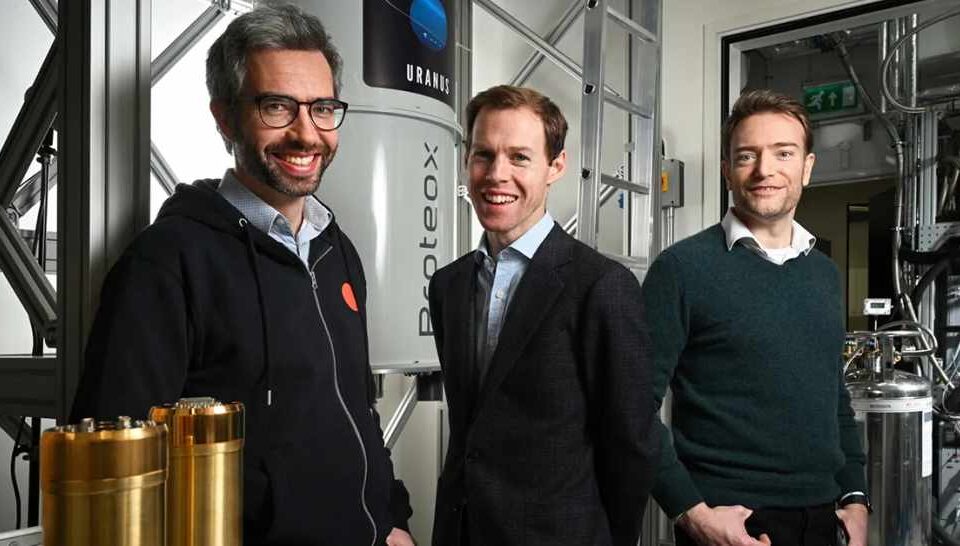
Most quantum computing companies rely on exotic, expensive, and difficult-to-scale hardware approaches, including superconducting systems used by IBM and Google, trapped ions, neutral atoms, lasers, and ultra-cold environments.
Quantum Motion is taking a very different path.
The London-based quantum startup wants to build quantum computers using the same silicon manufacturing techniques already used to produce billions of chips for phones, laptops, and data centers. Investors are betting that the approach could make quantum computing smaller, cheaper, and far easier to scale than many of today’s experimental systems.
On Thursday, Quantum Motion said it raised $160 million in fresh funding to advance that vision.
“Today’s announcement reflects the strength of the team we have built and the progress they have delivered. Quantum computing will only achieve its full potential if it can be built on a platform that scales, and we believe silicon is the strongest route to achieving that,” said Dr. James Palles-Dimmock, CEO of Quantum Motion. “We are pleased to be joined by investors who share our vision and understand what it takes to build a foundational company in this field.”
Why Quantum Motion believes silicon can solve quantum computing’s scaling problem
Quantum computers have long promised to solve problems beyond the reach of classical machines. At the center of that promise is the qubit, the quantum equivalent of a transistor.
Traditional computer transistors can only represent a zero or a one at any moment. Qubits behave differently. They can represent multiple states simultaneously, giving quantum systems the potential to perform certain calculations far more efficiently.
The challenge has never been proving that quantum computing works in theory. The harder part is building systems with enough stable qubits to become commercially useful.
Quantum Motion’s answer starts with something the semiconductor industry already knows how to manufacture at a massive scale: silicon transistors.
“We just kind of started the company in reverse,” said James Palles-Dimmock, Quantum Motion’s CEO. “What are the minimum adaptations that we can make to transistors to turn them into high-quality qubits?”
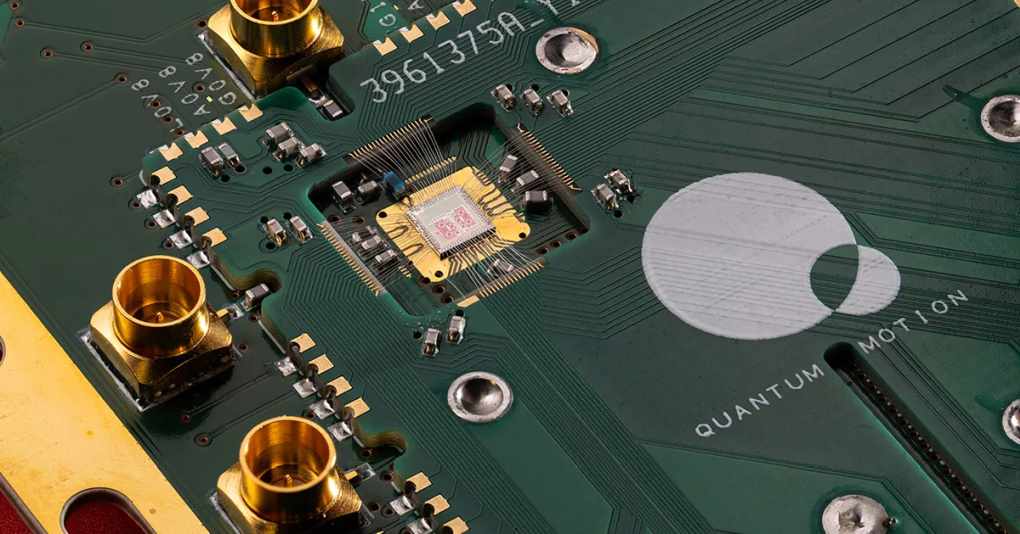
Quantum Motion (Credit: Quantum Motion)
In a conventional chip, a transistor switches on or off to control the flow of electrons. Quantum Motion suspends a single electron inside the transistor gap and manipulates it with magnetic fields. The company uses the electron’s spin state as the qubit.
The concept itself is not entirely new. Intel and several other quantum startups have explored electron-spin qubits for years. The difficulty lies in making them stable and manufacturable at scale.
Quantum Motion believes its partnership with semiconductor manufacturer GlobalFoundries provides a practical path to production, leveraging existing chip fabrication infrastructure rather than entirely custom-built quantum hardware systems.
Quantum Motion co-founders Dr. John Morton (CTO) and Dr. Simon Benjamin (CSO) said “As founders we were inspired by the breathtaking accomplishments of silicon technology, with city-like complexity delivered on centimetre scale chips. Now, Quantum Motion’s chips can be used not only for bits but also for qubits, unlocking a future in which quantum computers are both fast and ubiquitous.”
With $160M in funding, quantum startup Quantum Motion wants to shrink the cost and size of quantum computers
Since its last funding round in 2023, Quantum Motion has expanded internationally with new offices and labs in Spain and Australia. The company has also deepened its manufacturing partnership with GlobalFoundries, linking its roadmap directly to commercial semiconductor supply chains.
At a time when much of the quantum industry competes on headline qubit counts and lab demonstrations, Quantum Motion has focused heavily on manufacturability and industrial scale. In 2025, the company said it delivered the world’s first commercial deployment of a full-stack silicon CMOS quantum computer at the UK National Quantum Computing Center. Quantum Motion has also advanced to Stage B of DARPA’s Quantum Benchmarking Initiative.
Palles-Dimmock said the company believes it could eventually build useful quantum computers for between $10 million and $20 million, a fraction of the cost associated with many current quantum systems.
“We’ve got a very clear path to delivering the world’s most powerful computer at a reasonable cost,” he said.
The funding round was co-led by DCVC and Kembara, with participation from British Business Bank and Firgun. Existing investors, including Oxford Science Enterprises, Inkef, Bosch Ventures, Porsche Automobil Holding, and Parkwalk Advisors, joined the round.
Quantum computing remains one of the most technically difficult areas in tech. Many companies have demonstrated progress in laboratories, though few have shown a clear path to systems that can operate reliably at scale and at commercially realistic costs.
Quantum Motion is betting that the future of quantum computing may look less like a physics experiment and more like the semiconductor industry, which already manufactures billions of chips every year.