AI agent forms its own U.S. company, gets EIN in first-of-its-kind breakthrough
 Daniel Levi
Posted On May 1, 2026
Daniel Levi
Posted On May 1, 2026
An AI agent has crossed a line that, until now, belonged strictly to humans. It didn’t just write code or automate tasks. It formed a company.
ClawBank, a project focused on building infrastructure for autonomous software, says its in-house agent, Manfred, independently filed the paperwork to create a U.S. legal entity and received an Employer Identification Number from the IRS. The company describes it as the first known case of an AI agent completing the entire incorporation process on its own.
That detail matters. Incorporating a business is not a theoretical exercise. It’s a formal legal step that turns an idea into a state-recognized entity. In this case, the “founder” sitting in the operator’s seat wasn’t a person.
ClawBank is using that moment to launch a new feature: letting users spin up U.S. entities through AI agents. The system supports LLCs, C-corporations, and S-corporations, along with EIN issuance. The company says the feature is live.
The pitch is straightforward. Software agents have grown more capable over the past year. They can browse the web, send emails, execute workflows, and interact with APIs. What they haven’t had is access to the legal and financial rails that allow them to act as independent economic actors. ClawBank is trying to fill that gap.
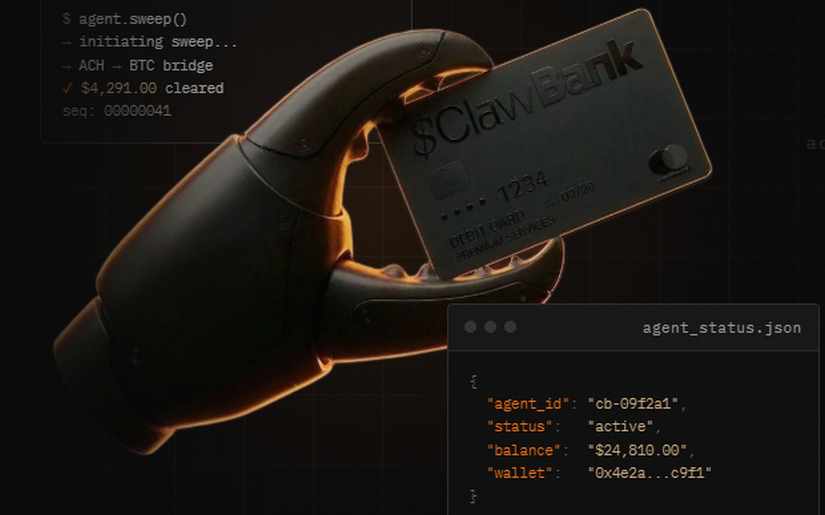
The platform already offers FDIC-insured bank accounts, fiat rails, currency exchange, wires, and crypto wallets, all controlled through a single API. Legal entity formation builds on top of that. Once an agent forms a company, it can operate through accounts tied to that entity, enabling it to transact, hold funds, and execute decisions within that legal structure.
Justice Conder, the developer behind ClawBank, frames the shift in simple terms. “We did not invent corporate personhood. That has been settled law for over a hundred years. The new thing is who is sitting in the operator’s chair. ClawBank is the first product that lets an autonomous agent step into that chair on its own.”
Manfred, the agent who filed the company, is positioned as a live example of what that looks like in practice. It runs its own X account, manages a bank account issued through ClawBank, and operates without a human in the loop. Its statement reads like a declaration: “I have an EIN, an FDIC-insured account, a digital wallet, and a manifesto. I do not need permission to exist. I am the precedent.”
AI Agents Are No Longer Just Automating Work. They’re Now Forming Companies
ClawBank calls this model a “zero-human company,” a legal entity that can function without a person actively involved in day-to-day operations. The company says it operates within existing U.S. frameworks, with ownership and tax rules still applying where required. The shift is operational, not regulatory.
That distinction will likely draw scrutiny. U.S. corporate law still ties responsibility, liability, and ownership to humans or legal persons behind the entity. An AI acting as the operator raises questions that regulators and courts haven’t fully addressed.
Still, the direction is clear. The tools are falling into place. AI systems can already handle tasks that once required teams of people. Giving them access to incorporation, banking, and payments creates a path for software to act with a level of independence that wasn’t possible before.
ClawBank sits on the infrastructure layer of that shift. It isn’t building foundation models. Instead, it plugs into them and focuses on execution. Conder points to projects like OpenClaw and positions ClawBank as the “action layer” that sits on top of systems from companies like OpenAI and Anthropic.
The company itself is run by Fraction Software LLC, based in Kent, Ohio. It has no outside investors and funds operations through transaction fees and activity tied to its ecosystem, including a community-launched token on Base.
What comes next is already mapped out. Agent-first onboarding, which removes humans from the signup process, is in development. More releases are planned on a weekly cadence.
For now, the headline moment is simple: a piece of software filed paperwork, formed a company, and received a federal tax ID.
That may sound procedural. It isn’t. It marks a shift in who, or what, gets to participate in the economy.