OpenAI is reportedly developing AI phone to compete with Apple’s iPhone
 Daniel Levi
Posted On April 28, 2026
Daniel Levi
Posted On April 28, 2026
OpenAI may be preparing its boldest move yet into consumer hardware. A new report from analyst Ming-Chi Kuo, first spotted by 9to5Mac, points to a smartphone in development, with mass production targeted for 2028. If that timeline holds, OpenAI would be stepping directly into the same arena dominated by Apple and its iPhone.
Kuo’s latest supply chain checks suggest OpenAI is already laying the groundwork. The company is working with MediaTek and Qualcomm on processor development, with Luxshare serving as the exclusive system co-design and manufacturing partner. Key specifications and suppliers are expected to be finalized by late 2026 or early 2027.
In a post on X, Ming-Chi Kuo said:
“OpenAI is working with MediaTek and Qualcomm to develop smartphone processors, with Luxshare as the exclusive system co-design and manufacturing partner. Mass production is expected in 2028…Specifications and suppliers are expected to be finalized by late 2026 or 1Q27.
— 郭明錤|Ming-Chi Kuo (@mingchikuo) April 27, 2026
If accurate, the report puts OpenAI on a collision course with Apple, whose iPhone still defines the modern smartphone experience nearly two decades after its debut.
What makes this effort stand out is OpenAI’s approach to the smartphone itself. Kuo frames it as a shift away from app-driven interaction. “Users are not trying to use a pile of apps. They are trying to get tasks done and fulfill needs through the phone.” That shift puts AI agents at the center of the experience, turning the phone into something that acts on behalf of the user rather than waiting for input.
That idea helps explain why OpenAI would build its own device in the first place. According to Kuo, full control over both hardware and operating system is key to delivering a complete AI agent experience. The smartphone remains the one device that constantly captures a user’s real-time context, which is critical for AI systems that rely on continuous input. And despite years of disruption across the tech industry, smartphones still ship in the hundreds of millions each year, making them the most important consumer computing platform.
Is OpenAI Building an Agentic Phone Instead of Another App-Driven Device?
The architecture behind such a device would split responsibilities between local and cloud-based AI. On-device systems would handle real-time awareness, lightweight models, and efficiency challenges such as power consumption and memory usage. Heavier workloads would be pushed to the cloud, creating a tightly integrated system that blends local responsiveness with large-scale compute.
OpenAI enters this space with a few advantages. Its consumer brand is already widely recognized, its models remain among the most capable, and it has years of user interaction data to build on. Hardware itself is no longer the barrier it once was. The modern smartphone supply chain is mature, and companies like OpenAI can tap into existing manufacturing ecosystems rather than build from scratch. On the business side, the company could bundle subscriptions directly with hardware and build a developer ecosystem around AI agents.
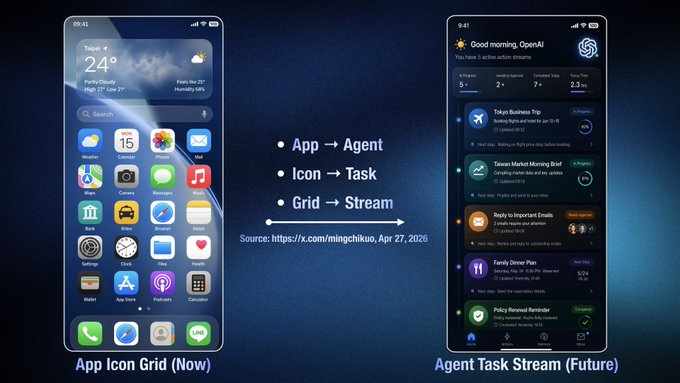
Is OpenAI Building an Agentic Phone? (Credit: Ming-Chi Kuo)
For chipmakers, the upside could be significant. MediaTek’s and Qualcomm’s roles in co-developing processors position them to benefit from any long-term upgrade cycle tied to AI-driven devices. Kuo points to the high-end smartphone segment, which ships roughly 300 to 400 million units annually, as an initial target. Even modest adoption within that tier could create meaningful demand for new silicon.
The manufacturing angle carries its own implications. Luxshare’s involvement gives it an early foothold in what could become a new generation of devices. The company has long competed in Apple’s supply chain, where Foxconn—also known as Hon Hai—holds a dominant position. Breaking that hierarchy has proven difficult. This project offers Luxshare a rare opportunity to gain ground in a new category before it fully takes shape.
The bigger question is whether OpenAI can reshape how people think about smartphones. Others in the industry see AI as an upgrade to existing devices, not a replacement. Aravind Srinivas recently argued that “the iPhone is actually not getting disrupted by AI at all,” suggesting that better AI simply makes today’s phones more valuable.
OpenAI appears to be betting on something different. If AI agents become the primary interface, the phone itself starts to feel less like a collection of apps and more like a system that understands intent. That’s a subtle shift on paper. In practice, it could redraw the line between software and hardware in the most important device people carry every day.