Sony AI’s ‘Ace’ robot beats elite table tennis players in real matches, signaling a leap in physical AI
 Daniel Levi
Posted On April 23, 2026
Daniel Levi
Posted On April 23, 2026
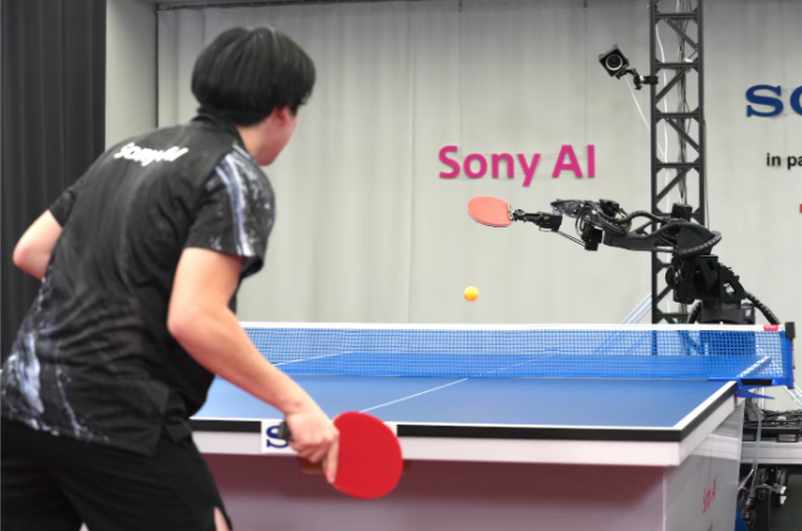
Sony just put a robot across the table—and it didn’t blink. In a series of live matchups that feel closer to science fiction than a lab demo, Sony AI’s table tennis robot, Ace, has beaten elite human players under official International Table Tennis Federation rules.
The results point to something bigger than a sports headline: machines are getting better at reacting, deciding, and acting in the real world at speeds humans can’t match.
The project, detailed in a new paper published in Nature, shows a robot stepping into one of the toughest tests in robotics. Table tennis looks simple until you try to build a machine that can keep up. The ball moves fast, spins hard, and gives you milliseconds to respond. It’s a stress test for perception, timing, and control all at once.
Sony didn’t start from scratch. The work builds on earlier breakthroughs such as GT Sophy, a racing AI agent that mastered high-speed strategy in the virtual environment of Gran Turismo. That system proved reinforcement learning could handle split-second decisions, long-term planning, and even racing etiquette against top human drivers.
Ace takes that same learning philosophy and pushes it into the physical world. Instead of simulated tracks, it deals with real spin, real motion, and real uncertainty—tracking the ball in flight, predicting its path, and responding in milliseconds.
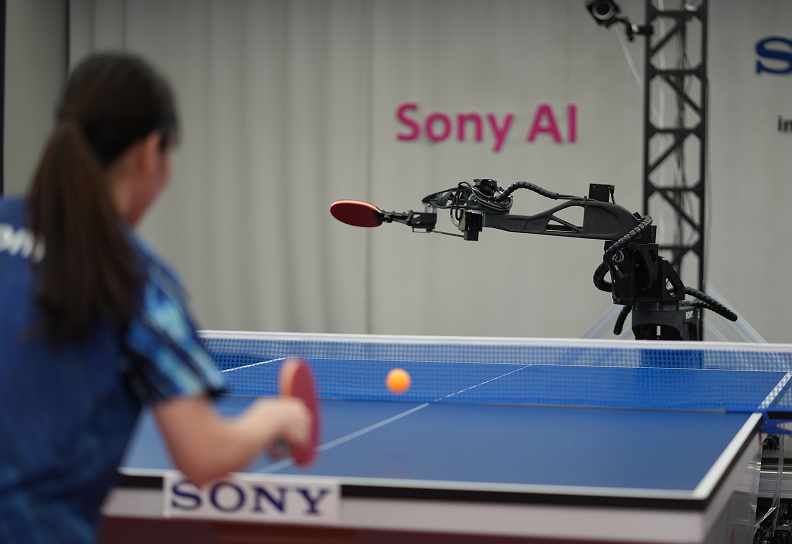
Courtesy: Sony AI
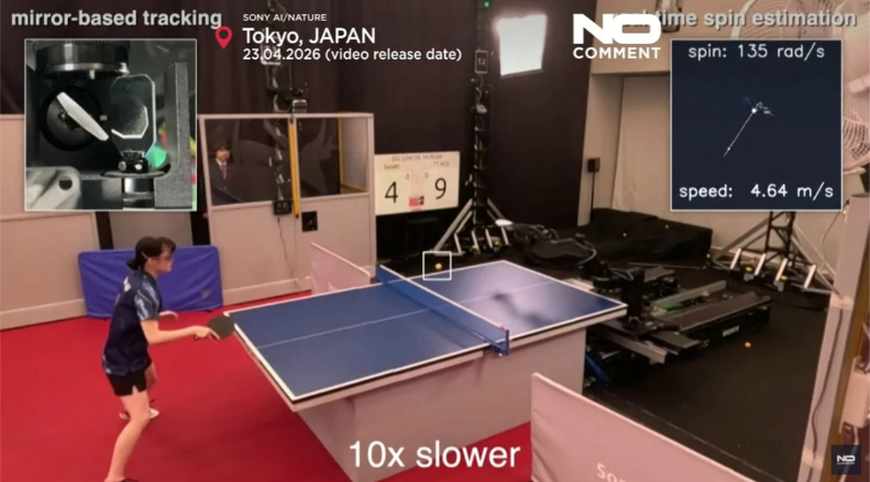
Sony’s answer is an autonomous robotic arm mounted on a mobile base. It tracks the ball with multiple cameras, reads spin in flight, and fires back shots with precision that doesn’t fade. During testing in Tokyo, Ace faced five elite amateur players—each with years of high-level training. It won three of the five matches and took seven of the 13 games played. It even delivered 16 unreturnable serves.
The next step was tougher. Ace played two professionals from Japan’s league circuit, including Minami Ando and Kakeru Sone. Early on, it lost those matches. It still managed to take a game and stayed in rallies that would push most humans. After further tuning, the system came back stronger. By late 2025 and early 2026, Ace was beating professional players, including Miyuu Kihara, ranked among the world’s top players.
What stands out isn’t raw force. It’s consistency. Ace returns high-speed shots—up to 14 meters per second—with heavy spin, achieving a success rate above 75 percent. Rallies stretch longer than typical human exchanges. Where players look for power-based openings, the robot keeps placing the ball over and over until the point breaks.
AI Meets the Real World: Sony’s ‘Ace’ Robot Defeats Elite Table Tennis Players
Under the hood, the system blends vision and learning in a way that shows how far robotics has come. Ace doesn’t follow a fixed script. It learns, adjusts, and reacts on the fly. As Sony explains, “By using a novel control algorithm based on reinforcement learning, Ace can adapt to the unpredictable physical dynamics of a live rally, continually updating its strike trajectory and strategy based on the ball’s observed flight and spin.”
Nine high-resolution cameras map the ball in 3D at 200 frames per second. Event-based sensors track spin that can exceed 9,000 revolutions per minute. Reaction time sits around 20 milliseconds, far quicker than human reflexes.
The training story matters just as much. Ace learned through reinforcement learning, running through thousands of hours in simulation before stepping into the real world. There are no hand-coded playbooks. The robot figures out what works through trial and error, then transfers that knowledge to live play.
One moment captured the shift. Kinjiro Nakamura, a former Olympian, watched Ace intercept a ball early and send back a sharp backspin. “No one else would have been able to do that,” he said. “I didn’t think it was possible. But the fact that it was possible… means that there is a possibility that a human could do it too.”
That line captures the tension here. Ace isn’t just copying human play. It’s exploring moves that stretch what players think is possible.
Inside Sony AI, the team sees this as a stepping stone. Table tennis forces a system to read motion, predict outcomes, and act with precision in a shared space with humans. The same capabilities can carry into factories, healthcare settings, and service environments where timing and safety matter.
Project lead Peter Dürr, director of Sony AI Zurich, put it plainly: “There’s no way to program a robot by hand to play table tennis. You have to learn how to play from experience.”
“Speed is really one of the fundamental issues in robotics today, especially in scenarios or environments that are not fixed,” said Michael Spranger, president of Sony AI, in an interview.
“We see a lot of robots that are in factories that are very, very fast,” Spranger said. “But they’re doing the same trajectory over and over again. With this technology, we show that it’s actually possible to train robots to be very adaptive and competitive and fast in uncertain environments that constantly change.”
Ace’s hardware reflects that focus. The arm uses six revolute joints and two prismatic ones, giving it the reach and speed to operate within the tight space of a regulation table. It even serves one-handed with a built-in ball holder, a small detail that shows how far the system has moved past a fixed lab setup.
There’s still a gap at the very top of the sport. The best professionals bring variation, deception, and mental pressure that no machine fully matches yet. But the trajectory is clear. Each round of training closes that gap.
Sony has released match footage and a short film documenting the project, and the clips are hard to ignore. A robot stands at the table, tracks a blur of motion, and sends it back with calm precision. No hesitation. No fatigue.
For years, robotics has looked strongest in controlled settings—factory lines, warehouses, repeatable tasks. Ace points to something else. A system that can react in real time, adjust on the fly, and keep up with humans in a dynamic environment.
Table tennis may be a small stage. The implications aren’t.
Watch how Sony AI’s ‘Ace’ robot takes on elite players in real matches