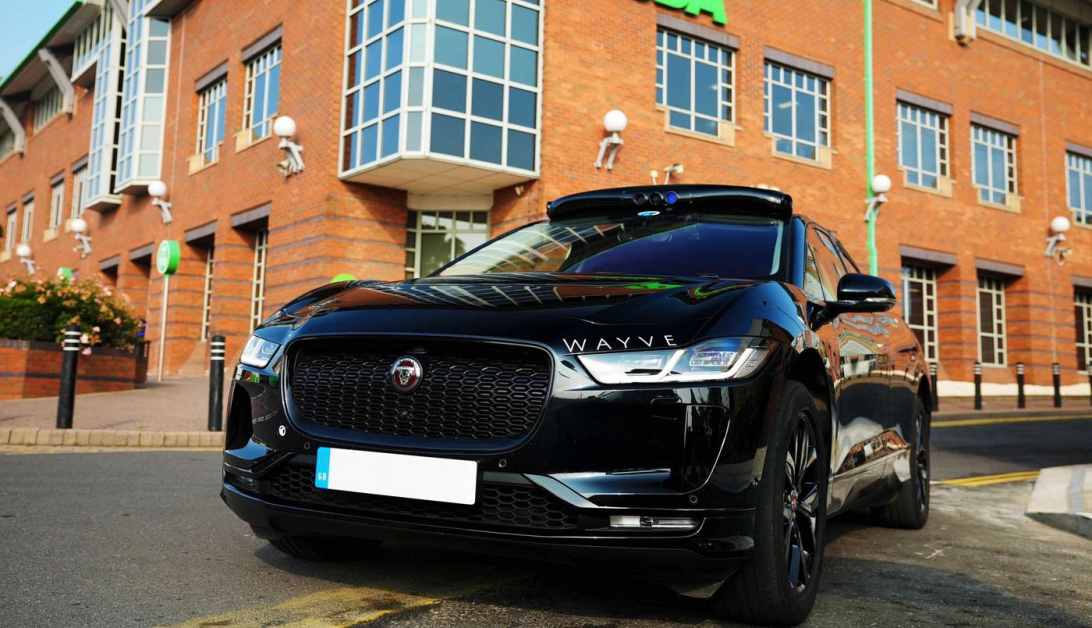
Wayve raises $60M from chip giants Qualcomm, AMD, Arm to challenge Waymo with mapless autonomous driving AI
 Nickie Louise
Posted On April 15, 2026
Nickie Louise
Posted On April 15, 2026

Wayve just pulled more of the semiconductor world into its orbit—and it’s not a vanity move.
The London-based autonomous driving startup said Wednesday it secured $60 million in fresh backing from Qualcomm, AMD, and Arm Holdings, adding three of the industry’s most influential chipmakers to a cap table that already includes Nvidia. The new investment follows Wayve’s $1.2 billion round announced in February and points to a deeper alignment between the company’s software ambitions and the hardware stack powering modern vehicles.
The funding came nearly six months after the Financial Times reported that Wayve was in advanced talks with Microsoft and SoftBank on a potential $2 billion round that could value the company at around $8 billion.
On paper, $60 million looks modest next to a billion-dollar raise. In practice, this is about positioning. Wayve is trying to do something few in autonomous driving have managed at scale: build a system that can learn to drive without relying on high-definition maps or pre-programmed routes.
That puts it on a different path from Waymo, which has built its lead on tightly mapped environments and extensive sensor setups. Wayve’s bet is simpler in concept and harder in execution—teach the system to drive the way humans do, by learning from experience.
Founded in 2017 by engineers out of Cambridge, Wayve has spent years training an AI model that runs on minimal hardware, using a camera-first approach. Instead of encoding the world in advance, the system learns directly from real-world driving data. The company relies on reinforcement learning, allowing the model to improve through trial and feedback and adapt to situations that don’t fit neatly into predefined rules.
Why Qualcomm, AMD, and Arm are backing Wayve’s mapless AI in the race against Waymo
That difference matters as the industry shifts from research to deployment. Automakers don’t all run on the same chips, and that fragmentation has slowed down efforts to standardize autonomous systems. By bringing in Qualcomm, AMD, and Arm, Wayve is signaling that its software can run across multiple silicon platforms already embedded in vehicles.
“What’s exciting for us is it gives our customers choice of which silicon platform they want to work with. And it lets us work with what’s already being used across the industry,” Wayve CEO Alex Kendall told CNBC.
“We can meet the industry where they are. It just increases the speed and scale of our adoption.”
That flexibility could turn into a commercial advantage. Instead of forcing automakers to redesign their hardware around a specific system, Wayve is positioning itself as a layer that fits into existing architectures. For an industry wary of costly overhauls, that pitch lands.
The company is already testing its technology across the U.K., Germany, Japan, and the U.S., giving it exposure to a wide range of driving conditions. It has signed a deal with Nissan to integrate its AI into driver-assistance systems, a step that moves it closer to real-world deployment. In March, Wayve, Nissan, and Uber said they would work together on robotaxis, tying the software directly to a commercial use case.
Kendall declined to detail other partnerships in progress, though his outlook was clear. “It’s going to be a matter of time before every vehicle has this kind of capability,” he said, referring to the systems Wayve is building.
The competition isn’t standing still. Waymo has been expanding beyond the U.S., with testing underway in both the U.K. and Japan. This week, the company said its vehicles in London are operating with trained specialists behind the wheel, a step ahead of public ride services expected later this year.
At the same time, Chinese players like Baidu, WeRide, and Pony.ai are expanding into international markets, bringing their own autonomous systems to the mix.
That leaves the sector heading into a new phase—less about proving the technology works, more about who can deploy it widely and make it fit into the cars people actually drive.
Wayve’s latest move shows where it thinks the answer lies: not in controlling the entire stack, but in working with it.