Intel joins Elon Musk’s $25B Terafab AI chip megafactory project
 Daniel Levi
Posted On April 7, 2026
Daniel Levi
Posted On April 7, 2026
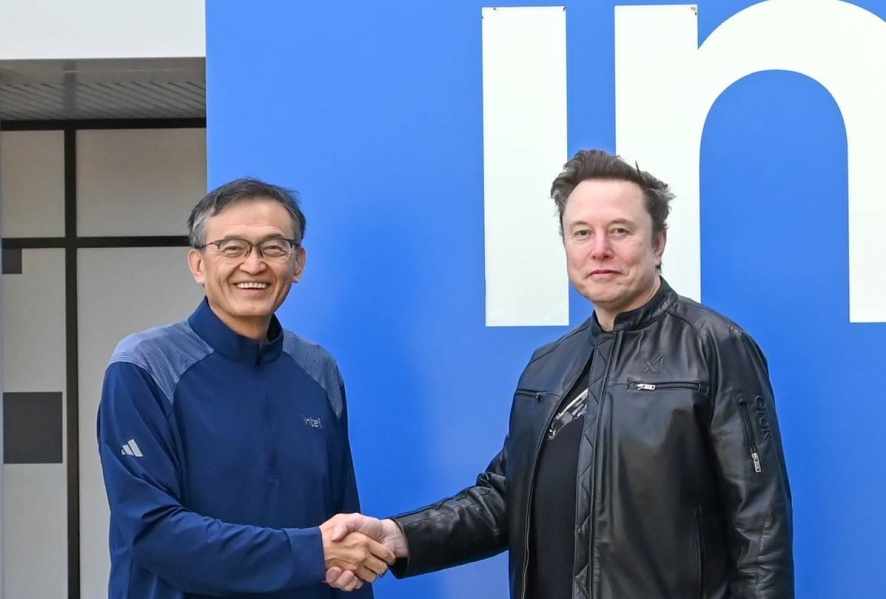
Intel just stepped into one of Elon Musk’s most ambitious bets yet—a $25 billion chip megafactory in Austin that aims to rewrite how AI hardware gets built.
On Tuesday, Intel said it will join Musk’s Terafab project alongside Tesla, SpaceX, and xAI, adding another heavyweight to a growing coalition that’s trying to bring chip design, manufacturing, and deployment under one roof.
“Intel is proud to join the Terafab project with @SpaceX, @xAI, and @Tesla to help refactor silicon fab technology. Our ability to design, fabricate, and package ultra-high-performance chips at scale will help accelerate Terafab’s aim to produce 1 TW/year of compute to power future advances in AI and robotics,” Intel said in a post on X.
Intel is proud to join the Terafab project with @SpaceX, @xAI, and @Tesla to help refactor silicon fab technology.
Our ability to design, fabricate, and package ultra-high-performance chips at scale will help accelerate Terafab’s aim to produce 1 TW/year of compute to power… pic.twitter.com/2vUmXn0YhH
— Intel (@intel) April 7, 2026
Bloomberg also confirmed the news, reporting, “Intel Corp. said it’s joining Elon Musk’s Terafab project, a long-shot chip manufacturing effort for Tesla Inc., SpaceX and xAI. Santa Clara, California-based Intel will help Musk’s companies “refactor” the technology in a chip factory.”
Inside Elon Musk’s $25B Terafab: Intel joins Tesla, SpaceX, and xAI in massive AI chip push
Musk first unveiled Terafab on March 23, describing it as a $25 billion facility built to support the rising demand for AI and robotics across his companies. The pitch is straightforward: control the entire stack and move faster than anyone else.
Standing inside the former Seaholm Power Plant in Austin, Musk framed the stakes in blunt terms. “We either build the Terafab or we don’t have the chips, and we need the chips.”
That urgency is shaping everything around the project.
Last month, Musk said SpaceX, which recently merged with xAI, and Tesla plan to build two advanced chip factories within the same campus. One will focus on powering electric vehicles and humanoid robots. The other is aimed at AI infrastructure, including systems intended for use beyond Earth.
TeraFab
Intel’s role brings manufacturing depth to the effort. In a post on X, the company said, “Our ability to design, fabricate, and package ultra-high-performance chips at scale will help accelerate Terafab’s aim to produce 1 terawatt per year of compute to power future advances in AI and robotics.”
Investors responded quickly. Intel shares rose about 2% in early trading and are now up roughly 38% this year, a sign that markets are paying attention to its renewed push into advanced chip production.
The Terafab site will sit next to Tesla’s Giga Texas campus in eastern Travis County. The plan goes beyond a typical semiconductor plant. Musk is aiming for a tightly integrated system in which design, fabrication, packaging, and testing occur in a single location. The goal is speed—shorter iteration cycles, fewer dependencies, and chips built specifically for each use case across his companies.
At full capacity, Terafab is targeting something rarely seen at this scale: about one terawatt of annual compute output. Musk described it as a mix of ground-based systems and infrastructure that could support future orbital data centers.
Production targets are just as aggressive. The facility is expected to turn out tens of billions of AI inference and memory chips each year. Early output will center on Tesla’s next-generation AI5 chips, which are tied to xAI’s Grok models. SpaceX is expected to receive specialized versions built for low-Earth orbit, where solar power and vacuum cooling create a different operating environment.
Musk made clear that existing suppliers still matter. He pointed to companies like TSMC, Samsung Electronics, and Micron Technology as key players. His view is that global chip supply still falls short of what’s coming next.
Internal projections across his companies suggest that demand for autonomous driving, robotics, training clusters, and space-based compute will outpace current production by a wide margin. Terafab is Musk’s answer to that gap.
If it works, it could shift how AI infrastructure gets built. If it doesn’t, it will stand as one of the most expensive attempts to bring chip production fully in-house. Either way, the scale of the bet is hard to ignore.