Amazon to add 3.5% FBA surcharge starting April 17, 2026, as fuel costs rise amid US–Iran war
 Daniel Levi
Posted On April 2, 2026
Daniel Levi
Posted On April 2, 2026
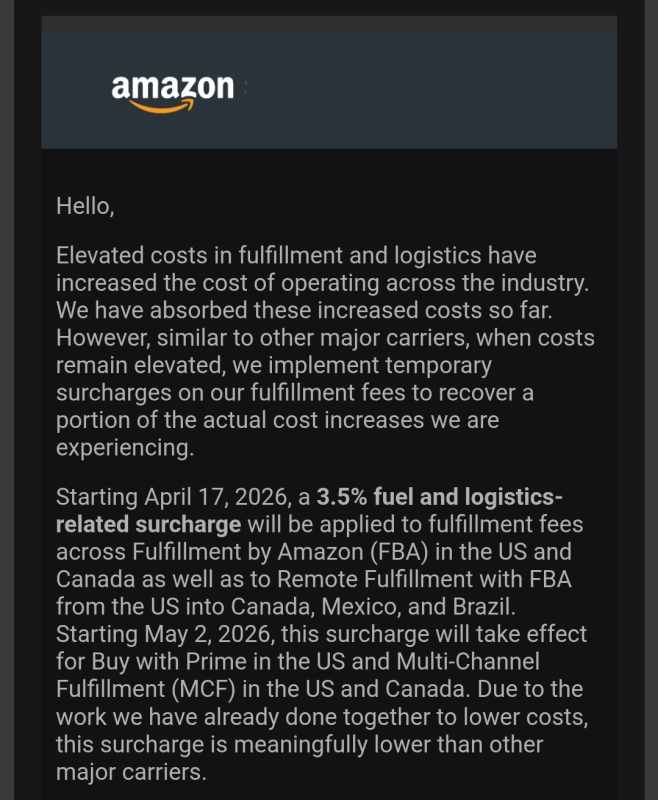
Amazon sellers woke up to a new cost line item just weeks before peak summer demand. In a message sent through Seller Central, Amazon said it will begin adding a 3.5% fuel and logistics surcharge to fulfillment fees, starting April 17, 2026. The move comes at a time when fuel prices are rising, and global shipping routes are under pressure amid the US–Iran war.
Amazon’s note to sellers frames the change as a response to persistent cost pressure across the logistics chain.
“Elevated costs in fulfillment and logistics have increased the cost of operating across the industry. We have absorbed these increased costs so far. However, similar to other major carriers, when costs remain elevated, we implement temporary surcharges on our fulfillment fees to recover a portion of the actual cost increases we are experiencing.”
Key Details From the Announcement
- Effective date: April 17, 2026 → 3.5% surcharge applied to FBA fulfillment fees in the U.S. and Canada, plus Remote Fulfillment from the U.S. into Canada, Mexico, and Brazil.
- Later date: May 2, 2026 → the same surcharge extends to Buy with Prime in the U.S. and Multi-Channel Fulfillment (MCF) in the U.S. and Canada.
- Reason: Elevated fuel and logistics costs that Amazon has been absorbing but can no longer fully cover (aligned with actions taken by other major carriers).
- Scope: Added on top of existing fulfillment fees; described as temporary and lower than competitor increases.
Amazon FBA Fees Increase: 3.5% Fuel and Logistics Surcharge Starts April 2026
The surcharge first applies to Fulfillment by Amazon in the U.S. and Canada, as well as to Remote Fulfillment shipments from the U.S. to Canada, Mexico, and Brazil. Two weeks later, on May 2, it expanded to Buy with Prime in the U.S. and Multi-Channel Fulfillment across the U.S. and Canada. The fee sits on top of existing fulfillment charges and is positioned as a partial offset rather than a permanent rate change.
For sellers, the timing matters. Amazon already adjusted its 2026 fee schedule in January, lifting average U.S. FBA fulfillment costs by about $0.08 per unit, with separate updates to storage and transportation. The new surcharge layers on top of that baseline. Early chatter in seller forums and on X suggests the added 3.5% translates to roughly $0.17 per unit for many standard items. On thin margins, that stacks up fast.
Amazon to add 3.5% FBA surcharge starting April 17, 2026
This isn’t new territory for Amazon. In April 2022, the company introduced a 5% fuel and inflation surcharge amid supply chain shocks and rising carrier rates. That step drew broad coverage at the time and signaled a shift in how Amazon passes through macro cost swings to its third-party marketplace. The current adjustment follows a similar playbook, with one notable difference: Amazon says this surcharge is lower than what major carriers are charging, pointing to ongoing efficiency work across its network.
Zoom out, and the backdrop is hard to ignore. Energy prices have been volatile, and logistics costs are moving with them. The conflict in the Middle East is adding fresh pressure to fuel markets and shipping lanes, feeding directly into fulfillment economics. Amazon’s scale gives it room to absorb some shocks, but not indefinitely.
For operators running high volume through FBA, the practical question is how to respond. Some will revisit pricing. Others will look at packaging, inventory placement, and channel mix to claw back a few cents per unit. Many will wait for clarity on how long the surcharge sticks around. Amazon hasn’t put an end date on it.
In a Reddit post, a user wrote: “If you think the Iran War doesn’t impact you… think again.” You know, once you add a fee, it almost never goes away.”
Meanwhile, as of April 2, 2026, the company hasn’t issued a public press release on its corporate newsroom, which tracks with how these updates typically roll out. Sellers get the heads-up first, then the broader narrative follows.
The bigger picture is simple. Fulfillment costs are rising again, and Amazon is passing through a slice of that increase. For a marketplace built on tight margins and high velocity, even a small percentage change can ripple quickly. The next few months will show how much of that cost sellers can absorb—and how much gets passed on to shoppers.
Trending Now