South Korean AI chip startup Rebellions raises $400M at $2.34B valuation to challenge Nvidia in AI inference chips, eyes U.S. expansion
 Daniel Levi
Posted On March 30, 2026
Daniel Levi
Posted On March 30, 2026

Samsung-backed Rebellions just pulled in $400 million, and it’s not chasing hype. The South Korean AI chip startup is going after a specific piece of the AI stack that’s starting to matter more than training: inference. With a $2.34 billion valuation and fresh capital in hand, the company is setting its sights on the U.S., lining up customers that sit at the center of the current AI race.
The round was led by Mirae Asset Financial Group and the Korea National Growth Fund, a state-backed investment vehicle. The deal places Rebellions among a growing group of semiconductor startups trying to carve out space in a market long dominated by Nvidia, whose GPUs still anchor most large-scale AI training workloads.
With $650 million raised in the past six months—more than 75% of its total funding to date—Rebellions is entering a new phase focused on U.S. expansion, scaling production of its Rebel100 platform, and preparing for a public listing, the company said on Monday.
“AI is now measured by its ability to operate in the real world – at scale, under power constraints, and with clear economic return,” says Sunghyun Park, Co-Founder and CEO of Rebellions. “That shifts the center of gravity toward inference infrastructure and software that makes that infrastructure usable. The companies that succeed in this era will not be defined by silicon alone, but by how effectively they integrate into the open source software ecosystem and enable developers to build and deploy without friction.”
Rebellions is taking a different route. Its focus is inference—the phase where AI models are actually used in production. That shift is starting to reshape demand. Training grabs headlines, yet inference is where models spend most of their time once deployed, running queries, serving users, and generating responses at scale. Efficiency, latency, and cost start to matter more than raw training performance.
“Our main target right now is big labs,” CEO Sunghyun Park told CNBC, pointing to companies like Meta and xAI rather than hyperscalers such as Amazon and Microsoft. Those labs are building and deploying models at a pace that demands specialized hardware, and Rebellions wants to be part of that supply chain early.
Backed by Samsung and SK Hynix, Rebellions Raises $400M to Power AI Inference Race
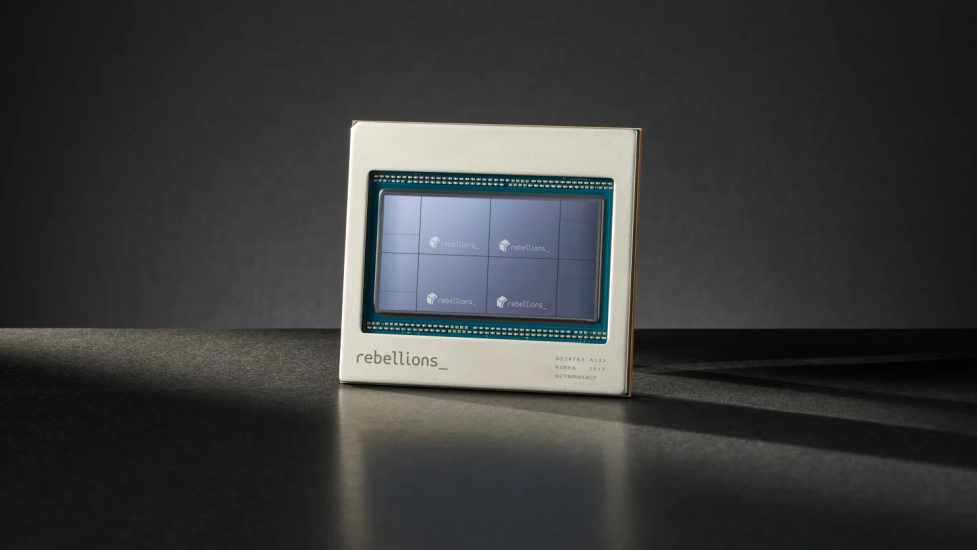
Rebellions AI chip (Courtesy: Rebellions)
The company already has proof-of-concept trials underway with U.S. customers, a sign that it’s moving beyond domestic traction. Park confirmed that preparations for an IPO are underway, though details on timing or listing venue remain undisclosed.
At the center of Rebellions’ product strategy is its Rebel100 NPU, which powers server systems built for inference workloads. The pitch is straightforward: higher energy efficiency paired with strong performance. “When it comes to inference alone, our chip offers … much higher energy efficiency and performance at the same time,” Park said.
That claim lands in a crowded field. Alongside Nvidia, startups like Cerebras and Groq are pushing their own architectures, each betting that specialized silicon will win as AI usage scales. Nvidia still holds the advantage in ecosystem and developer adoption, yet cracks are beginning to show as customers look for alternatives that can lower operating costs.
One bottleneck sits outside Rebellions’ direct control: memory. Advanced AI chips depend heavily on high-bandwidth memory, supplied by companies such as Samsung, SK Hynix, and Micron Technology. Supply remains tight, and prices have climbed sharply.
“Memory is not very easy to get. But our demand is so huge,” Park said.
Rebellions has a built-in advantage here. Samsung and SK Hynix are both investors, giving the startup a stronger position than many rivals competing for the same constrained supply. That relationship could prove decisive as inference demand rises and memory becomes a gating factor for deployment.
The company’s rise fits into a broader national push. South Korea has been working to strengthen its semiconductor sector, and Rebellions sits at the center of that effort. The government’s “K-Nvidia” initiative aims to back domestic players building advanced AI chips, with the Korea National Growth Fund committing significant capital to support that goal.
Rebellions’ latest raise signals that investors see room for new entrants, even in a market shaped by a dominant incumbent. The next phase will test whether inference-focused chips can win real share as AI systems move from training labs into everyday use.
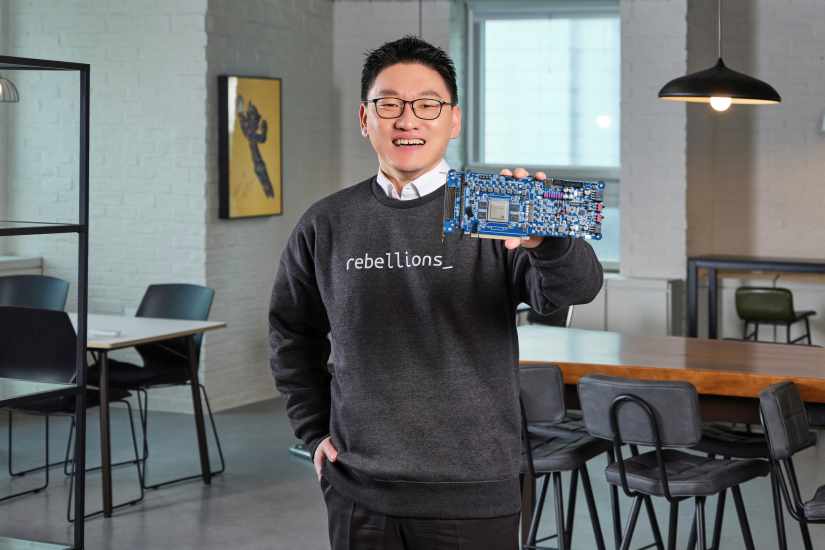
Rebellions founder Sunghyun Park (Courtesy: Rebellions)
Trending Now