Defense AI startup Shield AI raises $1.5B at $12.7B valuation, eyes Aechelon acquisition to boost autonomous warfare tech
 Nickie Louise
Posted On March 26, 2026
Nickie Louise
Posted On March 26, 2026
Shield AI is raising fresh capital at a moment when software is starting to define how military power is built and deployed. The San Diego-based defense startup announced it is raising $1.5 billion in Series G funding at a $12.7 billion post-money valuation, alongside $500 million in fixed-return preferred equity financing.
The round is led by Advent International and co-led by JPMorganChase’s Strategic Investment Group under its Security and Resiliency Initiative. Existing investors, including Snowpoint Ventures, InnovationX, Riot Ventures, Disruptive, and Apandion, are participating.
Funds managed by Blackstone are investing $500 million in preferred equity, with an additional $250 million delayed draw facility that brings total potential backing to $750 million. As part of the deal, Advent Chairman David Mussafer will join Shield AI’s board, and Todd Combs will serve as a board observer.
The scale of the financing points to a clear shift. Defense spending is rising, and autonomy is moving from concept to deployment. Governments are putting real money behind systems that can operate without GPS, communications, or continuous human control.
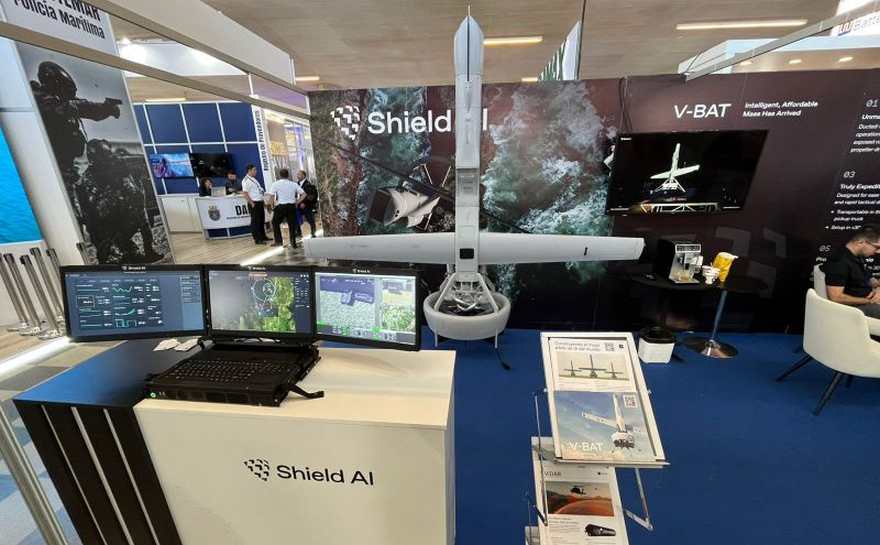
Shield AI has built its position around that exact problem. Its Hivemind software allows drones and aircraft to execute missions in contested environments where traditional systems fail. The platform has already been tested on F-16 fighter jets and the U.S. Air Force’s Collaborative Combat Aircraft program, placing the company inside some of the Pentagon’s most closely watched initiatives.
Inside Shield AI’s Push to Combine Autonomy and High-Fidelity Simulation
The company plans to use part of the new capital to acquire Aechelon Technology, a Sagewind Capital portfolio company. Aechelon is known for its high-fidelity simulation tools, physics-based sensors, and synthetic environments used by the U.S. military and its allies.
“The acquisition of Aechelon will accelerate the work we are doing with Hivemind, particularly in simulation like the Department of War’s JSE (Joint Simulation Environment),” Shield AI CEO Gary Steele said in a statement.
The Joint Simulation Environment plays a critical role in the development of modern systems. It allows military teams to test aircraft, autonomous platforms, and tactics in realistic digital scenarios before any real-world deployment. Bringing simulation and autonomy closer together tightens the feedback loop between training, testing, and execution.
That connection is becoming more valuable as warfare shifts. Conflicts in Ukraine and the Middle East have accelerated demand for autonomous systems that can operate under pressure, often without reliable infrastructure. Defense contractors and government agencies are placing greater weight on software as the layer that determines performance in those conditions.
Shield AI’s rise mirrors that trend. When TechStartups covered the company in January 2025, it was exploring a $200 million round at a $5 billion valuation with interest from Palantir Technologies and others. The latest raise more than doubles that valuation in just over a year.
Founded in 2015 by former Navy SEAL Brandon Tseng, along with Ryan Tseng and Andrew Reiter, Shield AI focuses on autonomy for government customers. Its systems are already in use by the U.S. and Ukrainian governments, placing it in active operational environments rather than controlled settings.
What’s happening around Shield AI reflects a broader shift in defense. Hardware still matters, but software is taking a central role in how systems operate, adapt, and survive in contested environments. With fresh funding and a deeper push into simulation, Shield AI is positioning itself at the center of that transition.
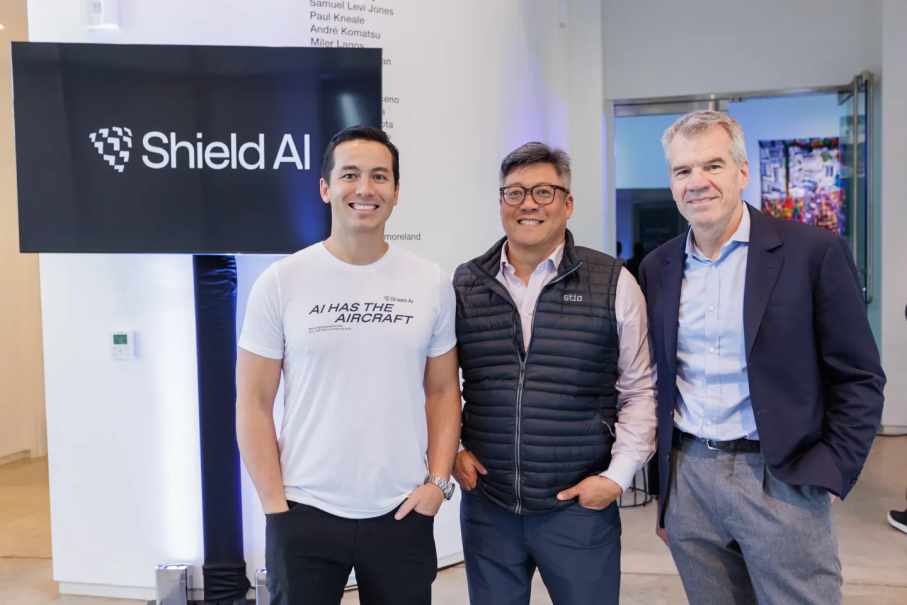
Shield AI team