
Beyond SQL: How NVIDIA’s Kumo Engine Could Transform Databases Into Predictive Intelligence Systems
 Daniel Levi
Posted On November 27, 2026
For nearly half a century, businesses have relied on SQL to ask databases questions about the past. What did customers buy? Which products generated the most revenue? How many subscribers canceled last month?
But what if asking a database what is likely to happen tomorrow were almost as easy as asking what happened yesterday?
NVIDIA’s open-source Kumo Engine brings developers closer to that possibility. The technology uses the relationships between records in existing databases to support machine learning models that predict future events, from customer purchases and subscription cancellations to fraudulent transactions and potential supply shortages.
Predictive analytics is hardly new. Banks, retailers, and technology companies have spent decades building statistical and machine learning models to anticipate business outcomes. The difficulty has often been the amount of engineering, computing resources, and specialized expertise required to turn raw business data into reliable predictions.
Kumo Engine tackles that engineering problem.
The timing is interesting. Much of the recent AI boom has centered on generating text, images, videos, and software code. Yet some of the most commercially valuable information sits inside ordinary relational databases, collected through years of customer interactions, financial transactions, and business operations.
A retailer may possess ten years of purchase history. A bank may have billions of transaction records. A software company may have detailed records of how customers interact with its products. Much of this information is used for reporting, auditing, and historical analysis rather than anticipating future events.
Kumo points to a different way of using that data. Instead of building a separate machine learning pipeline for every business question, developers could express what they want to predict and use existing relationships within their data to train predictive models.
The implications extend far beyond database engineering. They could change how businesses build software, make decisions, and extract value from information they already own.
What Is NVIDIA’s Kumo Engine and How Does It Work?
NVIDIA describes Kumo Engine as “an accelerator for context generation over structured data.” The open-source machine learning engine helps developers train and run predictive models directly on relational data. Written in Rust, the engine applies graph-based machine learning techniques to information stored across interconnected database tables.
At the heart of Kumo is relational deep learning (RDL), which treats relationships between database records as valuable machine-learning inputs.
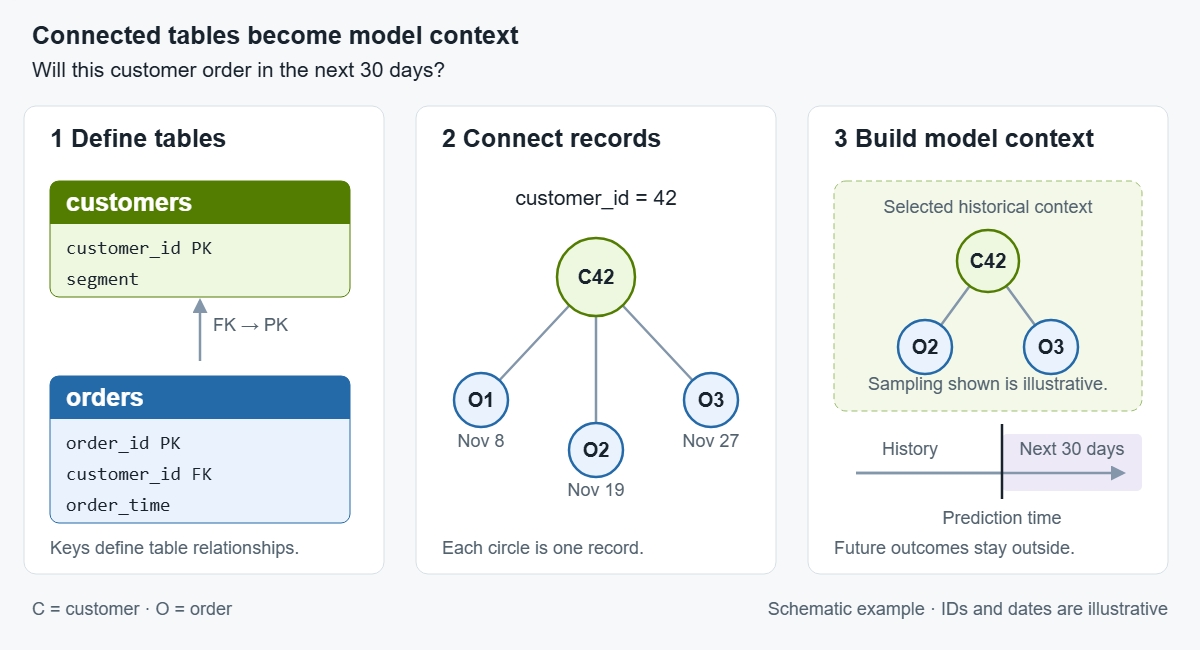
Consider an online retailer with separate database tables containing customer profiles, orders, products, payments, and returns. Each table contains useful information, but some of the most valuable insights emerge from examining how these records relate to one another.
A customer’s purchase history alone might provide limited clues about their next purchase. Connecting that history with product categories, purchasing frequency, return patterns, and the behavior of customers with similar interests could produce a more informed prediction.
Traditionally, data scientists would spend considerable time combining these tables, selecting relevant variables, and preparing datasets for machine learning through a process known as feature engineering.
Kumo Engine
Kumo takes a different approach. It represents relational data as a graph, where database records become nodes and their relationships become connections known as edges. Graph neural networks (GNNs) can then learn from those connections, identifying patterns across multiple tables without requiring developers to manually specify every potentially useful relationship.
The technology builds on academic research published at the 2024 International Conference on Machine Learning (ICML). The research proposed applying graph representation learning directly to relational databases, reducing reliance on manually engineered features.
Kumo Engine supports several types of predictive tasks:
-
Classification: Predict whether a customer is likely to cancel a subscription.
-
Regression: Estimate how much a customer might spend next month.
-
Forecasting: Predict future order volumes or product demand.
-
Link prediction: Identify products a customer is likely to purchase.
-
Fraud detection: Estimate the probability that a financial transaction is fraudulent.
The engine accounts for time when preparing training data. A model learning to predict customer behavior at a particular date should have access only to information available before that date. This helps prevent data leakage, a common machine learning problem that can produce misleadingly accurate test results.
NVIDIA offers a separate but related technology called Kumo Relational, a pretrained foundation model that generates predictions across connected database tables without requiring developers to train a new model for each task.
The distinction matters. Kumo Engine provides the infrastructure to train and run predictive models at scale. Kumo Relational offers a faster path to generating predictions from existing business data.
Neither requires businesses to abandon their existing relational databases. Instead, the opportunity lies in adding a new layer of intelligence to the data infrastructure companies have spent decades building.
For businesses, that could mean moving beyond dashboards that explain yesterday’s performance and building applications that help prepare for tomorrow’s decisions.
Beyond SQL: From Historical Queries to Predictive Queries
Perhaps the most compelling aspect of Kumo is how developers interact with it. Rather than requiring developers to translate every business question into a custom machine learning pipeline, Kumo introduces a SQL-like syntax called Predictive Query Language (PQL).
For anyone familiar with SQL, the concept is remarkably intuitive.
Consider a retailer that wants to calculate how much each customer spent over the past 30 days. A conventional SQL query might look like this:
Traditional SQL:
SELECT customer_id, SUM(amount)
FROM orders
WHERE order_time >= CURRENT_TIMESTAMP - INTERVAL '30 days'
GROUP BY customer_id;
The database retrieves existing records, performs the calculation, and returns the results. The answer is based on events that have already occurred.
Now suppose the retailer wants to know how much each customer is likely to spend over the next 30 days.
Using Kumo’s Predictive Query Language, the developer could express the question as follows:
Predictive Query Language (PQL):
PREDICT SUM(orders.amount, 0, 30, days)
FOR EACH customers.customer_id
This example follows the syntax provided in NVIDIA’s official PQL documentation.
Rather than calculating historical spending, a trained predictive model estimates each customer’s future spending using available data. The query defines the desired outcome, the prediction window, and the entities that need predictions.
The difference goes well beyond syntax. It changes the kinds of questions developers can express through a query language.
| Traditional SQL queries | Predictive queries using PQL |
|---|---|
| Which customers canceled last month? | Which customers are likely to cancel next month? |
| Which products generated the most sales? | Which products are customers likely to buy next? |
| Which invoices are overdue? | Which invoices are likely to become overdue? |
| Which transactions were fraudulent? | Which transactions are likely to be fraudulent? |
| How much revenue did each customer generate? | How much revenue might each customer generate next month? |
For a subscription software company, that distinction could mean contacting a dissatisfied customer before they cancel rather than discovering their departure in a monthly report. For a retailer, it could mean adjusting inventory before demand exceeds available stock.
SQL remains perfectly capable of preparing data for predictive analytics, and several database platforms already offer machine learning integrations. PQL’s contribution is providing a more direct way to define predictive tasks using relationships within existing business data.
Developers still need suitable data, properly configured relationships, and a reliable predictive model. A few lines of PQL do not guarantee an accurate prediction.
The appeal is that developers can spend less time specifying how to construct a machine learning task and more time deciding which business questions are worth answering.
What Makes NVIDIA’s Kumo Engine Different?
Predictive machine learning has existed for decades. What makes Kumo Engine interesting is its attempt to solve one of enterprise AI’s less glamorous but most expensive problems: efficiently getting the right data into a model.
Training a machine learning model is often just one part of the job. Data scientists must retrieve information from multiple sources, join tables, select relevant variables, reconstruct historical events, and prepare training datasets. As data volume grows, these operations can become computationally expensive.
Kumo Engine addresses these bottlenecks through several technical capabilities:
-
Automated relationship learning: Graph neural networks learn from connections across database tables, reducing the need for manually engineered features.
-
Time-aware graph sampling: The engine retrieves historical records based on a defined prediction time, helping prevent future information from contaminating training datasets.
-
High-performance Rust architecture: Kumo moves data efficiently between NVMe storage and GPUs, reducing bottlenecks during training and inference.
-
Large-scale data processing: Its disk-based graph architecture allows developers to work with datasets that exceed available system memory.
-
Enterprise data integration: Kumo supports existing data environments, including Snowflake and Databricks, reducing the need to rebuild established data infrastructure
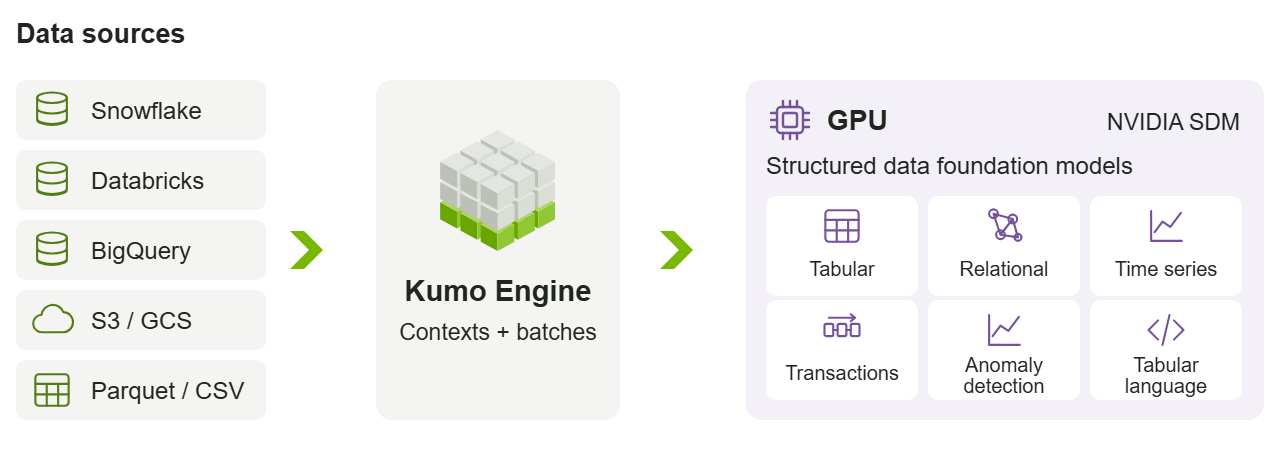
NVIDIA’s published benchmarks offer a glimpse into the engine’s performance.
In one experiment involving a synthetic commerce dataset containing 50 billion nodes and 175.5 billion connections, NVIDIA tested how efficiently Kumo could retrieve related records for machine learning tasks.
The company reported that Kumo generated context between 10 and 48 times faster than prepared DuckDB in earlier warm-cache tests, depending on the number of relationship levels being examined.
The engine ran on a 2.6 TiB graph index on a machine with just 1 TiB of RAM. NVIDIA claims its architecture can accommodate datasets roughly ten times larger than competing solutions that depend on keeping their data in memory.
These results come from NVIDIA’s own tests and apply to particular machine learning workloads, not everyday SQL operations. The benchmarks exclude initial data preparation, a cost that businesses must account for when evaluating the technology. Independent testing across production environments will provide a clearer picture of its practical performance.
The open-source business model is equally interesting. Released under the Apache 2.0 license, Kumo Engine gives independent developers, startups, and established enterprises access to its underlying technology without requiring proprietary software licensing agreements.
That does not make predictive AI free. Companies must still account for computing resources, storage, data preparation, deployment, and ongoing model maintenance.
What Kumo could change is the economics of building predictive software. A small development team with access to high-quality historical data may be able to build capabilities that previously required a dedicated machine learning engineering team.
For many businesses, the most valuable outcome may not be faster model training. It may be the ability to pursue predictive applications that were previously too expensive or time-consuming to develop.
Real-World Applications: What Businesses Could Build With Kumo Engine
Kumo’s commercial potential becomes clearer when you look at the software businesses already use. Most enterprise applications collect, organize, and display information. Far fewer anticipate what will happen next.
A customer relationship management (CRM) platform records sales conversations. Accounting software tracks invoices and payments. Inventory management systems monitor stock levels. Each contains historical information that could help businesses anticipate future events.
Adding predictive capabilities to these applications could change how companies use them.
Consider a small online retailer competing against Amazon. The retailer may have years of customer purchase history but lack the budget to employ a dedicated machine learning team. Using Kumo Engine, its developers could build recommendation systems that learn from relationships between customers, products, purchases, and browsing behavior.
The same principle applies across several industries:
| Industry | Potential predictive application |
|---|---|
| E-commerce | Predict customer purchases and recommend relevant products. |
| Banking and finance | Identify potentially fraudulent transactions and estimate credit risk. |
| SaaS | Predict customer churn, subscription renewals, and revenue growth. |
| Supply chain | Anticipate inventory shortages and fluctuations in product demand. |
| Insurance | Estimate the likelihood of future claims and assess financial risk. |
| Cybersecurity | Identify suspicious relationships between accounts, devices, and network activity. |
| Manufacturing | Predict equipment failures using maintenance and operational records. |
| Venture capital | Estimate which startups are likely to raise subsequent funding rounds. |
| Accounting | Predict late payments and potential cash flow shortages. |
| Logistics | Anticipate delivery delays and disruptions. |
These applications represent potential use cases rather than proven deployments of Kumo Engine. Their effectiveness would depend on the availability of relevant historical data and the accuracy of the underlying models.
One particularly compelling opportunity lies in vertical SaaS, where software companies serve individual industries and accumulate specialized data over time.
For example, a software provider serving thousands of dental practices could develop predictive features that estimate appointment cancellations, patient demand, and future staffing requirements using appropriately governed operational data.
The provider already has something a new competitor may struggle to acquire: years of industry-specific information and established customer relationships.
Predictive AI could turn that existing advantage into new products and revenue streams.
For customers, the value proposition changes too. Instead of paying for software that simply records business activity, they could pay for software that helps prevent costly mistakes, identify opportunities, and make better-informed decisions.
The Next Frontier of AI: Structured Data
The generative AI boom has largely focused on unstructured information such as text, images, audio, and video. Large language models have demonstrated how machines can generate content, write software, summarize documents, and interact with people through natural language.
But businesses operate on another category of information that receives considerably less attention: structured data.
Every purchase, invoice, insurance claim, subscription renewal, and financial transaction produces structured records. Over time, these records capture how a business operates, how its customers behave, and how different parts of the organization interact.
An LLM can explain why customers typically abandon their shopping carts. A predictive model trained on a retailer’s own data could estimate which customers are most likely to abandon theirs.
That distinction matters commercially.
Generative AI and predictive AI serve different but complementary purposes.
| Generative AI | Predictive AI |
|---|---|
| Writes a marketing email | Predicts which customers are likely to respond |
| Creates product descriptions | Predicts which products customers are likely to purchase |
| Summarizes financial reports | Forecasts future revenue |
| Generates customer retention strategies | Identifies customers at risk of canceling |
| Explains historical sales performance | Estimates future product demand |
| Drafts payment reminders | Identifies customers likely to miss payments |
The emergence of relational foundation models could bring some of the advantages of pretrained AI models to structured business data.
Researchers are already investigating this possibility. The Stanford Tabular and Relational (STAR) Project focuses on developing foundation models capable of learning from individual tables and interconnected relational databases.
Its research includes RelBench, an open benchmark introduced at NeurIPS 2024 that lets researchers evaluate predictive machine learning across relational databases using standardized tasks and evaluation methods. The benchmark includes applications spanning retail, healthcare, social networks, and other industries.
NVIDIA’s Kumo Relational builds on this direction. Instead of training a separate model for every predictive task, developers can provide related database tables, define a prediction using PQL, and generate results using a pretrained relational foundation model.
The convergence of generative and predictive AI presents another interesting possibility.
A business could use a relational model to identify customers at risk of canceling their subscriptions, then use an LLM to generate personalized retention emails for those customers. The predictive model determines who might need attention. The generative model helps the business decide how to communicate with them.
Together, these technologies could form the basis of a new generation of enterprise AI applications.
There is a competitive distinction worth examining. Many companies building generative AI products rely on the same foundation models. Their competitors can often access those models through the same APIs.
Proprietary business data is different. A decade of customer transactions, purchasing behavior, and operational records is hard for a competitor to replicate.
As predictive AI becomes more accessible, some of the most valuable corporate assets may be the databases that businesses have quietly accumulated over decades.
The next major opportunity in enterprise AI may have less to do with generating more information and more to do with extracting intelligence from information businesses already possess.
What Kumo Engine Means for Startups and Independent Developers
Some of the biggest beneficiaries of Kumo Engine may be companies that have never considered themselves AI businesses.
For years, building sophisticated predictive software required specialized expertise in data science, machine learning, and data engineering. Large technology companies could afford to assemble teams with those skills. Smaller businesses and independent developers often had to settle for simpler analytics or expensive third-party solutions.
Open-source infrastructure such as Kumo could help narrow that gap.
A bootstrapped SaaS company with five years of customer data could introduce predictive features without building its entire machine learning infrastructure from scratch. An independent developer could create a specialized application that helps small businesses anticipate cash flow problems, identify customers likely to leave, or forecast demand.
The opportunity is particularly attractive for startups targeting underserved industries where predictive software remains expensive, inaccessible, or poorly suited to smaller businesses.
Several potential business opportunities stand out:
-
Predictive CRM: Identify sales prospects most likely to become paying customers.
-
Revenue intelligence: Help subscription businesses anticipate churn, renewals, and revenue growth.
-
Predictive accounting: Help small businesses identify potential cash flow problems before they occur.
-
Industry-specific intelligence: Build predictive applications for specialized markets such as construction, logistics, hospitality, and manufacturing.
-
Predictive analytics platforms: Allow businesses to generate predictions from their existing databases without extensive machine learning expertise.
-
Predictive data infrastructure: Build connectors, monitoring tools, deployment services, and model validation software.
Startups do not necessarily need to create entirely new products around Kumo. Some of the strongest opportunities may involve adding predictive capabilities to software customers already use and trust.
That approach offers an economic advantage. Existing software providers have established distribution channels, customer relationships, and historical data. A predictive feature that demonstrably reduces customer losses or operating expenses could justify higher subscription prices or create an additional revenue stream.
Yet access to open-source technology alone does not create a defensible business. Competitors can download the same software, study the same documentation, and develop similar features.
The harder asset to replicate is years of reliable, industry-specific data collected through legitimate business operations.
This could reshape how founders think about competitive advantages in AI. Rather than competing solely on model capabilities, companies may increasingly compete on data quality, industry expertise, customer relationships, and their ability to integrate predictions into everyday business decisions.
The engine may be open source. The data that makes its predictions commercially valuable may not be.
Will Kumo Engine Replace SQL and Traditional Databases?
The short answer is no. Kumo Engine solves a different problem from the one traditional relational databases were built to address.
SQL remains indispensable for recording transactions, retrieving information, maintaining data integrity, and managing business operations. Companies still need reliable systems to process payments, update inventory, manage customer accounts, and store financial records.
A bank cannot replace its transactional database with a predictive model that estimates account balances. Nor should an accounting system substitute actual financial records with revenue forecasts.
Kumo fits into the existing data infrastructure rather than replacing it. Traditional databases provide the factual foundation, and predictive models learn from that information to estimate future outcomes.
NVIDIA’s technical documentation reinforces this distinction. Kumo Engine acts as a data-loading and context-generation accelerator for machine learning workloads, transforming relational records into inputs suitable for model training and inference.
There are several practical challenges businesses must address before deploying predictive AI at scale:
-
Data quality: Incomplete, inaccurate, or inconsistent records can produce unreliable predictions.
-
Historical context: Businesses with limited historical data may struggle to generate meaningful predictions.
-
Changing market conditions: Models trained on past behavior may perform poorly during economic disruptions or unexpected shifts in consumer demand.
-
Privacy and security: Connecting sensitive records across multiple databases introduces additional data governance responsibilities.
-
Bias and fairness: Historical records may contain biases that predictive models reproduce, particularly in lending, healthcare, and employment.
-
Computing costs: Large-scale predictive workloads still require investment in hardware, storage, and infrastructure.
-
Model validation: Businesses must continuously measure prediction accuracy and compare results against actual outcomes.
Another limitation deserves attention: prediction is not causation.
A model might identify customers who are likely to cancel their subscriptions, but that does not necessarily explain why they intend to leave or which intervention would persuade them to stay.
Businesses must distinguish between identifying a likely outcome and determining the best course of action. The latter may require controlled experiments, domain expertise, and human judgment.
Prediction accuracy alone is not sufficient either. A more sophisticated model may deliver little commercial value if its results arrive too late or if employees cannot act on them effectively. In some cases, a simpler statistical model may deliver comparable results at a fraction of the cost.
Companies evaluating Kumo should compare its performance against existing machine learning approaches using representative business data, measuring both predictive accuracy and the financial value of the resulting decisions.
The most realistic future is one in which SQL and predictive AI coexist. Relational databases will continue to record what happened, business intelligence tools will help explain historical performance, and predictive models will help estimate what might happen next.
SQL has spent decades answering questions with facts. Predictive AI introduces answers expressed in probabilities. Businesses will need both, and knowing when to trust each will become increasingly valuable.
From Systems of Record to Systems of Intelligence
The history of enterprise computing can be viewed through the changing questions businesses ask of their data.
Relational databases gave companies a reliable way to record transactions and retrieve information. Business intelligence software helped them identify trends and explain historical performance. Predictive AI introduces another capability: anticipating events before they occur.
This progression represents four distinct stages of enterprise data intelligence:
-
Systems of record: What happened?
-
Business intelligence: Why did it happen?
-
Predictive intelligence: What is likely to happen next?
-
Prescriptive intelligence: What should we do about it?
Each stage builds on the previous one. Kumo Engine addresses the third stage, potentially making predictive intelligence more accessible to businesses that lack extensive machine learning resources.
The fourth stage presents an even greater challenge. Turning predictions into effective business decisions requires more than accurate models. It requires economic reasoning, industry expertise, human judgment, and an assessment of each decision’s potential consequences.
NVIDIA’s contribution is making the predictive stage easier to implement using information businesses already collect.
For decades, companies have treated data primarily as a record of business activity. They have invested billions of dollars in collecting, storing, securing, and organizing that information. Much of its predictive value remains untapped.
If technologies like Kumo can make reliable predictions easier and less expensive to generate, businesses may begin to view their existing databases differently. Years of historical records could become the foundation for new products, services, revenue streams, and competitive advantages.
The broader significance of Kumo Engine may have less to do with NVIDIA’s technology itself and more to do with what developers build on top of it.
Predictive capabilities that once required dedicated machine learning teams could gradually become standard features of everyday business software. The distinction between a conventional software company and an AI company may become less meaningful as predictive intelligence becomes part of ordinary applications.
SQL is not going away. Neither are relational databases. What could change is what we expect business data to do for us.
For nearly half a century, databases have helped businesses document their past. The next chapter could see them play a much greater role in shaping their future.
The future of databases may not be defined by how quickly they can tell us what happened yesterday, but by how reliably they can help us prepare for tomorrow.
Below is a video of Kumo Engine at a glance.
Kumo Engine at a Glance (Click on the image to watch the video)