Bitcoin price crashes to $59,000 for first time since July as AI stock rout sparks crypto selloff
 Daniel Levi
Posted On November 20, 2026

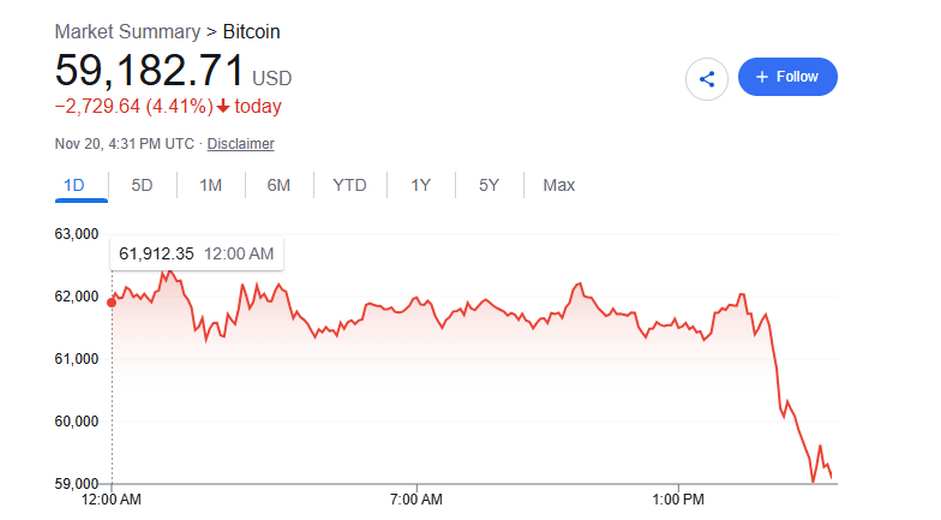
Bitcoin plunged below $60,000 on Friday, November 20, falling to its lowest level since July as a selloff in artificial intelligence stocks spread across global financial markets and investors scrambled to reduce exposure to risky assets.
The world’s largest cryptocurrency fell to $59,182.71, down $2,729.64, or 4.41%, as of the time of writing. The decline pushed Bitcoin through a closely watched psychological threshold and extended a losing streak that has wiped billions of dollars from the broader cryptocurrency market.
The damage wasn’t limited to Bitcoin. Ether, the second-largest cryptocurrency, fell 5.23% to $1,648.91, reflecting a broader retreat from digital assets as investors reassessed their risk appetite.
The selloff comes at a difficult moment for technology markets. Investors are growing increasingly concerned about the enormous sums being poured into artificial intelligence infrastructure, raising questions about whether the industry’s future profits can justify today’s spending and valuations.
That anxiety is now spilling beyond AI stocks into cryptocurrencies, where traders have become increasingly sensitive to shifts in market sentiment.
Why Bitcoin Is Falling as AI Stocks Take a Hit
Bitcoin’s latest decline highlights an uncomfortable reality for investors who once viewed the cryptocurrency as an alternative to traditional financial markets: when fear takes over, Bitcoin can behave much like the speculative technology stocks it was supposed to offer an escape from.
The connection has become difficult to ignore.
Technology stocks have faced mounting selling pressure as investors question the financial returns from billions of dollars committed to AI data centers, chips, and computing infrastructure. Those concerns have weighed on market sentiment, pushing traders away from assets seen as vulnerable to sudden price swings.
According to Reuters’ report, major U.S. stock indexes were heading for their steepest weekly decline since April 2025, when President Donald Trump’s sweeping Liberation Day tariffs rattled financial markets.
The pressure on cryptocurrencies extends beyond the AI selloff. Rising borrowing costs have made speculative investments less attractive, and the outcome of the U.S. midterm elections has introduced fresh questions about the direction of cryptocurrency regulation.
Investors are facing several sources of uncertainty at once, leaving little room for optimism in a market already struggling to regain its footing.
The scale of Bitcoin’s decline is particularly striking. According to market data cited by Investing.com, the cryptocurrency was heading for its seventh consecutive weekly loss on Friday, extending a downturn that began in early October.
The latest drop has turned the $60,000 level into a major test of investor confidence.
For months, Bitcoin enthusiasts have promoted the cryptocurrency as a store of value that can stand apart from traditional financial markets. Its recent performance tells a more complicated story.
When investors become nervous about economic growth, interest rates, or expensive technology stocks, digital assets are often among the first investments they sell.
The broader concern is that the cryptocurrency downturn may be part of a larger reassessment of risk across financial markets rather than an isolated correction in Bitcoin.
For now, the question is whether buyers will return after Bitcoin breaks below $60,000 or whether continued weakness in AI stocks will prompt another round of selling.
One thing is becoming clear: Bitcoin’s fortunes remain closely tied to investor confidence, and right now, that confidence is taking a beating.