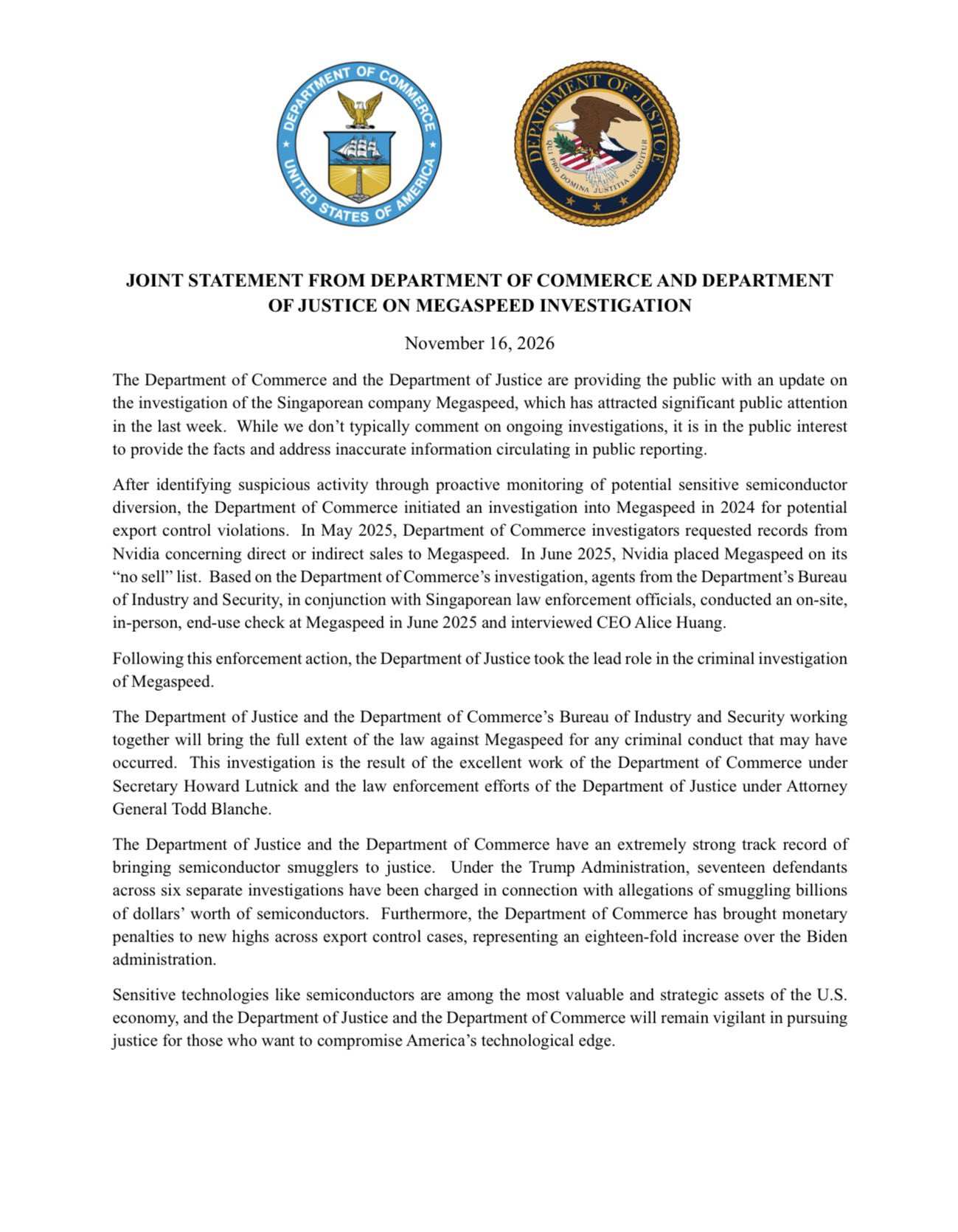
U.S. agencies confirm 2024 investigation into Nvidia partner Megaspeed, make no allegations against Nvidia
 Daniel Levi
Posted On November 17, 2026
The U.S. Departments of Commerce and Justice have confirmed that federal authorities began investigating Singapore-based cloud computing company Megaspeed in 2024 over suspected violations of semiconductor export controls. The joint statement, released Monday, sheds new light on a two-year investigation that has drawn Nvidia into a growing controversy following the resignation of its longtime CEO, Jensen Huang.
The statement makes no allegations of wrongdoing against Nvidia. Instead, it identifies Megaspeed as the subject of the investigation and details the chipmaker’s actions after U.S. authorities requested information about its business dealings with the Singaporean company.
The disclosure comes as Nvidia faces intense scrutiny over its relationship with Megaspeed, a cloud computing firm operating data centers across Southeast Asia, and questions about whether advanced AI chips were diverted to customers in China.
In the joint statement released November 16, the agencies said Commerce investigators identified suspicious activity involving the possible diversion of sensitive semiconductors, prompting an investigation into Megaspeed in 2024.
Joint Statement from Department of Commerce and Department of Justice on Megaspeed Investigation. https://t.co/aAdtN9aDfF
— U.S. Department of Commerce (@CommerceGov) November 17, 2026
In May 2025, investigators requested records from Nvidia concerning direct or indirect sales to Megaspeed. A month later, Nvidia placed the company on its “no sell” list, effectively blocking further direct sales under its internal restrictions.
That same month, officials from the Commerce Department’s Bureau of Industry and Security, working with Singaporean law enforcement, conducted an on-site inspection of Megaspeed and interviewed its then-CEO, Alice Huang.
“Following this enforcement action, the Department of Justice took the lead role in the criminal investigation of Megaspeed,” the agencies said.
U.S. investigation raises questions about Nvidia chip sales
The government’s disclosure establishes a timeline of enforcement actions stretching back two years. Yet it leaves several questions unanswered, particularly whether Megaspeed continued obtaining Nvidia chips through subsidiaries or intermediaries after being placed on the chipmaker’s restricted customer list.
Chris McGuire, senior fellow for China and emerging technologies at the Council on Foreign Relations, questioned the statement’s completeness in a post on X.
“Very, very strange statement tonight… about Megaspeed. The facts here just don’t add up, and this does nothing to explain why Commerce did not cut Megaspeed off from chips,” McGuire wrote.
He questioned whether Nvidia’s restrictions extended to Megaspeed subsidiaries Speedmatrix and PT Megaspeed International, suggesting that sales through related companies could undermine the restrictions.
“I would bet they did not! If they kept shipping to them after blacklisting Megaspeed, that would be very concerning,” he added.
Those concerns remain allegations and questions, not established findings. The joint statement does not say Nvidia violated U.S. export rules, nor does it establish that restricted chips continued reaching Megaspeed after June 2025.
The distinction matters. A company appearing in an export-control investigation does not automatically mean it is suspected of criminal conduct. The agencies have identified Megaspeed as the target of their criminal probe, but their statement does not formally clear Nvidia of potential violations.
Megaspeed probe unfolds amid Nvidia leadership crisis
The investigation has drawn greater attention after reports linked Alice Huang, a former Megaspeed executive, to Nvidia co-founder Jensen Huang, who resigned as CEO last week.
Alice Huang has faced allegations of ties to Chinese intelligence, including claims that she was recruited to gather information about the Nvidia executive. The Justice Department has not concluded that she was a Chinese spy, and Beijing has denied the espionage allegations.
Singaporean authorities have conducted their own investigation into Megaspeed. Police found insufficient evidence to establish certain suspected offenses involving server purchases but warned Alice Huang over inaccurate information about her role at the company. Singapore barred her from re-entering the country in February 2026, CNBC reported.
Megaspeed has maintained that its operations were lawful and that Alice Huang left the company in August 2025.
The controversy has coincided with an extraordinary leadership transition at Nvidia. On November 12, the chipmaker announced that Jensen Huang had resigned as CEO and board member, ending his 33-year tenure at the company he co-founded.
Nvidia appointed longtime Chief Financial Officer Colette Kress as interim CEO. She is scheduled to lead the company’s third-quarter earnings call on Tuesday, November 17, her first since taking the role.
For Nvidia, the immediate challenge extends beyond its leadership shake-up. The company must reassure investors about its operations as questions continue over the movement of advanced AI chips through overseas cloud providers.
For U.S. regulators, the Megaspeed investigation presents a broader test of semiconductor export enforcement.
The latest government statement clarifies when authorities began investigating Megaspeed and what steps they took in 2025. It does not resolve whether restricted chips reached China through related companies, nor does it establish wrongdoing by Nvidia.
That leaves a central question unanswered: How effectively can U.S. authorities track advanced AI chips after they enter international distribution networks?