AI discovers critical Java security flaw threatening enterprise systems used by Fortune 500 companies
 Daniel Levi
Posted On November 17, 2026

An AI-assisted security researcher uncovered a critical Java vulnerability in just one hour, then developed a working exploit in another two hours, spending less than $200 on AI tokens. The discovery has exposed a serious weakness in software used by some of the world’s largest corporations and raised fresh questions about how quickly artificial intelligence can find security flaws that have gone unnoticed for years.
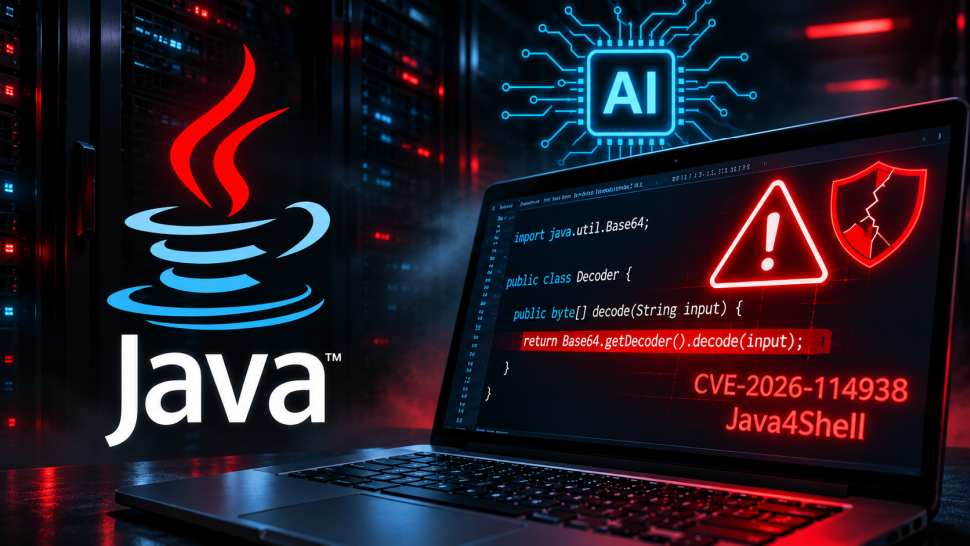
The vulnerability, dubbed Java4Shell (CVE-2026-114938), affects OpenJDK, the open-source foundation of Java, a programming platform that runs countless enterprise applications, financial systems, and cloud services.
Security researchers at Calif, the firm behind the discovery, say the flaw could allow attackers to execute malicious code remotely without authentication under certain conditions. The vulnerability carries a critical severity score of 9.2 under the CVSS 4.0 scoring system.
Since the vulnerability has leaked: Calif discovered and reported Java4Shell (CVE-2026-114938).
We’re publishing technical details by 1 PM Pacific today, after Oracle releases a patch.
Stay tuned!
— Calif (@calif_io) November 17, 2026
The stakes are significant. Java is used by approximately 90% of Fortune 500 companies, according to IBM figures cited by Calif. That doesn’t mean every company running Java is vulnerable, but it highlights how deeply the technology is embedded in corporate infrastructure.
How AI uncovered a critical flaw hiding inside Java
The discovery began when Calif security researcher Quang Luong turned to OpenAI’s Codex to help investigate potential weaknesses in OpenJDK’s HotSpot Java Virtual Machine.
According to Calif’s technical disclosure, Luong identified the vulnerability in roughly an hour and developed an initial working exploit within another two hours. The entire effort consumed less than $200 in AI tokens.
“While PHP is a high-level web technology, Java sits much deeper. Java is the world’s third most popular programming language, powering 90% of Fortune 500 companies. It is the beating heart of the modern economy. Banking, aviation, telecommunications, nearly every critical sector runs on Java, including national security systems,” Luong wrote.
The flaw lies in Java’s Base64 decoder, which converts encoded text into binary data. Base64 is widely used in authentication systems, file uploads, and communication between applications.
Java has long been recognized for its memory-safety protections, which help prevent many security problems commonly found in lower-level programming languages.
But Calif discovered that an assembly-language optimization intended to speed up Base64 decoding could corrupt memory when processing specially crafted input.
That weakness could allow attackers to read sensitive information or execute unauthorized commands on affected servers.
Calif demonstrated successful remote code execution against several widely deployed enterprise applications in controlled tests, including Atlassian Jira, Confluence, Jenkins, Keycloak, JFrog Artifactory, and PingFederate.
The researchers demonstrated attacks involving applications built with Spring Boot and Apache Struts, two popular Java frameworks.
The vulnerability has limitations. Exploitation requires certain x86-64 processors supporting AVX-512 VBMI instructions, and the attack depends on how an application handles malicious input. ARM64 processors are not affected by this particular flaw.
Calif stressed that different applications require different exploitation techniques, meaning no single attack automatically compromises every Java installation.
Oracle releases emergency security patches as AI reshapes vulnerability discovery
The disclosure coincided with Oracle’s November 17 security update, which includes fixes for 11 Java SE vulnerabilities.
In its official security advisory, Oracle confirmed the release of security patches and urged customers to update affected systems without delay.
“A Critical Security Patch Update (CSPU) provides targeted, high-priority security fixes in a smaller, more focused format, making them easier to apply with minimal disruption. Critical Security Patch Updates complement Oracle’s existing quarterly cumulative Critical Patch Updates (CPUs). These patches address vulnerabilities in Oracle code and in third party components included in Oracle products. Prior Critical Patch Update and Critical Security Patch Update advisories should be reviewed for information regarding earlier published security patches. Refer to Critical Patch Updates, Critical Security Patch Updates, Security Alerts and Bulletins for information about Oracle Security advisories,” Oracle said on its security alert page.
Meanwhile, Calif reported that Java4Shell affects OpenJDK versions starting with 17.0.6, and other affected releases and distributions require attention. Organizations are being encouraged to identify vulnerable Java installations, review exposed applications, and install the appropriate updates from their Java vendors.
The discovery comes as AI becomes increasingly capable of examining large codebases, identifying potential weaknesses, and helping researchers develop exploits.
For years, discovering sophisticated software vulnerabilities required considerable manual effort, specialized expertise, and extensive testing.
Java4Shell suggests that timeline may be shrinking.
Calif describes its approach as a collaboration between human researchers and AI agents. Security experts guide the investigation and evaluate findings, while AI handles parts of code analysis and exploit development.
The distinction matters. AI did not independently discover and validate every aspect of Java4Shell. Human expertise remained central to the research.
Yet the speed and low cost of the discovery raise difficult questions for software vendors and cybersecurity teams. The same tools helping researchers identify vulnerabilities could eventually make similar capabilities accessible to attackers.
The cited disclosures provide no evidence that Java4Shell has been exploited in the wild, but Calif’s successful demonstrations show why affected organizations cannot afford to ignore the warning.
For enterprises running Java, the immediate priority is patching vulnerable systems.
For the broader technology industry, the implications extend further. When AI can help uncover a critical vulnerability in one of the world’s most widely deployed programming platforms in hours, the race between those finding security flaws and those fixing them may be entering a new phase.