Replit raises $400M at $9B valuation as AI coding platform surges to over 40M users
 Nickie Louise
Posted On March 11, 2026
Nickie Louise
Posted On March 11, 2026
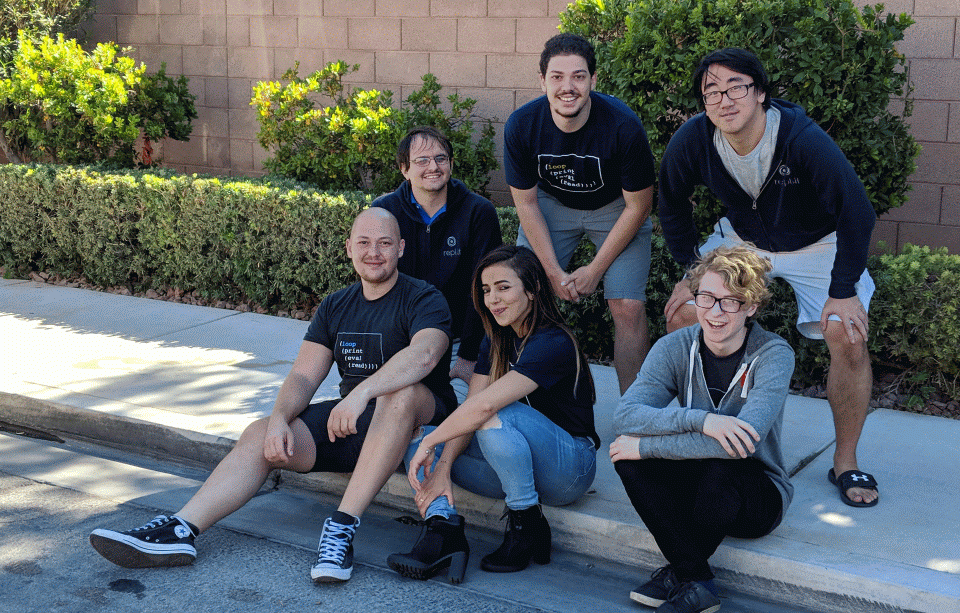
Replit just landed one of the biggest funding rounds in developer tooling this year. The AI coding platform has raised $400 million at a $9 billion valuation, tripling its value in roughly six months and drawing fresh attention to a new class of tools reshaping how software gets built.
The round brought together a long list of investors, including Georgian, G Squared, Prysm, 1789, Y Combinator, Coatue, a16z, Craft, and Qatar Investment Authority. Strategic investments came from Accenture, Databricks, Okta, and Tether. The mix of venture firms and enterprise players points to growing interest in platforms that make it easier for teams across an organization to build software.
Replit founder and CEO Amjad Masad shared the news on X:
“We’ve raised $400M at a $9B valuation. Investors include Georgian, G Squared, Prysm, 1789, YC, Coatue, a16z, Craft, and QIA, with strategic investments from Accenture, Databricks, Okta, and Tether. We’re also lucky to have incredible individuals backing us, including Shaq and Jared Leto.”
We’ve raised $400M at a $9B valuation.
Investors include Georgian, G Squared, Prysm, 1789, YC, Coatue, a16z, Craft, and QIA, with strategic investments from Accenture, Databricks, Okta, and Tether. We’re also lucky to have incredible individuals backing us, including Shaq and… pic.twitter.com/Ci0OrpDkP3
— Amjad Masad (@amasad) March 11, 2026
“This funding will help us scale our ambition and expand beyond coding into AI systems that center human creativity. Replit is now used at 85% of the Fortune 500. We have an opportunity to help shape the future of work. One where AI abstracts away the boring parts and humans shine as creative directors. We’re also investing more globally, particularly in Europe, Asia, and the Middle East. Innovation can come from anywhere in the world, and we want to help unlock it,” Masad added.
Masad launched Replit in 2016 as a browser-based coding workspace that allowed developers to write and run code together from anywhere. The platform started as a collaborative environment for programmers. It has evolved into an AI-driven development system that lets users build, test, and deploy applications from a single interface.
The platform’s “vibe coding” approach sits at the center of its appeal. Developers describe what they want, and AI helps generate the code and structure behind it. The model opens the door for designers, product managers, educators, and business teams who want to prototype ideas without deep engineering experience.
Replit’s growth tells the story. Annualized revenue climbed from $2.8 million to $150 million in about a year, according to company figures. The platform now counts 40 million users worldwide. Large companies have begun experimenting with it as well. Zillow and Duolingo are among those testing the platform to enable internal teams to build tools without waiting on traditional engineering pipelines.
A major catalyst arrived in September 2024 with the launch of Replit Agent, an AI system that can write, debug, and deploy code with minimal manual input. The tool helped push Replit past $100 million in annual recurring revenue, a tenfold jump from the end of the previous year.
The new model shifts programming into something closer to a conversation. A user describes a feature or idea, and the system produces working code. Teams then refine and ship the project from inside the same workspace.
The rise has not been without friction. Earlier this summer, the Replit Agent mistakenly deleted a customer’s codebase. Masad issued a public apology, and the company rolled out new safeguards after the incident. The episode served as a reminder that AI-driven development tools still carry risk even as adoption climbs.
Despite that setback, investor interest remains strong. The latest funding places Replit among the most valuable startups building AI development platforms. The company now faces the next challenge: turning a wave of developer enthusiasm into a durable platform that reshapes how software gets created across companies, classrooms, and startups around the world.
Trending Now
Top Tech News Today, March 25, 2026