Cursor upgrades AI coding agents as $29.3B startup battles Anthropic, OpenAI, and Microsoft
 Daniel Levi
Posted On February 25, 2026
Daniel Levi
Posted On February 25, 2026

Cursor is moving fast to maintain its early lead in AI coding. On Tuesday, the startup rolled out a major update to its artificial intelligence agents, aiming to stay ahead of mounting pressure from heavyweights like Anthropic, OpenAI, and Microsoft.
The stakes are rising. Cursor told CNBC its upgraded agents push performance further at a moment when the AI coding market is filling up with serious contenders. The company’s valuation has climbed to $29.3 billion, and by November it had crossed $1 billion in annualized revenue. Cursor entered the AI coding scene early, but the window of easy advantage is closing.
Interest in AI agents has surged over the past year as model capabilities improved. Software developers have been among the first to adopt the tools, using them to generate, edit, and review code. Cursor is betting the next phase is deeper automation inside real development workflows.
The company’s updated agents can now test their own changes and document their work using videos, logs, and screenshots. Developers can trigger the agents from the web, Cursor’s desktop app, mobile devices, Slack, or GitHub. The goal is simple: reduce the manual steps that slow teams down.
A key shift sits under the hood. The agents can run in parallel inside full development environments hosted on their own virtual machines. These cloud-based systems behave like physical computers, so agents no longer compete for resources on a developer’s laptop or waste time setting up environments.
“Instead of having one to three things that you’re doing at once that are running at the same time, you can have 10 or 20 of these things running,” Alexi Robbins, co-head of engineering for asynchronous agents Cursor, told CNBC in an interview. “You can have really high throughput with this.”
The competitive pressure is real. As of February, Anthropic’s Claude Code had reached more than $2.5 billion in run-rate revenue. OpenAI’s Codex has topped 1.5 million weekly active users. Microsoft CEO Satya Nadella said in October that GitHub Copilot had surpassed 26 million users. Cursor is growing into a crowded field where distribution and product depth both matter.
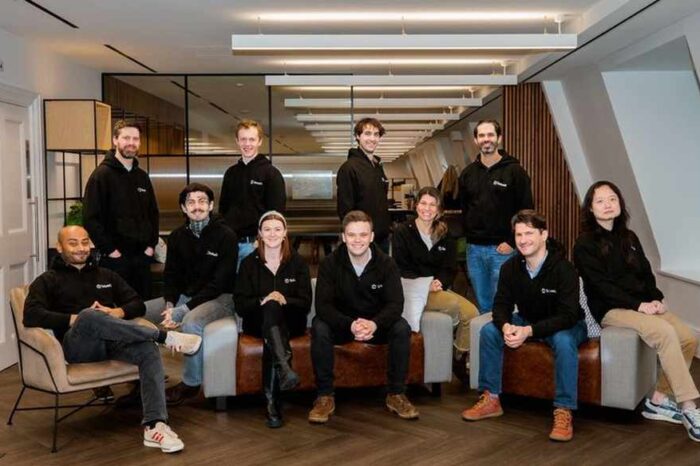
Founded in 2022 by four MIT graduates, Cursor built a devoted following after releasing the first version of its AI coding product the following year. TechStartups previously reported that the company raised $2.3 billion in Series D funding, co-led by Accel and Coatue, with participation from Andreessen Horowitz, Thrive Capital, Nvidia, and Google. The round pushed Cursor’s valuation to $29.3 billion, more than ten times its level earlier in the year.

Cursor Founders
The company says developers can now hand off more complex work to the upgraded agents, which can test and refine features until completion. The pitch is clear: fewer hours spent editing files and combing through code, more time focused on product judgment and design choices.
“We think of this less like a new feature and more like, ‘This is what it’s going to look like working with agents,’” said Jonas Nelle, Cursor’s other co-head of engineering for asynchronous agents. “They’re not just writing software, writing code, they’re sort of becoming full software developers.”
Inside Cursor, the shift is already visible. Nelle said internal testing has been a “big transformation” for the company. Around 35% of Cursor’s pull requests are now generated by agents running on their own virtual machines, a signal of how quickly the workflow is changing.
“You as an individual can do so much more by working with these agents,” Nelle said. “This is another step change in that progression.”
Cursor’s update arrives at a moment when AI coding tools are moving from helpful assistants to systems capable of taking on meaningful chunks of software work. Whether the company can hold its early advantage will depend on how quickly developers adopt this more autonomous model—and how aggressively rivals respond.
Trending Now
Top Tech News Today, March 25, 2026