The “Build It and They Will Come” Model Is Broken. The New Flywheel: If They Come, Build It
 Daniel Levi
Posted On February 24, 2026
Daniel Levi
Posted On February 24, 2026

For decades, founders have repeated the same advice: “build something great, and users will come.” But a small iOS app called Push Scroll tells a very different story.
Before a single line of production code existed, the creators behind the push-up-before-scrolling app ran an experiment. Instead of building first, they produced a short-form video showing how the app would work. The clip highlighted a familiar pain point: before you could keep scrolling, you had to complete push-ups.
The twist? The app didn’t exist.
The video did.
The team published multiple concept videos across social platforms to test different ideas. One concept took off, pulling in hundreds of thousands of views. Only after the signal was clear did they move quickly to build the actual product.
Today, Push Scroll is reportedly generating around $30,000 in monthly revenue.
The lesson is hard to ignore. Validation no longer has to come after the product ships. In many cases, it can come before the product even exists.
Push Scroll is not an isolated case. It is a signal.
Across the startup ecosystem, a growing number of founders are quietly reversing the traditional sequence. Instead of building first and hoping users show up later, they are watching where demand forms, pulling audiences together, and only then shipping tightly scoped products.
What’s emerging is a new operating model for modern builders.
Why the Old “Build It and They Will Come” Model Is Breaking Down
The traditional product-first playbook worked when software was expensive to build and distribution channels were less crowded. That environment has changed.
AI tools have dramatically lowered the cost and time required to create software. What once took months and a full engineering team can now be prototyped in days. The result is a surge of new tools competing for the same finite user attention.
At the same time, distribution has become the real bottleneck. Organic reach is fragmented. Paid acquisition costs have climbed. SEO still compounds, but it requires patience and precision.
User behavior has also shifted. People now expect immediate utility. If a product does not solve a clear problem within seconds, they move on.
Together, these forces have weakened the old assumption that great products naturally attract users.
The Rise of the Demand-First Flywheel
A different pattern is emerging among efficient builders.
Instead of starting with code, they start with signals.
They monitor search queries. They watch short-form video engagement on platforms like TikTok. They analyze repeated workflow friction. They focus on where users are already struggling.
Only after demand becomes visible do they build.
At TechStartups, we call this model the Demand-First Flywheel:
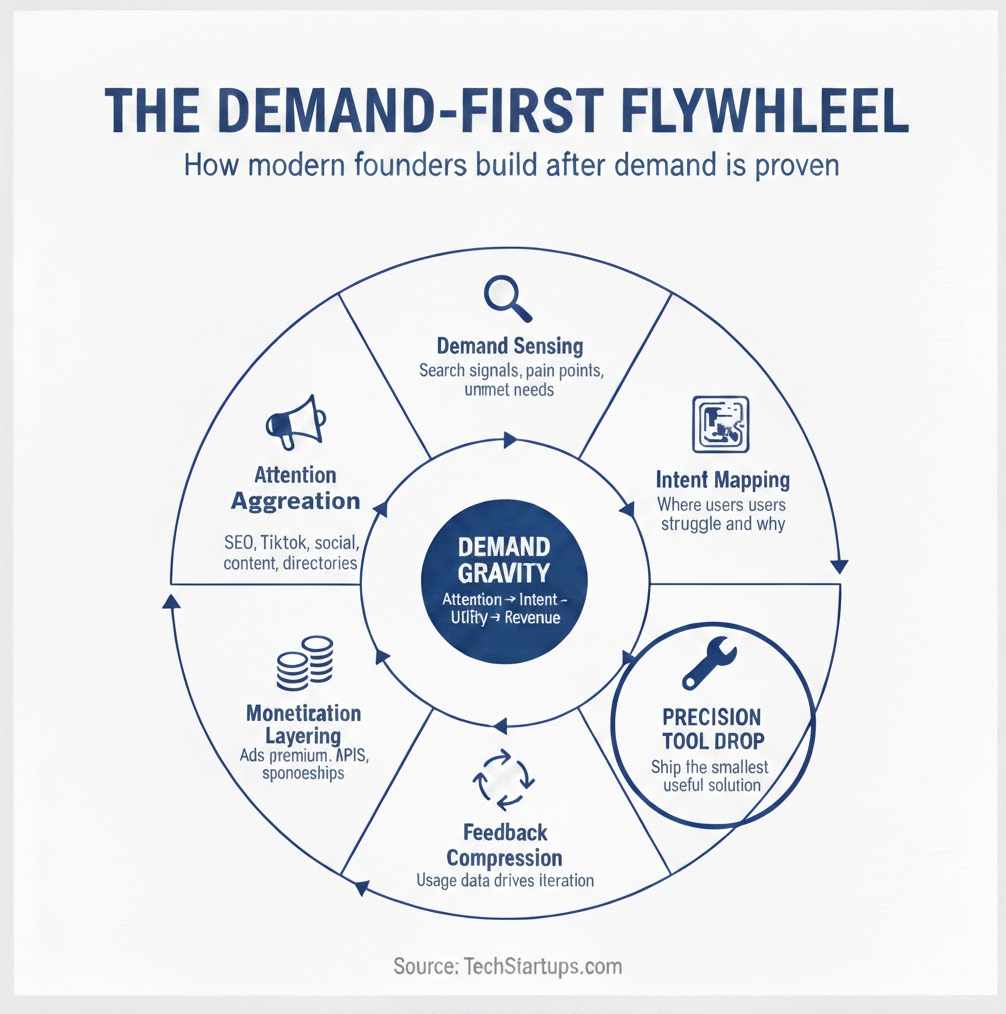
The Demand-First Flywheel shows how modern builders validate demand before shipping a product. (Source: TechStartups)
-
Demand sensing
-
Attention aggregation
-
Intent mapping
-
Precision tool drop
-
Feedback compression
-
Monetization layering
Each stage reinforces the next. Traffic informs product decisions. Product usage sharpens iteration. Monetization becomes more durable once utility is proven.
Attention Is the New Scarce Resource
One of the biggest mental shifts for founders is recognizing what actually compounds today.
It is not feature count.
It is not code volume.
It is qualified attention.
An audience that consistently arrives with a specific problem is one of the most defensible starting points a modern builder can have. When trust and intent are already concentrated, even simple tools can gain traction quickly.
This is why we are seeing growth in:
-
niche mobile apps
-
microSaaS apps
-
vertical apps
-
comparison hubs
-
single-purpose utilities
These products succeed not because they are technically complex, but because they sit directly in the path of existing demand.
Where Many Founders Still Misstep
Despite the shift, many teams continue to follow outdated patterns.
Some build full SaaS platforms before validating real demand. Others chase feature depth rather than solving a single sharp pain. Many treat traffic as a vanity metric rather than a signal of intent.
Premature monetization is another common mistake. When founders try to extract revenue before users experience clear utility, growth often stalls and trust erodes.
The demand-first approach requires patience early and precision later. Skipping either step weakens the flywheel.
What This Means in the AI Era
AI has permanently changed the build-versus-distribution equation.
Because software creation is becoming faster and cheaper, the advantage is shifting toward founders who can:
-
identify demand early
-
attract the right audience
-
ship narrowly scoped solutions
-
iterate based on real usage
In this environment, the winning question is no longer, “What should we build first?”
It is:
Where is demand already forming, and how quickly can we serve it?
Founders who internalize this shift move faster with less risk. Those who ignore it often ship into crowded markets with little traction to show for it.
The Bottom Line
“Build it, and they will come” is no longer a reliable strategy.
The modern playbook is more disciplined and more data-driven: bring the right users first, study their friction points, and then build exactly what removes the pain.
In a world where software supply keeps rising, clarity in demand is the real advantage.
And increasingly, the builders who win are the ones who wait for the signal before they ship.
Trending Now
Top Tech News Today, March 25, 2026