Claude Code targets COBOL, sending IBM stock down over 10%
 Daniel Levi
Posted On February 23, 2026
Daniel Levi
Posted On February 23, 2026
Anthropic says its AI coding tool can automate legacy COBOL modernization, raising fresh questions about IBM’s mainframe moat.
IBM shares slid sharply after Anthropic stepped into one of enterprise computing’s most entrenched strongholds: COBOL. In a new post promoting its Claude Code product, the AI startup laid out a vision for automating legacy code modernization, a move that lands squarely in territory long dominated by IBM’s mainframe ecosystem.
The development comes less than two weeks after Anthropic’s Claude plugins triggered a $285 billion Wall Street “SaaSpocalypse” as AI tools began targeting entire SaaS workflows.
IBM Shares Fall as Anthropic Moves on COBOL Modernization With Claude Code
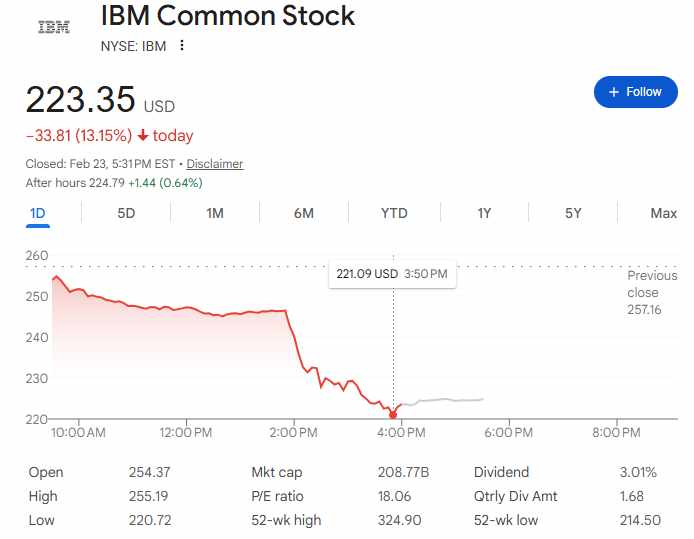
The market reaction was swift. IBM fell more than 10% as investors weighed what credible AI-assisted migration could mean for decades-old mainframe lock-in. IBM shares fell $33.81, or 13.15%, to close at $223.35 on Monday.
The reaction quickly spilled onto social media. On X, The Kobeissi Letter, an industry commentary on global capital markets, wrote:
“IBM stock, $IBM, falls over -10% after Anthropic announces that Claude can streamline COBOL code. It’s becoming increasingly clear how pivotal the times we are in right now truly are.”
BREAKING: IBM stock, $IBM, falls over -10% after Anthropic announces that Claude can streamline COBOL code.
It’s becoming increasingly clear how pivotal the times we are in right now truly are. pic.twitter.com/yGVZBeHk3R
— The Kobeissi Letter (@KobeissiLetter) February 23, 2026
COBOL, short for Common Business-Oriented Language, still runs much of the world’s financial plumbing. Systems written in the language handle everything from ATM transactions to airline operations and government workflows. The problem is not that COBOL stopped working. It is that the people who know it are steadily disappearing.
IBM Mainframe Moat Meets Claude Code: Anthropic’s COBOL Play Spooks Wall Street
Anthropic is betting that this talent gap creates an opening.
In its blog post, the company argued that tools like Claude Code can automate the most time-consuming parts of legacy modernization. The pitch is straightforward: let AI map sprawling codebases, surface hidden dependencies, and translate aging logic into modern languages, all under human supervision. Anthropic says the process allows teams to move incrementally rather than attempt risky full rewrites.
“Modernizing a COBOL system once required armies of consultants spending years mapping workflows. This resulted in large timelines and high costs that few were willing to take on.
AI changes this.
Tools like Claude Code can automate the exploration and analysis phases that consume most of the effort in COBOL modernization,” Anthrophic said in a blog post.
For enterprises sitting on decades of accumulated business logic, that promise carries weight.
IBM, of course, is not standing still. The company has its own AI modernization push through watsonx and continues to position its Z mainframes as the safest long-term home for mission-critical workloads. The strategy is deeply tied to IBM’s broader revenue engine.
“The strength of our Z placement fuels our flywheel for growth with its attractive 3x to 4x stack multiplier across IBM,” CFO James Kavanaugh said after the company’s latest earnings report.
That “Z” flywheel matters. Mainframes often anchor high-margin software, services, and support contracts. Keeping workloads on IBM infrastructure has long been part of the company’s economic model.
Anthropic’s message points in the opposite direction. Its framework assumes that organizations may want the freedom to move workloads across cloud environments once legacy code becomes easier to migrate. The company argues that AI shifts the economics that kept modernization projects stalled for years.
“Legacy code modernization stalled for years because understanding legacy code cost more than rewriting it. AI flips that equation.”
The claim speaks to a long-standing pain point. Large COBOL systems were built and modified across decades, often with incomplete documentation. Many projects failed or ballooned in cost after teams discovered hidden dependencies late in the process. Anthropic says AI-driven code analysis can surface those risks early.
The company highlights several capabilities it believes change the equation: automated dependency mapping, workflow reconstruction, and risk scoring across massive codebases. In its view, engineers can focus on validation and business logic instead of spending months deciphering old systems.
Still, the path forward is not purely technical. Many banks, airlines, and government agencies keep COBOL tied to mainframes for reasons that go beyond cost. Reliability, regulatory comfort, and operational familiarity all play a role. For many IT leaders, the existing system remains the devil they know.
That reality gives IBM breathing room. Even with stronger automation, full migration of core financial infrastructure remains a slow, risk-heavy process. Enterprises rarely move these systems quickly.
Yet the direction of travel is becoming harder to ignore.
If AI tools can shorten modernization timelines from years to quarters, the pressure on legacy platforms will grow. Investors appear to be factoring in that possibility now, which helps explain the sharp move in IBM’s stock.
Anthropic is still early in proving real-world impact at scale. Enterprise migrations live and die on reliability, auditability, and regulatory sign-off. Many CIOs will want hard evidence before shifting mission-critical workloads.
For the moment, the episode highlights something bigger than a single product launch. AI coding tools are starting to probe parts of the enterprise stack that once looked untouchable.
COBOL may be old. The business logic inside it is anything but.

Anthrophic
Trending Now

Top Tech News Today, March 13, 2026