This Nuclear Engineer Turned a ‘Boring’ Niche into a $50M-a-Year Business
 Daniel Levi
Posted On February 17, 2026
Daniel Levi
Posted On February 17, 2026

From Submarines to HOA Software
Ben Currin didn’t plan to build software for homeowners’ associations.
He trained as a nuclear engineer. He served as a submarine officer in the U.S. Navy. His early career revolved around reactor systems and national defense — not homeowner dues, condo elevators, or accounting workflows.
Yet today, the company he leads helps manage more than 6 million homes across 50,000 communities. It serves roughly 500 professional community association management firms, and, based on disclosed growth figures from a recent interview on The Top podcast with Nathan Latka, the business has grown from high-single-digit millions in ARR in 2022 to roughly $50 million in ARR after a minority private equity investment.
The market he entered is rarely discussed in startup circles.
Community association management — better known as HOA management — isn’t glamorous. It’s not consumer social. It’s not AI-native crypto fintech. It’s an operational industry built around shared properties: condominium buildings, gated neighborhoods, clubhouses, golf courses, landscaping, insurance, compliance, and dues collection.
But hidden inside that “boring” category was a sneaky-big opportunity.
And Currin saw it.
The Sneaky Size of the HOA Market
Community association management doesn’t make headlines. No one goes to business school planning to run an HOA management firm. And yet the industry quietly sits at the center of millions of Americans’ daily lives.
If you’ve lived in a condominium building with a shared roof and elevator, or in a neighborhood with a clubhouse, pool, landscaped common areas, or even a golf course, you’ve interacted with a homeowners’ association. Behind every one of those communities is a professional management company responsible for running what amounts to a small, highly regulated financial entity.
They collect dues. They pay vendors. They manage insurance policies and reserves. They oversee compliance with community covenants. They close monthly financials. They coordinate maintenance, handle homeowner disputes, process invoices, and prepare budgets.
It is operational work. Financial work. Administrative work.
It is also recurring, complex, and deeply embedded in the real estate sector.
That is the environment Vantaca entered.
Today, Vantaca serves approximately:
-
500 management company customers
-
Representing 50,000 communities
-
Covering more than 6 million homes
That scale reveals something important: this isn’t a niche in the sense of “small.” It’s a niche in the sense of “overlooked.”
Currin and his co-founder, Dave Sawyer, understood that the opportunity wasn’t in chasing consumer growth. It was in becoming indispensable to the firms already running these communities. Vantaca positioned itself as the general ledger system of record for management companies — the accounting backbone, workflow engine, reporting system, and homeowner engagement portal all in one.
In vertical SaaS, the system of record is everything. Once a platform controls the ledger and operational workflows, switching becomes expensive and risky. That foundation creates the opportunity to expand monetization beyond basic licensing.
Industry pricing often ranges from 50 cents to $1 per door per month. At scale, that alone can support meaningful recurring revenue. But once embedded, Vantaca layered in payments for inbound dues and outbound vendor payouts, treasury connections tied to association deposits, and tools that extend into the vendor ecosystem.
The strategy is straightforward in hindsight: win the ledger, then expand into the financial flows surrounding it.
What looks like a “boring” software product is, in reality, a high-retention financial infrastructure layer within a fragmented yet essential industry.
And that is what made the market so valuable.
The Bootstrapped Climb from $300K to $10M ARR

Vantaca CEO Ben Currin is talking to the team
When Currin joined Sawyer in late 2017, there was no grand financing strategy. There was no roadmap to a minority private equity round. There wasn’t even a polished SaaS machine.
There was an industry insider who had felt the pain firsthand.
Sawyer owned a community association management company. Frustrated by outdated tools and manual processes, he began building software internally to run his own firm. That company became the first beta customer. The product wasn’t born in a pitch deck; it was born in operational necessity.
Currin entered the picture just as that early foundation was taking shape.
By 2018, Vantaca generated only a few hundred thousand dollars in revenue. It was early-stage, fragile, and proving itself in a conservative market that doesn’t change vendors lightly.
But growth came quickly.
By 2019, the company crossed its first $1 million in annual revenue. Not through aggressive marketing spend. Not through venture-backed blitzscaling. Instead, it relied on customer advocacy inside a tight-knit industry. Early management company clients opened their doors to prospects and showcased real operational improvements.
The playbook was simple:
Win one credible operator.
Prove measurable efficiency gains.
Use that proof to close the next one.
Because the product controlled accounting and workflows, customers tended to expand their usage rather than churn.
Since 2019, the company has reinvested nearly all of its earnings in product and team growth. Sales and marketing spend remained modest. Hiring was deliberate. Expansion was funded largely from operating cash flow.
By 2022, Vantaca had quietly reached what Currin described in his interview as “high single-digit millions” in annual recurring revenue — somewhere between $5 million and $10 million — entirely bootstrapped.
That milestone mattered.
It meant the business had survived five years in the market. It had proven retention. It had established pricing power. And most importantly, it had demonstrated repeatability.
The company wasn’t searching for product-market fit anymore. It had found it.
What changed in 2022 wasn’t validation.
It was a constraint.
As Currin explained, the team realized they weren’t facing a lack of demand. They were limited by capacity. Onboarding resources, product development velocity, engineering bandwidth, and sales coverage were becoming bottlenecks. Each additional dollar invested in the business reliably produced more revenue, but growth was paced by available internal capital.
That is a very different position from a startup burning cash in search of traction.
Vantaca had traction.
Now it needed acceleration.
The Minority Bet — and the 10x Acceleration
By the summer of 2022, Vantaca was no longer a fragile startup. It was a proven vertical SaaS company generating millions in recurring revenue, embedded in hundreds of management firms, and steadily expanding its footprint across thousands of communities.
But growth had begun to expose its limits.
Every additional hire increased onboarding capacity. Every engineering addition accelerated the product roadmap. Every incremental sales investment opened new segments of the market. The economics were clear: reinvestment produced measurable returns.
The constraint was capital.
Rather than pursue a traditional venture capital path or sell control of the company, Currin and his co-founder made a different decision. They partnered with JMI Equity in a minority investment.
The structure mattered.
The deal included both primary capital—cash invested in the business to fund expansion—and secondary liquidity for early contributors who had taken risks in the formative years. But the founders retained majority control.
It was not an exit.
It was fuel.
That distinction shaped what happened next.
With additional capital, Vantaca expanded product development, invested ahead of sales, and increased operational capacity. Onboarding bottlenecks eased. Engineering velocity improved. Sales coverage widened.
The result, according to Currin’s own description, was more than 10x growth from 2022 levels to today.
If the company was generating high-single-digit millions in ARR before the investment, that implies ARR is now roughly $50 million.
What changed wasn’t the market.
It wasn’t a pivot.
It was speed.
The minority structure allowed the founders to capitalize on the business without prematurely giving up control at a stage when they believed meaningful upside still remained. It also preserved cultural continuity inside an industry where relationships and trust matter deeply.
In 2024, the company further strengthened its position by bringing on another minority investor, Cove Hill Partners, through a recapitalization. Again, the approach followed the same principle: provide liquidity where appropriate, strengthen the balance sheet, and continue compounding inside the same vertical.
For many founders, the lesson is subtle but important.
Capital is most powerful when it removes a bottleneck in a system that already works.
In Vantaca’s case, the product was validated. The customers were sticky. The economics were clear. The only missing ingredient was acceleration.
And acceleration, when applied to a proven engine, compounds quickly.
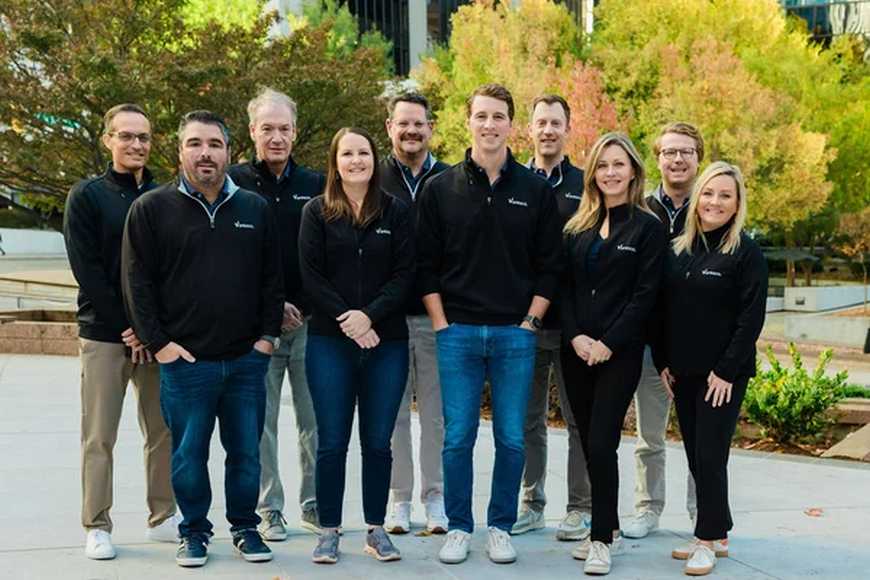
Vantaca Team
The AI Layer — Turning Infrastructure Into an Agentic Platform
For the first several years of its growth, Vantaca was fundamentally an operational system: a ledger, a workflow engine, a payments layer. It replaced fragmented processes with centralized control.
Then AI moved from the experimental stage to the practical stage.
Currin has described artificial intelligence as the single biggest shift inside the company over the past few years. But Vantaca didn’t approach AI as a marketing feature. It approached it as an extension of the workflow.
In late 2024, the company acquired HOAi, a small startup founded by Y Combinator alumni. The acquisition functioned almost as an acqui-hire — bringing in a team building agent-based automation for the same vertical that Vantaca already dominated.
Rather than bolt AI onto the surface, Vantaca embedded it inside the system of record.
The concept is straightforward: if the platform already handles billing, invoicing, reporting, and communication, an AI agent can operate within those workflows rather than merely analyzing them.
HOAi evolved into an operational agent that can:
Automate accounts payable workflows
Respond to homeowner billing questions
Generate reports
Assist with budget preparation
Execute repetitive administrative tasks
Operate voice agents that handle inbound homeowner calls
In some cases, tasks that previously required weeks of manual coordination were reduced to minutes. In other cases, call center workloads could be supplemented or partially replaced by AI voice systems integrated directly into the ledger and payment infrastructure.
This is an important distinction.
Many companies talk about AI as a layer that interprets data. Vantaca positioned AI as a participant in the workflow—an agent operating within financial systems already trusted by management companies.
Because the company controls the underlying accounting infrastructure, it can deploy automation without forcing customers to integrate external tools or migrate data.
The result is not just efficiency. It is leverage.
Management companies can grow their portfolio of communities without increasing headcount at the same rate. That changes unit economics for Vantaca’s customers — and strengthens retention for Vantaca itself.
In this context, AI does not create a new product category.
It deepens the moat around the existing one.
Why “Boring” Markets Produce Outsized Outcomes
It’s tempting to assume that the biggest outcomes come from the loudest markets.
Crypto. Consumer AI. Social platforms. Autonomous vehicles.
Community association management rarely enters that conversation.
And yet, the mechanics that powered Vantaca’s growth are quietly repeatable across many overlooked industries.
First, the market was fragmented but essential. HOAs and condominium associations are not discretionary. They are structural components of real estate. The financial responsibilities tied to them — dues, reserves, vendor payments, insurance — must be managed regardless of economic cycles.
Second, the product anchored itself as the system of record. In vertical SaaS, control of the ledger is more valuable than surface-level features. When accounting, reporting, and operational workflows live on a single platform, the cost of switching rises, and expansion becomes natural.
Third, monetization is compounded inside the workflow. Pricing per door created predictable SaaS revenue. Payments added transaction-based upside. Treasury connections and vendor ecosystem tools expanded the financial footprint. AI automation increased operational leverage for customers, reinforcing stickiness.
None of these moves required chasing adjacent markets.
They required a deepening presence inside oneself.
The minority private equity strategy amplified the effect rather than altering direction. Capital was used to remove bottlenecks in onboarding, product development, and go-to-market execution. It did not change the company’s identity or force a premature liquidity event.
The result was acceleration, not reinvention.
That’s the part many founders overlook.
Scaling is often less about discovering a new opportunity and more about systematically compounding inside a validated one.
Vantaca didn’t pivot into something trendier. It doubled down on HOA management — and expanded horizontally within that ecosystem.
What looked boring from the outside turned out to be high-value infrastructure from the inside.
And infrastructure businesses, when executed well, tend to endure.
The Larger Lesson for Founders
Ben Currin did not leave the Navy with a plan to build HOA software. He did not chase the most visible startup category. He entered a market he barely knew, partnered with an industry insider who understood its pain, and built patiently.
The early years were modest. A few hundred thousand dollars in revenue. Then a million. Then several million. No headlines. No viral moments.
By the time outside capital arrived, the business was already working.
That sequencing — validation first, acceleration second — is increasingly rare in startup culture.
But it is often more durable.
Vertical SaaS in “boring” markets rarely produces overnight fame. What it can produce, when combined with discipline and operational depth, is steady compounding that becomes difficult to displace.
From submarine officer to vertical SaaS operator, Currin’s path is unconventional.
The strategy behind it is not.
Find a fragmented but essential industry.
Become the system of record.
Expand into financial flows.
Layer automation inside trusted infrastructure.
Use capital to remove constraints, not to chase validation.
Sometimes the most valuable opportunities aren’t hidden.
They’re simply ignored.
For a deeper dive into Vantaca’s growth strategy, pricing model, and minority investment playbook, watch Ben Currin break it down in the full interview below.
Trending Now
Top Tech News Today, March 25, 2026