Figma stock is down 85% from its IPO peak. Here’s what went wrong
 Daniel Levi
Posted On February 4, 2026
Daniel Levi
Posted On February 4, 2026
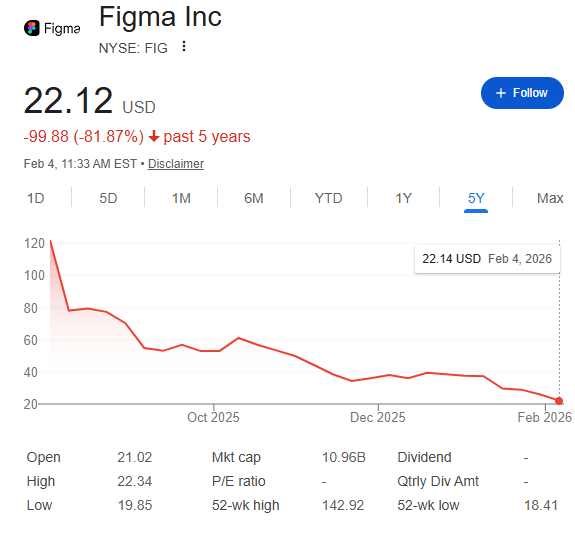
For a brief moment last summer, it looked like Figma had pulled off the cleanest tech IPO in years. The design startup went public on July 31, 2025, debuting on the New York Stock Exchange under the ticker FIG. Shares priced at $33 exploded out of the gate, opening near $85 and closing the first day at $115.50. The stock later touched $143, valuing Figma at over $60 billion and turning its listing into a symbol of renewed faith in growth software.
Six months later, that story looks very different.
By late January 2026, Figma shares were trading near $21. The company’s market cap had fallen to roughly $10.5 billion. More than $50 billion in paper value vanished. The stock was down over 40% for the year and roughly 85% from its post-IPO high. For a company still growing fast, still profitable on an operating basis, and still embedded inside the world’s largest enterprises, the reversal raised an obvious question. What changed?
The short answer is not revenue. Figma crossed the $1 billion annual revenue run rate, with quarterly sales climbing close to 40% year over year. The platform counts 13 million monthly active users and reaches about 95% of the Fortune 500. Google, Microsoft, Netflix, Uber, and Coinbase all rely on it. Two-thirds of its users are not designers. They are product managers, engineers, and business teams who treat Figma as a shared workspace rather than creative software.
The longer answer sits at the intersection of hype, timing, and a fast-moving shift in how software gets built.
Figma’s $68B IPO High to $10B Reality: What Drove an 85% Stock Collapse in Six Months
Founded in 2012 by Dylan Field and Evan Wallace, Figma won by turning design into a shared workspace. What started as a tool for interface designers spread across entire companies, becoming the place teams brainstormed, prototyped, and aligned. Today, more than 13 million people use Figma each month, and most of them are not designers. Product managers, engineers, and executives rely on it as the default layer for collaboration. That broad, non-designer adoption is what made Figma powerful. It is also what puts it directly in the path of AI-driven workflows that no longer need a shared canvas.
Figma’s IPO came loaded with narrative fuel. In 2022, Adobe agreed to buy the company for $20 billion, a deal framed as validation of Figma’s role as the next design platform. Regulators in Europe and the UK shut it down in late 2023, citing competition concerns. When Figma quietly filed for an IPO months later, public investors treated the listing as a second chance to own what Adobe couldn’t.
The offering itself poured gasoline on the moment. Demand pushed pricing above the initial range. The stock’s first-day surge drew in retail traders chasing momentum. Lockups eventually expired. Insider selling followed. Sentiment flipped quickly. Stocktwits chatter swung from neutral to bullish and back again as shares slid session after session.
Still, those mechanics do not explain the scale of the drop. The real pressure point is strategic, not financial.
Figma built its dominance by replacing files with collaboration. Designers stopped emailing assets. Teams worked live. That behavioral shift created a moat that lasted a decade. The problem is that the next shift is not about collaboration. It is about replacement.
AI tools now skip the design file entirely.
Systems like Claude Code allow users to describe an interface in plain language and receive working components in return. For the millions of Figma users who were never designers to begin with, that shortcut matters. If a product manager can generate a prototype through text, the need to open a shared canvas fades. Design becomes output, not process.
Figma has responded by leaning hard into AI. The company launched new features, partnered with OpenAI and Google, acquired Weavy, and rolled out Make. That push carries a cost. Gross margins fell from 91% to 83% over 18 months as infrastructure spending climbed. Investors noticed. The market stopped pricing Figma as a high-margin collaboration platform and started treating it as a software company racing to defend its workflow.
There is a deeper signal inside the tooling itself. Figma’s own MCP server limits how external agents interact with the platform. An indie developer published a post titled “A Better Figma MCP,” showing that Claude could gain more functionality by opening a browser and interacting with Figma’s plugin API directly. The official integration exists to control access, not accelerate it. That stance protects designers. It slows agents.
This is the Adobe playbook flipped. Adobe tried to buy Figma because it broke away from file-based silos. Now Figma is protecting a human-only workspace as AI agents move upstream, removing the need for shared design surfaces altogether.
Public markets tend to price inflection points early. In this case, investors looked past near-term growth and focused on where design workflows might land next. Six months was enough time for enthusiasm to collide with uncertainty. The moat turned out to be behavioral, not technical, and behavior shifts fast when better shortcuts appear.
That does not mean Figma is finished. Crossing $1 billion in revenue gives the company time. Its footprint inside large enterprises is real. Analysts still hold price targets far above current levels ahead of earnings. Figma could still define how AI-assisted design works at scale.
The clock, though, is visible now. Every month that someone ships a working interface from a text prompt instead of opening a Figma file tightens it. Fear of backlash from designers slows progress. Speed favors whoever removes steps.
Six months ago, Figma symbolized the return of the tech IPO. Today, it stands as a reminder of how quickly markets reprice software when the workflow itself is up for grabs.

Figma Founders
Trending Now

Top Tech News Today, March 25, 2026