Ex-Meta engineers raise $3.5M for new startup Slashwork to build an AI-first rival to Slack and Microsoft Teams
 Nickie Louise
Posted On February 4, 2026
Nickie Louise
Posted On February 4, 2026
When Meta shut down Workplace, it quietly left behind a question that many enterprise teams still ask: What comes next after Slack and Teams? A group of former Meta engineers believes the answer lies in software that does more than relay messages. Their new startup, Slashwork, is built around the idea that workplace communication should actively help people find information, connect dots, and get work done.
On Wednesday, the London-based AI startup stepped out of stealth with $3.5 million in funding and a bold thesis. The tools most companies rely on today were shaped long before large language models entered everyday work. Slashwork is betting that starting fresh, with AI embedded at the core rather than layered on later, can change how teams interact with their own knowledge.
After Meta Killed Workplace, Its Former Engineers Are Back With an AI-Driven Replacement
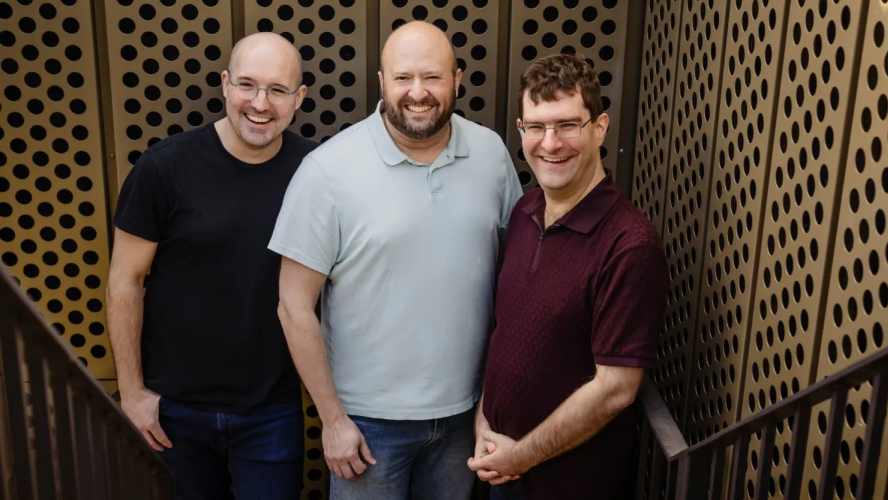
Slashwork was founded by Jackson Gabbard, David Miller, and Josh Watzman, all alumni of Meta’s internal tooling and Workplace efforts. Their pitch is straightforward: today’s dominant communication tools were built before large language models became part of daily work. Slack from Salesforce and Microsoft Teams still center on people sending messages to each other. Slashwork wants to treat every message, file, and image as something software can reason over.
“We’ve started from there, and then we’ve said ‘What about the 2026 AI era?’” Gabbard told CNBC. “What does it look like whenever you start rethinking all of that from the ground up, with AI built into every place that it makes sense?”
Inside Slashwork, every piece of content carries a large language model embedding. That setup lets users search across conversations in plain language, even when they cannot remember where something was shared. The system also supports AI agents that can track down posts or images that do not surface in standard searches. The goal is to make workplace knowledge feel less buried and less dependent on perfect recall.
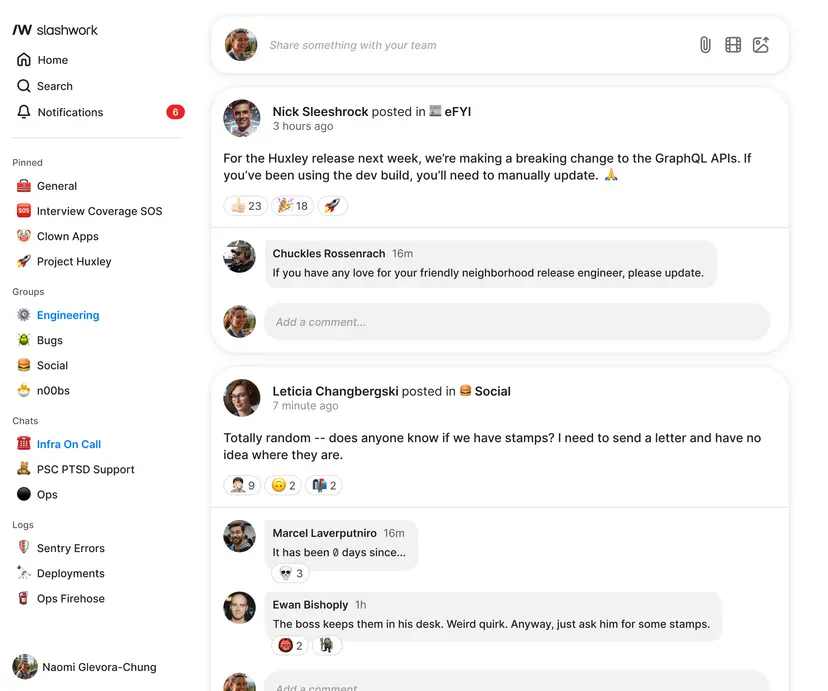
Slashwork
The timing is deliberate. Facebook Workplace launched in 2016 as a familiar, Facebook-style feed for companies. It grew to millions of paid users before Meta announced plans to shut it down in 2024 as leadership shifted focus toward the Metaverse and internal AI bets. That left a gap for customers who liked the social feed model but wanted something that better reflected how work actually flows today.
Slack Co-Founder and Sheryl Sandberg’s VC Back Slashwork’s AI Workplace Platform
The investor list reflects that history. Beyond Sandberg, participants include former Meta revenue chief David Fischer, former ads head Carolyn Everson, and longtime sales leader AJ Tennant, who helped build Slack’s early go-to-market motion. Tennant said the tight link between communication and AI-driven assistance gives Slashwork an edge that older platforms struggle to retrofit.
“Having AI agents that support you in getting your work done, combined with the communication, is going to bridge a lot of gaps that I think exist in enterprise,” Tennant told CNBC.
Another familiar name sits on the board. Julien Codorniou, who ran Workplace from launch through its rise to 11 million paid subscribers, has overseen Slashwork’s incubation. He frames the shift as a move from chat systems built purely for conversation to tools that treat software as an active participant.
“The current generation of tools, Slack, Teams, Zoom — which are all 10 years old, pre-AI — were optimized for people talking to people,” Codorniou said. “With AI we can also have people talking to systems, and that amplifies the potential for communication.”
Slashwork plans to roll out first to smaller, tech-focused teams, with a broader launch planned later this year. Gabbard said the company intends to stay lean, directing most of the new capital into product design and iteration rather than headcount. The founders are betting that a lighter, AI-native approach can win over teams still searching for what comes after Workplace, Slack, and Teams.
Trending Now
Top Tech News Today, March 25, 2026