OpenAI launches ads in ChatGPT as it expands Go Plan and pushes for profitability
 Nickie Louise
Posted On January 16, 2026
Nickie Louise
Posted On January 16, 2026
OpenAI is about to change how people experience ChatGPT. Starting in the coming weeks, the company will begin testing ads inside its chatbot, marking its first serious move into advertising. The test will focus on U.S. users who are on the free plan or the new low-cost ChatGPT Go tier, OpenAI confirmed today.
The timing is no accident. OpenAI is spending aggressively on infrastructure, with long-term commitments of roughly $1.4 trillion for data centers and AI chips. That bill comes fast, even for a company that ended 2025 with an estimated $20 billion in annualized revenue, driven mostly by subscriptions and API sales. The catch? Most of ChatGPT’s hundreds of millions of users still don’t pay.
Ads offer a way to close that gap.
In a post on X, OpenAI wrote:
“In the coming weeks, we plan to start testing ads in ChatGPT free and Go tiers. We’re sharing our principles early on how we’ll approach ads–guided by putting user trust and transparency first as we work to make AI accessible to everyone.”
ChatGPT Is Getting Ads: OpenAI Confirms Testing for Free and Go Users in the U.S.
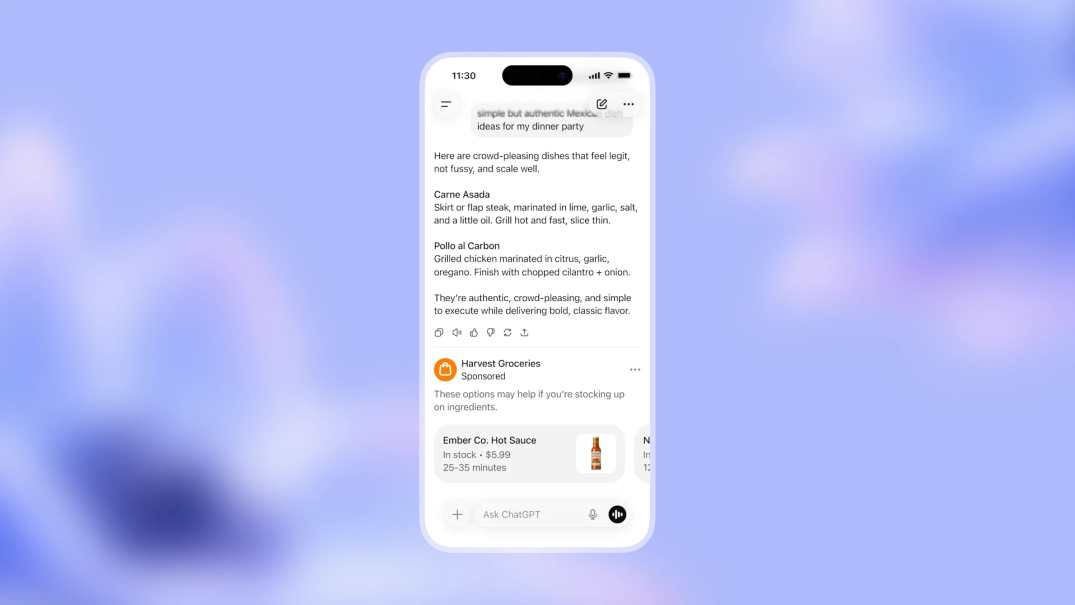
OpenAI says sponsored content will appear at the bottom of responses when relevant, such as a branded hot sauce recommendation after a user asks about Mexican recipes. Each ad will carry a “sponsored” label and sit apart from the main answer. The company insists the core response will stay untouched.
“Responses in ChatGPT will not be influenced by ads,” OpenAI wrote in its announcement.
That promise sits at the center of this experiment. ChatGPT has become a daily tool for work, learning, and personal tasks. Trust is the product. OpenAI knows it.
The company says conversations will stay private and won’t be shared or sold to advertisers. Personalization can be switched off. Users can clear ad data at any time. Ads won’t show for anyone under 18, and they won’t appear near sensitive topics like health, mental health, or politics.
OpenAI Tests ChatGPT Ads as It Eyes Long-Term Revenue Growth
According to OpenAI, paid plans stay clean. Plus, the Pro account at $20 per month and the Business and Enterprise accounts will remain ad-free.
Alongside the ad rollout, OpenAI is pushing its Go plan into the U.S. and global markets. Priced at $8 a month, Go offers more messages, file uploads, image tools, longer memory, and access to models like GPT-5.2 Instant. The tier first launched in India and now covers more than 170 countries.
This two-track strategy is clear. Ads help subsidize free access. Subscriptions protect the premium experience. OpenAI wants to keep AI within reach while building a business that can sustain its own spending.
Fidji Simo, OpenAI’s CEO of Applications, has stressed that preserving trust is most important. People rely on ChatGPT for personal and professional decisions. Turning it into a noisy ad channel would risk everything the company has built.
Public reaction has been mixed. Some see ads as inevitable. Running AI at scale is expensive. Others are not thrilled. Posts on X range from “No one wants ads!” to warnings that ChatGPT is becoming “just another platform.”
OpenAI calls its approach “thoughtful and tasteful.” The company says testing will stay limited at first, with feedback shaping what comes next.
The bigger picture is hard to miss. Google already runs ads inside its AI products. Every major platform eventually looks for a revenue engine that matches its scale. OpenAI is no different.
The company is rumored to be exploring a future IPO. Ads could play a major role in proving it can generate predictable income without leaning only on subscriptions.
For now, OpenAI is betting on transparency. The company published its ad principles in full:
“Our mission is to ensure AGI benefits all of humanity; our pursuit of advertising is always in support of that mission and making AI more accessible.”
It adds that ads won’t shape answers, conversations stay private, users control personalization, and the company won’t optimize for time spent in the app.
“We prioritize user trust and user experience over revenue,” OpenAI said.
That promise will get tested soon.
Once ads go live, users will see them only when a product or service lines up with the current conversation. OpenAI says people will be able to learn why an ad appears, dismiss it, and share feedback.
The company even teased future formats that would let users interact with ads, asking follow-up questions before buying. That could blur the line between assistant and storefront.
Small businesses stand to benefit. OpenAI argues AI ads could level the field, helping brands compete without massive budgets.
Still, this move carries risk. Chatbots feel personal. People talk to them differently than they do to search engines. Drop an ad into that space, and the tone changes.
OpenAI knows what’s at stake. This test isn’t just about money. It’s about whether a conversational AI can support ads without breaking trust.
The company says it will listen, adjust, and keep users first. Whether people accept sponsored content inside their digital assistant will shape what AI platforms look like next.
For OpenAI, the message is simple: growth costs money. Ads are the next bet. Trust is the line it refuses to cross.
Trending Now
Top Tech News Today, March 25, 2026