No-Code vs. Custom AI Apps: Pros, Cons, and Which One You Should Choose
 Daniel Levi
Posted On January 8, 2026
Daniel Levi
Posted On January 8, 2026
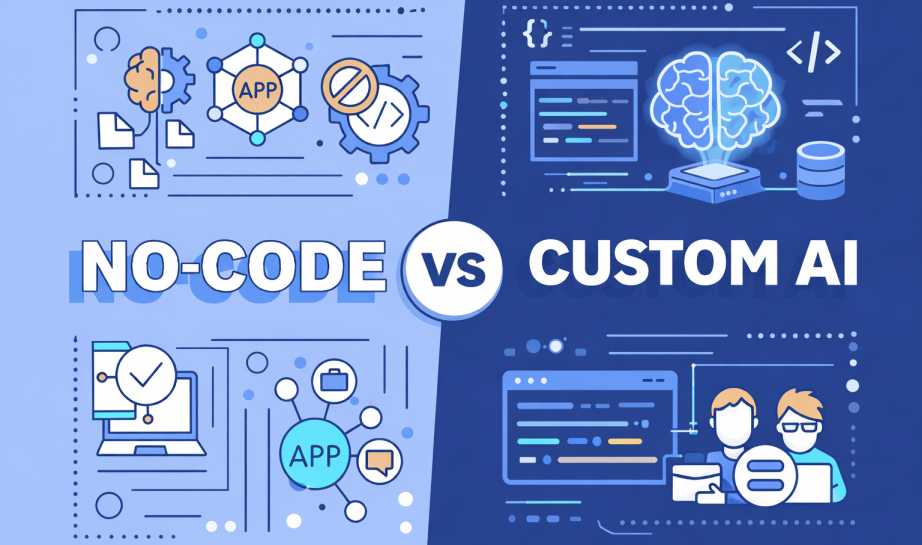
AI is now part of everyday business. Teams use it to automate tasks, extract insights from data, and speed up decision-making. Simple tools are built without code. Tailored systems are developed from scratch to match complex workflows.
Choosing between a no-code AI app and a custom AI app shapes how you build, grow, and scale. The right choice depends on your goals and how fast you need results.
1. Speed and Accessibility
No-code platforms deliver results fast. They rely on drag-and-drop logic and pre-built AI models. New apps go live within days. Even small teams without developers can build prototypes or automate simple workflows independently.
No-code AI app development platform like Bubble or Glide makes sense for quick experiments. It’s ideal for testing new ideas. You can create internal tools with minimal setup.
Still, simplicity has limits. As your product grows, visual builders often can’t handle complex data flows or large datasets. That’s when you shift to custom AI app development services.
A custom AI app development process takes more time but provides complete control over architecture, integrations, and model behavior. You build around your workflow instead of forcing your process into someone else’s template.
2. Flexibility and Integration
No-code apps use templates and fixed APIs. They’re fine for simple automation, reports, or task bots. However, they struggle once real-time analytics or large databases are introduced.
A custom AI app connects directly to your CRM, ERP, or proprietary data storage. Developers can train models on your data and design dashboards that mirror your workflow.
When a company runs several data systems, flexibility becomes critical. Ready-made tools rarely support unique data formats. Custom builds adapt from the start and grow with the business.
Here’s how the two compare across core parameters:
| Criteria | No-Code AI App | Custom AI App |
| Speed to launch | Days to weeks | Weeks to months |
| Initial cost | Low | Higher upfront |
| Scalability | Limited | Unlimited |
| Integration depth | Basic | Full system integration |
| Customization | Template-based | Tailored features |
| Data security | Shared hosting | Private and compliant |
| Long-term ROI | Moderate | High (strategic asset) |
3. Cost and Maintenance
No-code starts cheap but can become costly as you scale. Subscription fees grow with usage, and feature limitations often push teams to migrate later.
Custom apps demand more resources at launch, but costs flatten over time. You own the code, the logic, and the hosting. You’re not tied to vendor pricing or sudden platform changes.
An experienced partner offering AI app development services can design a modular architecture that is easy to maintain, scalable, and future-proof. That’s the key difference: investment versus dependency.
4. Performance and Control
For light workloads, no-code performs fine. For heavy data operations, it can slow down or fail under load.
Custom AI development delivers consistent speed and handles complex logic easily. You can integrate GPU acceleration, private cloud infrastructure, or custom ML models.
Security is another factor. No-code often means shared environments and limited transparency over how data is processed. Custom builds meet internal compliance requirements and provide full visibility.
5. When to Choose Each
Use a no-code AI app when:
- You need a quick MVP or demo.
- The project is internal and low-risk.
- You want to validate market interest fast.
Choose custom AI app development when:
- The AI feature is core to your product.
- You handle sensitive or regulated data.
- You expect high traffic or complex integrations.
- You need full control of model training and infrastructure.
Conclusion
Both approaches have their place. No-code gives you speed and experimentation. Custom AI delivers control and long-term scalability.
For startups, no-code is a shortcut to test ideas. For growing businesses, a custom AI app becomes a foundation for differentiation. If you plan to integrate AI into your operations over the coming years, invest once and own the system end-to-end.
Trending Now
Top Tech News Today, March 25, 2026