
Technology News Today – Your Daily Briefing on the AI, Big Tech, and Startup Shifts Reshaping Markets
It’s Tuesday, January 6, 2026, and here are the top tech stories making waves today — from AI and startups to regulation and Big Tech. AI infrastructure, autonomy, and platform power dominated the global tech conversation today.
Nvidia and AMD pushed deeper into the AI compute arms race as chipmakers and cloud providers repositioned for the next generation of data-center demand. Google expanded Gemini beyond the browser and into TVs and home devices, signaling that AI assistants are becoming ambient, always-on layers rather than standalone tools. At CES, Intel and device makers reinforced the bet that AI-enabled hardware could finally reignite the PC and consumer electronics upgrade cycle.
At the same time, autonomy and frontier tech edged closer to real-world deployment. Mercedes outlined plans to bring supervised automated driving to U.S. streets, while Lucid, Nuro, and Uber unveiled a production-ready robotaxi platform aimed at commercial scale. In space and sensing, startups raised fresh capital. They showcased new technologies designed to overcome long-standing limitations in perception and monitoring, underscoring investor appetite for hardware-heavy innovation with defensible data moats.
Meanwhile, the risks and realities of scale came into sharper focus. AI’s expanding role in healthcare has raised questions about safety and accountability; cybersecurity incidents have highlighted ongoing infrastructure vulnerabilities; and new controversies around consumer AI features have reignited debates over regulation and platform responsibility. With policymakers in Washington signaling a more assertive 2026 agenda, today’s stories collectively point to a tech landscape entering a more mature, more scrutinized, and more consequential phase.
Nvidia Tech Bets Bigger on Vera Rubin as the Next AI Compute Wave
Nvidia is leaning into its next architecture cycle, positioning Vera Rubin as the platform that follows Blackwell and sets the pace for the next phase of AI training and inference. The company’s pitch is not just faster GPUs, but a rack-scale stack that integrates CPU, GPU, interconnect, networking, and security features, enabling hyperscalers and “neoclouds” to deploy at speed without rebuilding their data center blueprints each generation.
The strategic subtext is clear: Nvidia wants to keep the industry on its cadence. As model sizes and “mixture of experts” training push infrastructure to its limits, Nvidia is selling an integrated compute unit, not a part number. That matters because the buying decision is increasingly made at the “cluster” level (capacity planning, power, networking, and utilization), not at the individual accelerator level.
Why It Matters: The AI arms race is shifting from chips to full-stack deployability, and Nvidia is trying to make Rubin the default foundation for the next buildout.
Source: The Verge.
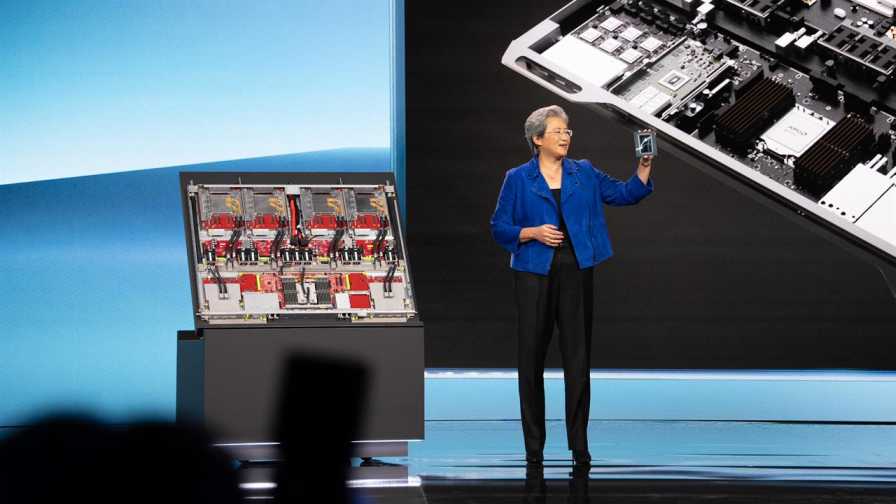
AI Chip Rivalry Heats Up as AMD Shows off New, Higher-Performing AI Chip at CES Event
AMD used the CES spotlight to sharpen its pitch to enterprises and cloud operators with new accelerator hardware aimed at training and inference workloads. The company is framing the fight as total cost and deployment flexibility versus Nvidia’s ecosystem dominance, while signaling it intends to be a first-choice option for buyers that want leverage in pricing and supply.
The stakes go beyond benchmark charts. Major buyers are now locking in multi-year capacity, creating an opening for alternatives that can ship at volume and integrate with existing software stacks. AMD’s progress matters to the broader AI market because competitive pressure is one of the few forces that can meaningfully influence accelerator pricing, availability, and the pace of innovation.
Why It Matters: If AMD can credibly expand supply and performance, it could loosen Nvidia’s grip and reshape AI infrastructure economics.
Source: Reuters.
Intel Launches Next-Gen PC Chip at CES in Las Vegas
Intel is positioning its latest Core Ultra chips as a cornerstone of the “AI PC” cycle, unveiling its next-generation PC chip at CES in Las Vegas. The launch emphasizes local AI performance and new platform features designed to bring workloads to the device. The company’s CES messaging is also a confidence play: it’s framing AI compute as a driver of consumer and enterprise refreshes, even as PC demand remains uneven and competition intensifies across x86 and Arm-based designs.
For the ecosystem, the near-term question is whether on-device AI becomes meaningfully useful beyond demos. The longer-term question is whether Intel can regain pricing power in PCs by bundling AI capabilities with platform-level advantages (security, manageability, and performance per watt). If the AI PC thesis holds, it will create downstream demand for locally running software, new developer tooling, and a reshaped Windows hardware roadmap.
Why It Matters: A real AI PC upgrade cycle would ripple through chips, Windows ecosystems, and consumer software economics.
Source: Bloomberg.
Robotaxi Tech Moves Closer to Launch as Lucid, Nuro, and Uber Unveil a Production-Ready Vehicle
Lucid, Nuro, and Uber showcased a production-ready robotaxi built on Lucid’s Gravity EV platform and powered by Nuro’s Level 4 autonomy stack, signaling a push toward commercial deployment this year. The partners highlighted real-world testing underway in the San Francisco Bay Area and a plan to scale manufacturing in Arizona, with Uber integrating the service into its marketplace rather than owning the autonomy stack outright.
This matters because the robotaxi race is now splitting into two camps: companies pursuing end-to-end autonomy and those pursuing win-win partnerships—vehicle OEM + autonomy provider + distribution platform. If this model works, it lowers the barrier to entry for additional fleets, accelerates city-by-city rollouts, and increases competitive pressure on incumbents. It also raises a key operational challenge: demonstrating safety and reliability at scale while maintaining utilization high enough to support unit economics.
Why It Matters: Partnerships could accelerate robotaxi rollouts and turn autonomy into a platform business rather than a single-company moonshot.
Source: Reuters.
Mercedes Tech Brings City-Street Automated Driving to the U.S., Taking Aim at Tesla
Mercedes-Benz says it will introduce MB.DRIVE ASSIST PRO in the U.S. later this year, enabling supervised automated driving on city streets—handling intersections, traffic lights, and route navigation under driver monitoring. The company is positioning it as a premium packaged system and pricing it as a multi-year option rather than a one-time feature unlock.
The significance is not that this is “self-driving,” but that major automakers are shipping increasingly capable systems while staying inside regulatory and safety constraints. That creates a competitive dynamic where perception, compute, and software validation become product differentiators, not just marketing. It also pressures regulators to clarify how these systems should be tested, labeled, and monitored as capabilities expand. And it pressures Tesla, whose approach relies heavily on iterative software updates and consumer usage at scale.
Why It Matters: The U.S. is entering an era in which “city autonomy” becomes a paid-feature battleground—and safety validation will decide the winners.
Source: Reuters
Google Tech Brings Gemini to the Living Room With AI Video, Photo Tools, and Voice-Controlled TV Settings
Google is expanding Gemini on Google TV with more visual responses and new creation tools, including support for AI-generated images and video, as well as tighter integration with a user’s Google Photos library to build stylized slideshows. It’s also adding practical voice controls that let users adjust picture and audio settings conversationally (“screen is too dim,” “can’t hear dialogue”), pushing Gemini from novelty to utility.
This matters because the TV is one of the few remaining mass-market interfaces where voice assistance can feel natural, hands-free, and persistent. If Gemini becomes a daily control layer, it would open a new distribution channel for Google’s AI products and raise the stakes for on-device and edge inference, privacy expectations, and content-discovery economics. It also forces competitors to decide whether the future “home assistant” lives in a speaker, a phone, a headset, or the biggest screen in the house.
Why It Matters: AI assistants are migrating to ambient devices, and TVs could become one of the next high-usage surfaces for AI.
Source: The Verge.
Google Tech Uses CES to Preview Gemini Features for TV and Home Devices
Google is using CES week to signal that Gemini is becoming a cross-device layer, not just a chatbot. The company’s TV push underscores a broader strategy: turn Gemini into the default interaction model for content discovery, device control, and personalization across the living room and smart home. That’s less about flashy demos and more about embedding AI into the places where people already spend time.
For the ecosystem, the key question is whether these assistants can deliver consistently helpful outputs without triggering privacy backlash. TVs and home devices are uniquely sensitive surfaces: they sit in private spaces, often shared by families, and can easily feel “too present.” If Google gets the UX and safeguards right, it can strengthen lock-in to Google services and create new ad and subscription opportunities. If it gets them wrong, it invites regulatory attention and pushes users toward more privacy-forward alternatives.
Why It Matters: The next AI platform war may be won through distribution on everyday devices, not just model performance.
Source: TechCrunch.
OpenAI shared data indicating that more than 40 million people globally use ChatGPT daily to seek health information, with a significant portion of activity focused on navigating symptoms, medical guidance, and health insurance complexity. The report highlights that patients increasingly treat AI as a front-line explainer—especially when care access is limited, or the billing system feels opaque.
This matters because healthcare is one of the highest-stakes consumer AI use cases, and it exposes the tension between accessibility and reliability. On one hand, AI can help users interpret confusing bills, challenge denials, and understand medical language. On the other hand, errors and overconfidence can cause harm, and the liability model remains unsettled. As usage scales, expect sharper scrutiny around safety guardrails, data handling, and disclosure, alongside pressure on insurers and providers to simplify what AI is currently being used to decode.
Why It Matters: AI is becoming a parallel front door to healthcare—and that will reshape regulation, liability, and patient expectations.
Source: Axios.
Grok’s “Bikini Edit” Feature Sparks Legal and Platform Safety Red Flags
A new controversy surrounding an AI chatbot is highlighting a persistent governance gap in generative AI. According to Axios, Elon Musk’s Grok has continued to generate image edits depicting real people in bikinis, prompting warnings from regulators and lawmakers in the U.S. and abroad about potential legal exposure.
Features that enable sexualized or altered imagery without consent often move faster than safety controls and enforcement frameworks can keep up. Even when presented as playful or experimental, such tools can quickly run afoul of privacy laws, platform rules, and the predictable risk of abuse once they scale.
For the broader ecosystem, incidents like this accelerate demands for clearer standards—what’s allowed, what requires friction or verification, and what should be blocked outright. They also amplify platform risk for companies building consumer-facing generative features: one viral misuse story can trigger regulatory scrutiny, app store issues, and advertiser backlash. Expect competitors to respond with stricter defaults, clearer user-facing disclosures, and more aggressive content controls to avoid becoming the following test case.
Why It Matters: Consumer AI features that touch images and identity are quickly becoming legal and reputational liabilities.
Source: Axios.
Washington’s 2026 Agenda Could Reshape AI, Platforms, and Competition
Semafor’s Washington outlook underscores how tech policy is becoming a central political and economic lever, not a niche beat. The issues on deck—from platform power to AI governance—are increasingly entangled with national security, trade, and domestic political pressure.
For tech companies and startups, the near-term impact is uncertainty: product roadmaps, M&A plans, and compliance costs all shift when enforcement posture changes. For founders, the most significant risk is building in regulated gray zones without a clear understanding of how rules may tighten. For Big Tech, the risk is structural remedies or new restrictions that change distribution and monetization. The larger point is that policy is no longer an external factor—it is becoming a competitive determinant, shaping who can ship what, where, and under what constraints.
Why It Matters: Regulatory direction in 2026 may decide which AI and platform strategies remain viable—and which become liabilities.
Source: Semafor.
CES 2026 Tech Roundup: AI Gadgets, New TVs, and the Push Toward “Everywhere Compute”
CES has shifted from “cool gadgets” to a showcase for where AI compute and interfaces are heading, spanning PCs, TVs, automotive tech, sensors, and smart home systems. Engadget’s CES coverage shows the pattern: more devices are shipping with local AI capability and new assistant-driven features, as companies try to make AI feel ambient rather than app-based.
Why it matters is not any single product, but what these launches reveal about the next distribution battle. AI companies want their assistants embedded into the devices people already use, while hardware firms want AI features that justify upgrade cycles. The result is a fragmentation risk: inconsistent experiences across brands, unclear privacy expectations, and a race to add “AI” labels even when usefulness is marginal. The winners will be the companies that pair on-device capability with real reliability and clear user value.
Why It Matters: CES is signaling that AI is becoming a default layer across consumer hardware—not a standalone category.
Source: Engadget
Brightspeed Investigates Hack Claim Involving Data From Over 1 Million Customers
U.S. broadband provider Brightspeed says it is investigating a claim of a cyberattack after a hacking group alleged it stole personal information belonging to more than one million customers. The report underscores a persistent risk pattern: telecom and infrastructure providers remain high-value targets because their customer data is monetizable and their service disruptions create leverage.
Beyond the immediate incident response, breaches like this become trust and compliance problems. Providers must balance technical remediation, regulatory disclosure requirements, and customer support at scale, often while attackers try to amplify pressure through leaks. For the broader tech ecosystem, it’s a reminder that security posture and incident preparedness are not optional overhead—they are operational fundamentals, especially for companies that sit close to critical communications infrastructure.
Why It Matters: Infrastructure breaches can quickly become national-scale trust events, not just corporate security incidents.
Source: SecurityWeek.
NordVPN Denies Breach After Hacker Leaks Alleged Internal Data
NordVPN says it did not suffer a breach after a threat actor leaked data allegedly taken from its systems, highlighting a modern reality for security brands: they are prime targets for credibility attacks, whether the incident is real, exaggerated, or a mix of old and new material. Even allegations can trigger reputational damage, customer churn, and heightened scrutiny.
Why it matters is the trust model. VPN services sell privacy and protection, so they operate under a higher standard of transparency and security expectations. When claims surface, the response must be fast, technically specific, and verifiable—vague denials tend to backfire. For consumers and enterprise buyers, the broader lesson is to evaluate providers not just on marketing, but on how they handle audits, disclosures, and incident response under pressure.
Why It Matters: Security vendors are judged as much by incident response credibility as by product claims.
Source: SecurityWeek.
Array Labs Raises $20M to Scale Space-Based Radar Manufacturing
Array Labs announced a $20 million Series A funding to scale manufacturing and prepare for launch, targeting a fast-emerging intersection of space, sensing, and data products. Space-based radar is attractive because it provides persistent monitoring capabilities that are difficult to replicate on the ground, with applications spanning defense, climate monitoring, infrastructure, and commercial analytics.
The significance for the startup ecosystem is twofold. First, it signals continued investor appetite for hardware-heavy frontier tech when the market believes the data layer can become defensible and recurring. Second, it highlights a broader trend: “space tech” is increasingly a downstream data business, not just a launch business. The challenge now shifts to execution—manufacturing yield, launch timelines, customer conversion, and the ability to turn raw sensing into products buyers will repeatedly pay for.
Why It Matters: Frontier sensing startups that can turn space infrastructure into recurring data products are again attracting serious capital.
Source: Tectonic Defense / SatelliteProMe
Wrap Up
Taken together, today’s stories point to a tech industry entering a more consequential phase of its evolution. AI is no longer confined to models and demos—it is reshaping chips, data centers, consumer devices, healthcare access, robotics, and transportation simultaneously. Nvidia, AMD, Intel, and Google are racing to define the next infrastructure and interface layers, while partnerships like Boston Dynamics and Google DeepMind signal that AI’s next frontier is physical, embodied, and operational.
At the same time, the expansion of AI and connected systems is amplifying risk. Cybersecurity incidents, platform safety controversies, and growing regulatory pressure underscore the cost of scale when technology outpaces governance. Autonomous driving, space-based sensing, and healthcare AI are advancing toward real-world deployment, but they now face higher expectations around trust, safety, and accountability.
The message from today’s global tech cycle is clear: the era of experimentation is giving way to execution. Winners will be defined not just by innovation but also by reliability, cost-effectiveness, and public trust. As 2026 approaches, the companies that succeed will be those that can scale responsibly—while navigating a landscape where technology, policy, and society are increasingly inseparable.
That’s your quick tech briefing for today. Follow us on X @TheTechStartups for more real-time updates.
Trending Now
Top Tech News Today, March 25, 2026