Silver’s price surge: Why AI’s next bottleneck isn’t chips, but power, metals, and infrastructure
 Daniel Levi
Posted On December 29, 2025
Daniel Levi
Posted On December 29, 2025
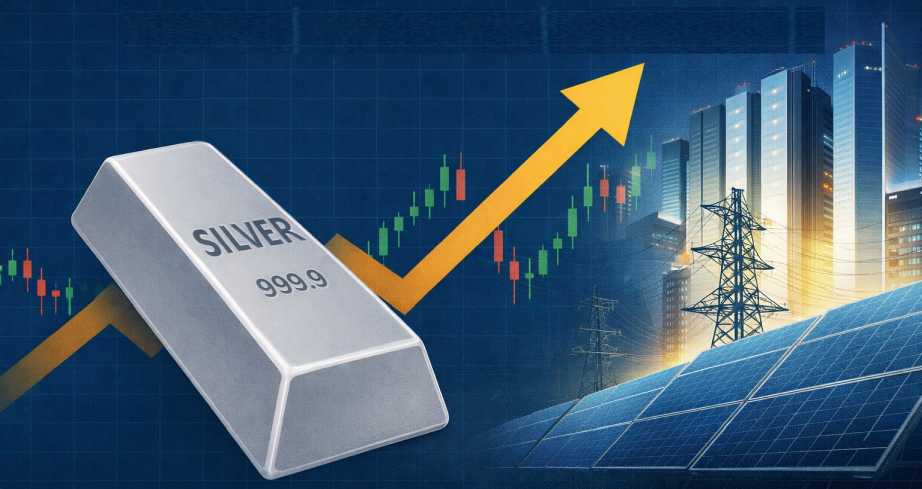
Silver has quietly done something unusual.
In recent weeks, prices have surged at a pace that’s difficult to ignore—not because silver suddenly became fashionable again, but because it sits at the crossroads of two forces reshaping the global economy: industrial electrification and AI-driven infrastructure buildout. While markets remain fixated on chips, GPUs, and model breakthroughs, a less visible constraint is tightening underneath the AI boom: the physical inputs required to power and scale it.
As Bloomberg recently reported:
“Gold staged a dramatic rally in 2025 as the US Trump administration’s unorthodox economic policies sent investors and central banks reaching for safe-haven assets. Right now, however, it’s silver that’s stealing the spotlight.
Surging investor demand collided with limited availability to catapult the price of silver above $80 a troy ounce at the end of December, almost triple its value a year earlier and enough to dwarf even gold’s meteoric rise of more than 70%.”
This is not a story about precious metals trading or investor speculation. Silver’s price move is better understood as a signal—one that highlights how the economics of AI are shifting from software and silicon into energy systems, manufacturing capacity, and real-world materials. As AI workloads scale, the limiting factor is increasingly not what models can do, but what infrastructure can support.
The AI race is no longer just about intelligence. It is becoming a competition for power, reliability, and access to finite industrial resources. Silver is one of the clearest indicators of that shift.
Why Silver’s Price Surge Matters More Than It Seems
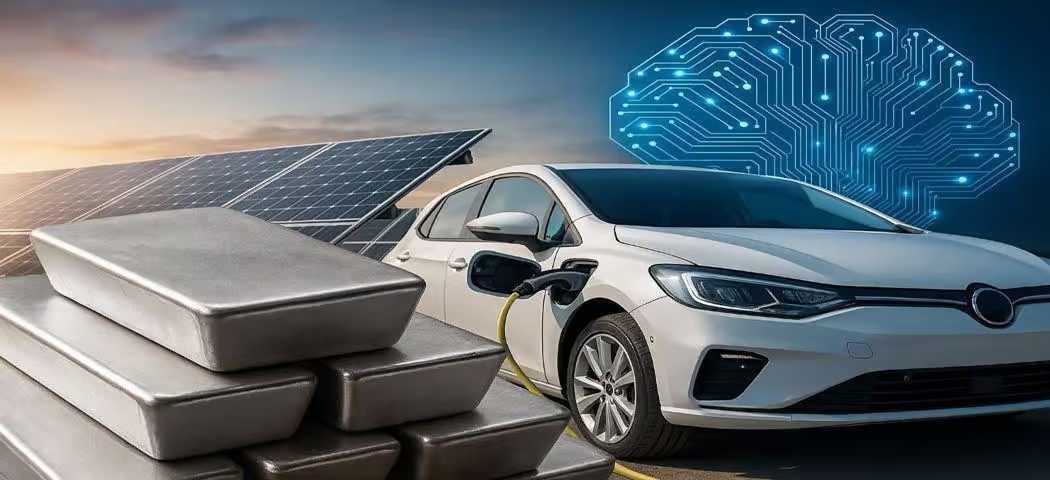
At first glance, silver doesn’t appear to be a critical AI material. It isn’t a chip, a battery, or a rare earth. Yet silver plays an outsized role in the systems on which AI depends—because it is the most electrically conductive metal on Earth and exceptionally reliable under heat and load.
Silver is embedded across:
- Power electronics and high-reliability connectors
- Data-center hardware and networking equipment
- Solar panels that feed energy-hungry AI facilities
- Industrial control systems that keep large compute clusters stable
Unlike software or even chips, silver has a constraint that markets often underestimate: it cannot simply be scaled on demand.
Silver is not produced the way iron or aluminum is. There are relatively few primary silver mines. Instead, the majority of global silver supply is recovered as a byproduct of mining other metals—most commonly copper, lead, and zinc. This means silver production is tied to the economics of entirely different industries. Even when silver prices rise sharply, output does not automatically follow.

That structural reality creates a lag that matters in an AI-driven economy. When demand increases—from solar installations, electrification, and data-center expansion—supply cannot respond quickly. New mines take years to develop, and byproduct recovery depends on the profitability of unrelated mining activities.
This is why silver behaves differently from many industrial commodities. It sits at an uncomfortable middle ground: essential to modern infrastructure but structurally difficult to scale. When prices move rapidly, they often reflect real physical tightness, not merely speculative excess.
For AI, that matters. Large-scale AI is no longer lightweight or abstract. It runs on power-dense data centers, energy-intensive hardware, and electrical systems that prioritize efficiency and reliability. Silver’s surge is not about one metal becoming expensive—it’s about the rising cost and complexity of building the physical backbone that AI increasingly demands.
How AI Quietly Became an Infrastructure-First Business
For most of the past decade, tech scaled cheaply.
Software shipped instantly. Cloud services abstract hardware. Marginal costs fell as usage rose. AI initially followed the same pattern. Models improved, APIs became easier, and intelligence felt almost weightless.
That phase is ending.
Modern AI systems don’t just live in code. They are located in buildings, draw power from the grid, generate heat that must be physically removed, and depend on hardware that must be manufactured, shipped, installed, and powered continuously. As models scale, so does everything underneath them.
This is the quiet shift happening now: AI growth is increasingly limited by physical reality.
Data centers are no longer simple warehouses for servers. They are energy-intensive industrial facilities. Training and running advanced models require continuous, stable power at levels comparable to those of small cities. Cooling systems have become as crucial as compute. Grid access, transformer availability, and power contracts are now strategic considerations rather than background details.
That’s where materials enter the picture.
Every step of this expansion depends on industrial inputs: copper for wiring, aluminum for structures, steel for buildings, and silver for electrical efficiency and reliability. When any one of those inputs tightens, costs ripple outward. When several things tighten at once, timelines slip, and assumptions break.
What makes this moment different is speed. AI infrastructure is being built faster than traditional industrial planning cycles were designed for. Utilities, grid operators, and manufacturers are playing catch-up. In that environment, price signals in metals like silver are not noise. They’re early warnings.
This doesn’t mean AI is stalling. It means the economics are changing. Scaling intelligence is no longer just about better algorithms or faster chips. It’s about whether the physical systems beneath them can keep up—and at what cost.
The AI race is still accelerating. But it’s no longer frictionless. And that friction is showing up first in places the tech industry hasn’t had to think much about before: power availability, materials supply, and infrastructure limits.
Silver Demand: Who Feels the Pressure First, and Who Is Built to Absorb It
Not all AI companies experience rising infrastructure costs in the same way. In fact, the pressure created by higher energy, material, and buildout costs is uneven by design.
The first to feel strain are not the household-name tech giants. It’s the companies sitting in the middle of the stack.
Smaller hardware manufacturers, component suppliers, and infrastructure-adjacent startups often operate with thin margins and limited pricing power. They purchase materials at spot prices, rely on shorter-term contracts, and have far less ability to absorb cost increases without passing them on. When silver, copper, or power prices increase, the effects are reflected quickly on balance sheets.
For AI startups building physical products—custom accelerators, edge devices, robotics, or energy-intensive systems—the math becomes unforgiving. A few percentage points of cost inflation can erase margins. Timelines stretch. Fundraising assumptions change. What once appeared manageable scale-ups to feel fragile.
By contrast, large, integrated players are better insulated.
Hyperscalers and major cloud providers enter into long-term power purchase agreements, hedge commodity prices, and negotiate supply contracts years in advance. They spread infrastructure costs across large revenue bases and can redesign systems for efficiency as constraints tighten. For them, rising costs are inconvenient, not existential.
This gap creates a subtle but essential dynamic in the AI market.
As infrastructure becomes more expensive and complex, scale itself turns into a competitive advantage. Companies that can finance power, secure materials, and build reliably at scale pull further ahead. Those who can’t are forced to slow down, partner up, or exit entirely.
There’s also a second-order effect investors are starting to notice. AI businesses that once resembled software plays are being repriced as infrastructure-intensive operations. Capital efficiency matters again. Cash burn tied to physical buildouts is viewed differently than spending on code or talent.
The result is a quiet sorting process.
AI isn’t becoming less powerful. But the path to scale is narrowing. Success increasingly depends not just on innovation, but on access to power, materials, and the ability to operate in a world where physical constraints matter.
In that environment, silver’s surge is less a shock than a signal. It highlights which companies are built for the next phase of AI—and which ones were designed for a world where infrastructure stayed cheap and invisible.
Silver Price and Bigger Takeaway — AI Is Now an Infrastructure Race
Silver’s recent surge isn’t a warning about one metal. It’s a reminder about the phase AI has entered.
For years, the tech industry benefited from an unusual dynamic: intelligence could scale faster than the physical world on which it depended. Software moved at internet speed. Compute abstracted hardware. Costs fell even as ambition grew. That made it easy to believe AI progress would remain mostly digital.
That assumption no longer holds.
Today’s AI systems are anchored to reality in ways that can’t be optimized away. They need electricity in vast, uninterrupted quantities. They require cooling systems that comply with physics, not code. They require materials from mines, factories, and global supply chains that move far more slowly than software releases.
This is where silver fits into the story. Its price didn’t rise because AI suddenly discovered it. It has risen because the world is demanding more of the same infrastructure simultaneously—AI, electrification, clean energy, and industrial automation are all competing for the same finite inputs. When that happens, friction shows up first in materials.
The implication for AI is not collapse, but constraint.
Growth will continue, but it will favor companies that can plan, finance, and execute at the infrastructure level. Access to power, grid connections, long-term supply agreements, and capital discipline will matter as much as model performance. Efficiency will become a moat again. The scale will more sharply separate leaders from followers than before.
For founders, this changes how AI businesses should be built. For investors, it changes how they should be valued. And for the industry as a whole, it marks a shift that’s easy to miss if the focus stays only on chips and benchmarks.
The next chapter of AI won’t be decided solely by more innovative models. It will be decided by who can operate reliably in a world where power, materials, and infrastructure are no longer cheap, invisible, or guaranteed.
Silver didn’t create that reality. It simply made it harder to ignore.
The video below explores the recent surge in silver prices and argues that rising material and energy constraints could pressure tech stocks and government capacity. While the framing is more forceful than this analysis, it reflects a growing concern about the physical limits underlying the expansion of today’s AI and technology.
Trending Now
Top Tech News Today, March 23, 2026