The Vibe Coding Delusion: Why Thousands of Startups Are Now Paying the Price for AI-Generated Technical Debt
 Daniel Levi
Posted On December 11, 2025
Daniel Levi
Posted On December 11, 2025

Vibe coding was supposed to change everything. Instead, it exposed how little we understand about building software in the age of AI.
Back in March 2025, TechStartups published “When Vibe Coding Goes Wrong,” one of the first warnings that something wasn’t adding up. Founders were shipping “apps” overnight. Developers were posting viral clips of AI writing features from a single prompt. Tools like Cursor, Replit Agent, and Lovable were seeing explosive growth in usage. It felt like the rules of software were being rewritten.
But behind the excitement was a quieter truth: hallucinated code, broken integrations, brittle architectures, and demos that fell apart the moment real users touched them.
A few months later, we followed with “Are We Really Ready for Vibe Coding?” — a second look at whether the industry was building faster than it could understand. That piece marked the moment hype hit its ceiling: the tools were improving, but the cracks were widening.
Nine months after our first article, the movement now sits at a clear crossroads. AI can generate software faster than ever, but the cost of skipping real engineering has become impossible to ignore.
This third installment in our series looks beyond the hype and into the trenches, examining the wins, the failures, and the uncomfortable truths emerging as vibe coding moves from early euphoria to hard reality.
For most of 2025, “vibe coding” dominated feeds on X and LinkedIn. The idea was irresistible: describe a product to an AI model, let it generate the code, skip the engineers, and ship something that looks real in days. Screenshots spread faster than nuance, and founders convinced themselves that complex systems could be built with one developer and an LLM.
But behind the viral demos lies a very different story—one that rarely gets shared because it doesn’t drive engagement. According to Groove founder Alex Turnbull, who spent the past year building two full-scale AI CX platforms, the promise of vibe coding fell short. It set thousands of startups on a collision course with failure they never saw coming.
And now the bill is coming due.
The Hype Was Easy. The Cleanup Isn’t.
Alex Turnbull, founder of Groove, has spent the past year building two full-scale AI CX products: Helply and InstantDocs. He is one of the first founders willing to say out loud what others whisper privately: the promise of vibe coding didn’t just fall short; it created a silent crisis.
“The promise sounds incredible: build a help desk, an AI CX agent, a knowledge base product, etc. Ship it fast and let the model handle the hard parts. Total bullshit. Today, I’m sharing the truth from someone who actually spent 12 months building two world-class AI CX products from scratch, and why the Vibe Coding is setting founders up for catastrophic failure,” Turnbull said in a post on LinkedIn.
The hype drove unprecedented adoption of AI coding tools. Then came the collapse:
-
AI coding usage fell 76% in 12 weeks
-
Base44 surged 950%, then dropped 95%
-
Lovable swung from +207% growth to –37%
-
Cursor fell from +62% to –19%
On the surface, these numbers appear to be another red-hot category cooling off. But the deeper signal is more concerning: founders walked straight into the complexity wall—the moment when the demo ends, and real engineering begins.
It wasn’t just hobby projects. Roughly 10,000 startups tried to build production apps with AI assistants. More than 8,000 now need rebuilds or rescue engineering, with budgets ranging from $50K to $500K each.
The $4B Vibe Coding Problem You Don’t Hear People Bragging About
Based on estimates, the total cost of the vibe coding cleanup ranges from $400 to $4B. This is the first AI-generated technical debt crisis.
“Vibe Coding isn’t just bullshit. It’s expensive bullshit that is actively a disaster for thousands of startups. AI coding traffic collapsed 76% globally in 12 weeks. Base44 spiked 950% in May, crashed 95% by October. Lovable went from +207% growth to -37%. Cursor dropped from +62% to -19%. Yes, Claude Code also spiked to 1M users in weeks. Yes, this could also be a high velocity, red ocean like we’ve never seen,” Turbull shared in a LinkedIn post.
The latest report from SimilarWeb also supports Turnbull’s post. According to the report, popular AI-vibe coding tools have seen a sharp decline in traffic since their peak early this year. Below is a table of changes in popular code completion & DevOps tools from February through July.
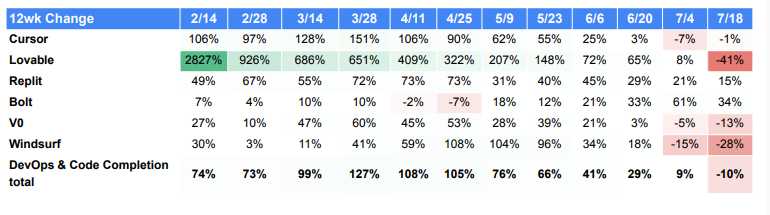
Changes in code completion & DevOps tools from February through July
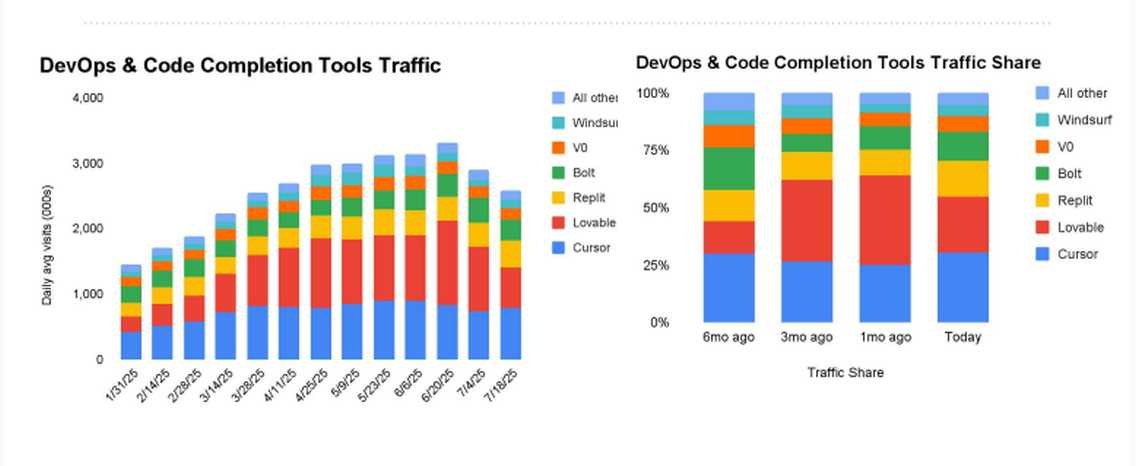
The Data Behind the Breakdown
The collapse in AI coding usage lines up with broader research showing how difficult it is to turn AI prototypes into real systems:
-
95% of generative AI pilots fail to produce measurable revenue or cost savings (MIT, 2025).
-
42% of companies abandoned most of their AI initiatives in 2025 — more than double the rate in 2024.
-
80% of AI projects never reach their intended outcomes (RAND).
-
70–90% of AI projects never scale beyond the pilot phase.
-
Only 5% of organizations saw rapid revenue growth from AI investments.
The pattern is consistent across organizations: early enthusiasm, rapid prototyping, then a steep drop-off once teams face integration, security, scale, and governance requirements.
The part social media never shows: the cost of finishing what AI started.
Inside the Reality: What Building a Real AI CX Platform Takes
Turnbull’s team spent 12 months building two enterprise-grade products — Helply and InstantDocs.
He makes one point very clear:
“VibeCoding didn’t get us there. Only real engineering could.”
Their stack demanded:
-
Import pipelines for tens of thousands of knowledge articles
-
Real-time sync with major platforms like Zendesk, Intercom, and Groove
-
Auditing systems that make AI outputs accountable
-
Secure execution layers for AI actions touching sensitive customer data
-
Guardrails that prevent hallucinations from corrupting workflows
-
Multi-tenant architecture that scales without breaking
-
UX decisions, data modeling, infrastructure design, and reliability engineering
No AI assistant can foresee or handle these interconnected layers.
A human senior engineer can — because they’ve seen what breaks.
Turnbull gives one example: the Knowledge Gap accuracy engine.
From the outside, it looked simple.
It took a senior engineer three months to build it correctly.
This is the gap between “the AI coded something that runs” and “a business can trust this with customers.”
Why Founders Fell for It
Because the demo looks real.
A prototype generated by an LLM can feel like a product — interactive, clickable, functional. But beneath the surface, it lacks:
-
error handling
-
stable data models
-
scaling logic
-
integration reliability
-
security layers
-
governance
-
observability
-
resilience under load
It’s an advanced Figma file wearing a software costume.
Founders saw the illusion, not the infrastructure.
Even Turnbull admits he underestimated the depth of the engineering required. Each new layer revealed ten more underneath, and every one mattered.
The Hidden Cost of Believing You Don’t Need Senior Engineers
The marketing implied you could replace senior engineers with AI. But in practice, senior engineers are precisely who you need the moment your product touches:
-
enterprise data
-
user accounts
-
compliance requirements
-
scale
-
reliability
-
integrations
-
AI actions that can break real systems
Turnbull’s point is blunt:
“The myth that one junior dev plus AI can build enterprise software is one of the biggest lies being spread right now.”
LLMs are powerful — but they do not understand responsibility, reliability, or long-term consequences.
Real products demand judgment.
The Vibe Coding Tax Arrives
Startups that shipped prototypes as products are now paying for it.
Rebuild costs look like this:
-
$200K–$300K in senior engineering
-
4–8 months of re-architecture
-
$30K–$150K monthly burn while the team rebuilds the foundation
-
Migration issues
-
Lost users
-
Damaged trust
And the harshest truth:
Your product might secretly be a demo.
Customers will find out.
And they won’t be gentle.
Turnbull predicts that in 2026, rescue engineering will be the hottest discipline in tech — because thousands of products built via vibe coding can’t support real usage.
So, What Can You Use Vibe Coding For?
Safe uses
-
Prototypes
-
Demos
-
Pitch Concepts
-
Interactive mockups
Not safe
-
Anything touching customer data
-
AI CX platforms
-
Production apps
-
Workflows requiring reliability or scale
AI is phenomenal at producing something that looks finished. It is poor at making a finished product.
AI accelerates sound engineers. It does not replace them.
The New Reality for Founders
Vibe coding isn’t going away. It will shape the next generation of software development. But the real test now is whether founders can separate speed from illusion.
AI will continue to expand what small teams can accomplish — that is undeniable. What’s dangerous is the belief that speed replaces engineering. That belief is what buries startups.
The takeaway from Helply and InstantDocs is clear:
AI accelerates good engineers. It does not replace them.
The founders who thrive in 2026 won’t be the ones chasing shortcuts. They’ll be the ones who treat AI-assisted development with the same seriousness they treat their customers’ trust.
A demo may get attention and win likes. But ultimately, it’s the product that drives adoption and wins customers. And customers can tell the difference.
Trending Now
Top Tech News Today, March 23, 2026