Harness raises $200M in funding led by Goldman Sachs, pushing the AI startup to a $5.5B valuation
 Nickie Louise
Posted On December 11, 2025
Nickie Louise
Posted On December 11, 2025

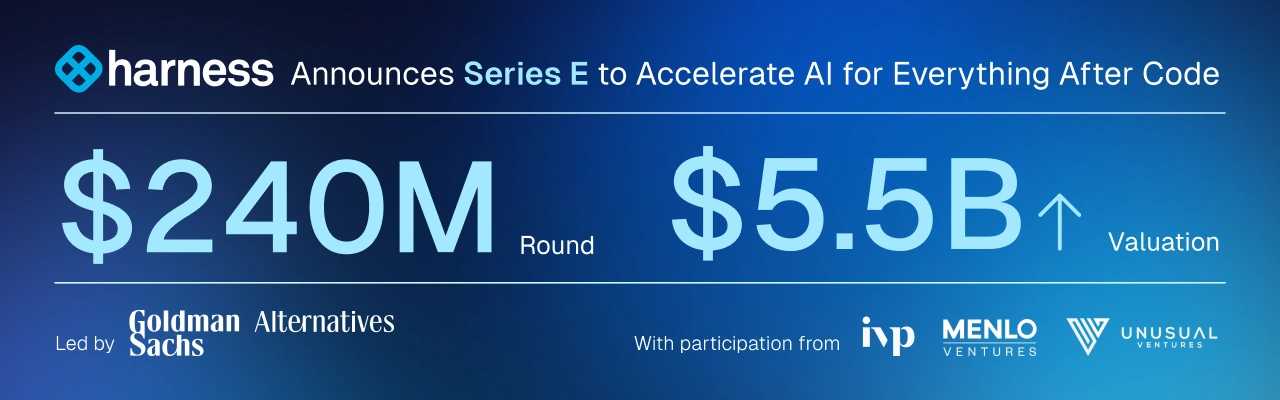
Harness has secured $200 million in new funding led by Goldman Sachs, pushing the AI software development startup to a $5.5 billion valuation. The raise is part of a larger $240 million Series E package that includes a planned $40 million tender offer involving IVP, Menlo Ventures, and Unusual Ventures.
“We’re announcing a $240 million Series E financing round, comprised of a $200 million investment led by Goldman Sachs and a planned $40 million tender offer with participation from IVP, Menlo Ventures, and Unusual Ventures. This investment values Harness at $5.5 billion,” co-founder and CEO Jyoti Bansal wrote in a blog post on Thursday.
The AI startup‘s valuation jump marks a 49% increase since its last round nearly four years ago, a period during which AI has shifted from a promising idea to a tool that boardrooms now see as a core part of software development. Investors have been racing into the sector as organizations across industries seek to automate structured work and accelerate their engineering output.
Bansal launched Harness in 2017 to simplify software delivery for enterprises. A year later, he co-founded Traceable, an API security company, and Unusual Ventures. That network of companies and relationships has given him a front-row view into how quickly AI-driven development has been adopted across large organizations.
Goldman Sachs leads $200M Series E as AI startup Harness climbs to a $5.5B valuation
Speaking with Reuters, Bansal said the company wasn’t actively raising. “We were not looking to actively raise capital right now,” he said. “But we had a lot of investor interest. So a lot of people were coming and reaching out to us, and that’s what kind of created this financing.”
The renewed investor appetite reflects a broader shift in how companies produce software. As executives seek ways to move faster without expanding engineering headcount, the volume of code written has surged. Harness has found itself well-positioned for this shift, offering workflow AI tools that convert written instructions into working software and automate long-standing bottlenecks in the delivery process.
The company says major enterprises, including National Australia Bank, Morningstar, and United Airlines, have adopted its tools. United’s deployment times increased by 75% after adopting the platform, according to Harness. Large U.S. banks such as JPMorgan Chase and Citigroup, which have publicly expressed interest in AI-driven productivity gains, are both customers and investors.
This blending of clients and investors has drawn comparisons to the dot-com era, where companies often held both strategic and financial stakes in the startups they used. Bansal described the relationships as collaborative, adding that Harness works closely with Anthropic, OpenAI, Google Gemini, and AWS.
As AI development tools continue to spread across enterprises, the company is positioning itself as a central player in how software is built and shipped. The new funding provides Bansal with fresh capital—and fresh expectations—at a time when demand for AI-driven development tools shows no signs of slowing.